Ada Guide: ADA Compliance for Small Business and Web Accessibility

Sidharth Nayyar
TLDR:
ADA compliance for your small business website means making it usable for people with disabilities. Your site is legally considered a "place of public accommodation," just like a physical store, making accessibility a legal requirement. The key is to follow the Web Content Accessibility Guidelines (WCAG) by fixing common issues like missing image descriptions (alt text), poor color contrast, and ensuring your site works with a keyboard. Taking proactive steps not only protects you from expensive lawsuits but also expands your customer base and improves SEO.
For small business owners, the term ADA compliance can sound intimidating, but the concept is simple: making sure your entire business is open and accessible to people with disabilities. This applies to everything from the front door of your shop to the homepage of your website. It’s not just about doing the right thing; it’s a legal requirement, and over the past few years, we've seen a huge spike in lawsuits aimed squarely at small companies.
A Quick Guide to ADA Compliance for Small Businesses
Getting a handle on the Americans with Disabilities Act (ADA) doesn't have to be overwhelming. At its heart, compliance is about one thing: removing barriers. It’s about ensuring that someone with a disability can access the same products, services, and opportunities as anyone else.
Think of it this way: you wouldn't lock your front door to a paying customer, right? An inaccessible website does exactly that. Your website is your digital storefront, and if people with vision, hearing, or motor impairments can't use it, you're effectively turning away a huge segment of the population.
To help you get started, this table breaks down the core areas of focus.
Core Components of Small Business ADA Compliance
| Compliance Area | Primary Goal | Key Actions |
|---|---|---|
| Physical Location | Ensure all customers can enter and navigate your space safely. | Install ramps, widen doorways, create accessible restrooms, and ensure clear pathways. |
| Website & Digital | Make sure your website is usable for people with disabilities. | Follow WCAG standards, provide alt text for images, and ensure keyboard navigability. |
| Policies & Training | Create an inclusive environment for both customers and employees. | Develop accessibility policies, train staff on best practices, and offer accommodations. |
| Communication | Offer multiple ways for people to communicate with your business. | Provide text-based options like email/chat, offer captioning for videos, and be ready to assist. |
Each of these areas is a piece of the puzzle. Addressing them methodically is the key to building a truly accessible business.
The Growing Legal Risk for Small Enterprises
The legal ground has shifted, and small businesses are finding themselves in the spotlight for compliance issues. The numbers are pretty telling: around 77% of ADA lawsuits target companies earning less than $25 million a year. This isn't just a coincidence; it shows that smaller companies are seen as easier targets for legal action, whether for a physical barrier or a website flaw. You can dig into more data on website accessibility trends to see the full scope of the issue.
This surge in lawsuits is happening because so much of life and commerce now takes place online. That makes website accessibility a major part of modern risk management for any business owner.
For a small business, being proactive about accessibility is not just about avoiding a lawsuit. It's about building a stronger, more inclusive brand that connects with the widest possible audience.
An Actionable Framework for Compliance
The good news is that you don't need a team of lawyers to get started. Your path to ADA compliance for small business can begin with a few practical steps. Focusing on a clear plan will help you make real progress without getting bogged down.
Here’s a simple framework to get you on the right track:
Learn the Rules: Start by getting familiar with the Web Content Accessibility Guidelines (WCAG). These are the global standards for web accessibility and what courts often refer to.
Audit Your Website: Do a thorough check of your site to find common roadblocks. Are your images missing descriptions? Is the text hard to read because of poor color contrast? Can you navigate the site using only your keyboard?
Make Practical Fixes: Start tackling the issues you found. Many common problems, like adding alt text or fixing links, are surprisingly straightforward to resolve.
Think Long-Term: Accessibility isn't a "one-and-done" task. It’s an ongoing commitment. Make it a habit to regularly check your site and train your team on best practices as you add new content or features.
Why Your Website Falls Under the ADA
It’s easy to think of the Americans with Disabilities Act as something for brick-and-mortar businesses—ramps, accessible restrooms, and so on. But that view is dangerously outdated. Your website is your digital front door, and it needs to be open to everyone.
Over the years, the Department of Justice (DOJ) and numerous court rulings have made it crystal clear: websites are considered “places of public accommodation.” This isn't some legal gray area anymore. That one phrase means all the ADA's rules about providing equal access apply directly to your online presence. An inaccessible website isn't just a technical glitch; it's a legal barrier that effectively tells millions of people their business isn't welcome.
The Digital Storefront Analogy
Picture this: a potential customer is standing outside your shop, wallet in hand, ready to buy. But they can't get in because there’s a massive step at the entrance and no ramp. They can see what you’re selling, but they can’t reach it. So, they walk away and spend their money at your competitor's place down the street, which has an accessible entrance.
That’s exactly what’s happening every day on inaccessible websites.
Someone with low vision tries to read your product descriptions, but the text is too small or the color contrast makes it impossible to see. They leave.
A blind user navigates with a screen reader, but your images have no descriptive text, so your products are just a mystery. They leave.
A person with a motor disability can't use a mouse, but your "Buy Now" button isn't reachable with a keyboard. They can’t complete the purchase, so they leave.
In every case, a simple, fixable barrier cost you a sale. Under the ADA, it's also considered discrimination.
It's Not Just About Lawsuits—It's Smart Business
Let's be honest, the threat of a lawsuit is a pretty big motivator for getting compliant. But focusing only on the risk means you're missing the bigger picture. Making your website accessible is one of the smartest business moves you can make.
For starters, you instantly expand your potential customer base. Roughly one in four adults in the U.S. has a disability, and they have significant spending power. By making your site usable for them, you’re tapping into a massive, loyal market that your competitors are probably ignoring.
Then there's the SEO boost. It turns out that Google loves accessible websites. Why? Because many of the things you do for accessibility—like adding descriptive alt text to images, organizing content with clear headings, and providing transcripts for videos—are the exact same signals search engines use to understand and rank your site. Good accessibility practices often translate directly into better search rankings.
Finally, think about your brand. An accessible website shows you care about being inclusive. It tells the world that you value every single customer, and in today's market, that kind of reputation is priceless. It builds trust and sets you apart from the crowd.
Understanding WCAG: The Rulebook for Your Website
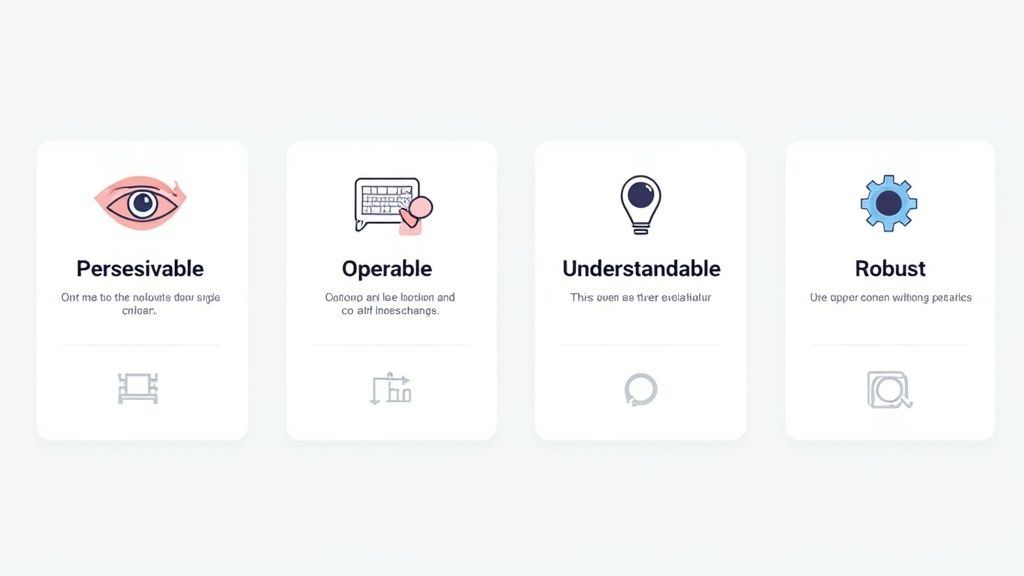
While the ADA sets the legal requirement for accessibility, it doesn't give you a technical blueprint for your website. That’s where the Web Content Accessibility Guidelines (WCAG) come into play. Think of WCAG as the detailed building code for your digital property. It provides the clear, internationally recognized standards you need to follow.
Developed by the World Wide Web Consortium (W3C), WCAG is the gold standard for web accessibility. When legal challenges arise, courts consistently look to WCAG to determine if a website is truly accessible and compliant with the ADA.
The good news is that WCAG is built on four core principles. Every rule and guideline fits neatly under one of these pillars, which makes it much easier to grasp the "why" behind each technical requirement.
Perceivable: Making Sure Information Can Be Sensed
First up is Perceivable. The idea is simple: users must be able to perceive the information you're presenting. It can’t be invisible to all their senses. This often means providing alternatives for content that some people might not be able to see or hear.
A classic example is alternative text (alt text) for images. A person who is blind often uses a screen reader to browse the internet, but that software can't "see" a photo. By adding a descriptive alt text tag—like "a golden retriever catching a red frisbee in a park"—you give the screen reader a clear description to announce, making the image's purpose known.
Other key examples include:
Video Captions: For users who are deaf or hard of hearing, captions are essential to making audio content perceivable.
Good Color Contrast: Text needs to stand out from its background so people with low vision or color blindness can read it without strain.
Operable: Making Sure Everyone Can Navigate and Interact
The Operable principle is all about functionality. Can visitors actually use your website and get around easily? This is especially important for people with motor disabilities who might not be able to use a traditional mouse.
Imagine trying to submit an online form but finding it impossible to move from one field to the next using only your keyboard. An operable website ensures every link, button, and form field can be accessed and used with keyboard commands alone, without ever needing to point and click.
By focusing on operability, you ensure that your site's functions aren't dependent on a single method of interaction. This creates a more flexible and resilient user experience for everyone, not just those with disabilities.
Understandable: Keeping Things Clear and Predictable
Next, the Understandable principle demands that both your content and your site's operation are easy to comprehend. This is about more than just using plain language; it’s about creating a predictable, logical experience.
For example, your navigation menu should be consistent. If the "Contact Us" link is in the top-right corner of your homepage, it should be in that same spot on every other page. This kind of predictability helps all users, but it's a lifeline for those with cognitive disabilities who can get easily disoriented by confusing layouts. Clear instructions and helpful error messages are also a big part of making a site understandable.
Robust: Ensuring Your Site Works With Different Technologies
Finally, the Robust principle is all about compatibility. Your website needs to be built with clean, standard code so it can be reliably interpreted by all sorts of browsers, devices, and assistive technologies like screen readers.
This is the most technical of the four principles, but the concept is straightforward: follow the rules. When you use standard HTML and CSS, you ensure that as technology evolves, your site will continue to function correctly with whatever new tools or devices your users might have.
These four principles create a solid framework for ada compliance for small business. To get a better handle on the specific technical requirements, you can explore these essential guidelines for website accessibility. And to truly get into the nitty-gritty, you can dive deeper into the specific checks by learning about the WCAG success criteria that define these standards.
Common Website Barriers and How to Fix Them
Let's be honest: most small business websites have a few accessibility skeletons in their closet. The good news is that the most common problems—the ones that create real legal risk—are often the easiest to fix. We're talking about missing image descriptions, text that's hard to read against its background, videos without captions, and forms that are impossible to use without a mouse.
Tackling these issues isn't just about checking a box for ADA compliance. It's about making your site genuinely better for everyone.
Now that we’ve covered the "why" behind the WCAG principles, it’s time to get our hands dirty. Identifying and knocking out these common accessibility hurdles is your first, most critical step. Think of it as clearing out the low-hanging fruit—making a massive difference for users with disabilities while seriously dialing down your legal exposure.
These aren't just theoretical problems; they're the exact issues that show up again and again in legal complaints. In just one year, over 2,019 ADA website accessibility lawsuits were filed in the US. And here’s the kicker: a staggering 70% of them targeted eCommerce businesses making less than $25 million a year. The complaints almost always circle back to the basics: missing alt text, poor color contrast, and checkout processes that lock people out. All totally fixable.
Missing Image Descriptions (Alt Text)
One of the most frequent yet simplest barriers to fix is missing alternative text, or "alt text," for images. Alt text is a short, descriptive sentence tucked into your website's code that tells someone what an image is about. It's invisible to most visitors, but for someone who is blind and uses a screen reader, it's absolutely essential.
Without it, their screen reader might just announce "image" or read out a cryptic file name like "IMG_5892.jpg." That leaves a gaping hole in their experience. A good description bridges that gap, turning a picture into useful information.
- The Fix: Go through your site's images and add simple, descriptive alt text. If it’s a product photo, describe it: "Men's blue waterproof hiking boot." If it's just a decorative swoosh that adds no real meaning, you can leave the alt text blank (alt="") so screen readers know they can skip right over it.
Insufficient Color Contrast
This one is huge. Low contrast between your text and its background—think light gray text on a white background—can make your content impossible to read for people with low vision or certain types of color blindness.
This isn't just a matter of taste; it's a functional requirement for a usable website. The WCAG guidelines give us specific minimum contrast ratios to ensure text is legible for as many people as possible.
Good color contrast is a cornerstone of accessible design. It doesn't just help users with visual impairments; it makes your content more legible for everyone, including those browsing on a phone in bright sunlight.
- The Fix: Grab a free online color contrast checker and test your brand's color combinations. The tool will tell you if you meet the WCAG AA standard. If your colors don't pass, it's time for a slight adjustment. Darken the text or lighten the background to hit that sweet spot of a 4.5:1 ratio for normal-sized text.
Inaccessible Online Forms
For many small businesses, online forms are everything. They're how people contact you, sign up for your newsletter, or buy your products. But too often, they're a dead end for users with disabilities. A form might be missing clear labels or be completely unnavigable if you can't use a mouse.
Imagine trying to check out but being unable to tab from one field to the next or select a shipping option. That’s the reality for someone relying on a keyboard, and it means a lost customer for you.
- The Fix: First, make sure every single form field has a properly coded label that screen readers can identify. Then, test it yourself. Can you fill out and submit the entire form using only your Tab, Enter, and arrow keys? If you get stuck, a developer needs to fix that navigation flow. For a deeper dive, check out our guide on how to https://www.webability.io/blog/design-accessible-web-sites.
Lack of Video Captions and Transcripts
If you use video to market your business or explain your services, you have to provide an alternative for visitors who are deaf or hard of hearing. Without captions, they're missing out on everything you're saying.
But here’s a secret: captions and transcripts benefit everyone. Plenty of people watch videos with the sound off (think open-plan offices or late-night scrolling). Plus, search engines can crawl the text in a transcript, giving your SEO a nice little boost.
- The Fix: Add accurate, synchronized captions to every video. YouTube's auto-captioning is a good start, but always, always go back and edit it for accuracy—AI makes some weird mistakes. It’s also a best practice to provide a full text transcript on the same page. Speaking of usability for everyone, ensuring your website works well on a phone is just as fundamental. Learning how to make your website mobile-friendly is a parallel step that helps eliminate barriers for all users.
A Step-By-Step Plan for ADA Compliance
Let’s be honest: the idea of making your entire website ADA compliant can feel pretty daunting. But you don't have to boil the ocean. It's not some impossible mountain to climb; it’s a journey you can take one step at a time. This roadmap breaks the whole process down into five manageable stages, turning a big challenge into a clear, achievable project.
Step 1: Conduct a Thorough Accessibility Audit
First things first, you need to know where you stand. Think of an accessibility audit as a health check-up for your website. It's designed to find any barriers that might be blocking users with disabilities from fully engaging with your content. A truly comprehensive audit isn't just about running a quick scan—it requires a mix of automated tools and real human insight.
Automated Scanning: Start with an accessibility scanning tool. These can quickly crawl your site and flag common, low-hanging fruit like missing alt text on images, poor color contrast, or unlabeled form fields. Plenty of free tools can give you a solid high-level overview in just a few minutes.
Manual Testing: Technology can't catch everything. This is where manual testing becomes so important for understanding the actual user experience. For instance, try this: unplug your mouse and navigate your entire site using only the Tab key. Can you get to every link, button, and form field in a logical order? This simple test often reveals major roadblocks that automated tools miss.
This two-pronged approach gives you the full picture. The automated scan delivers the raw data, while the manual check provides that critical human context.
This diagram shows some of the most common web barriers your audit will likely uncover and what it takes to fix them.
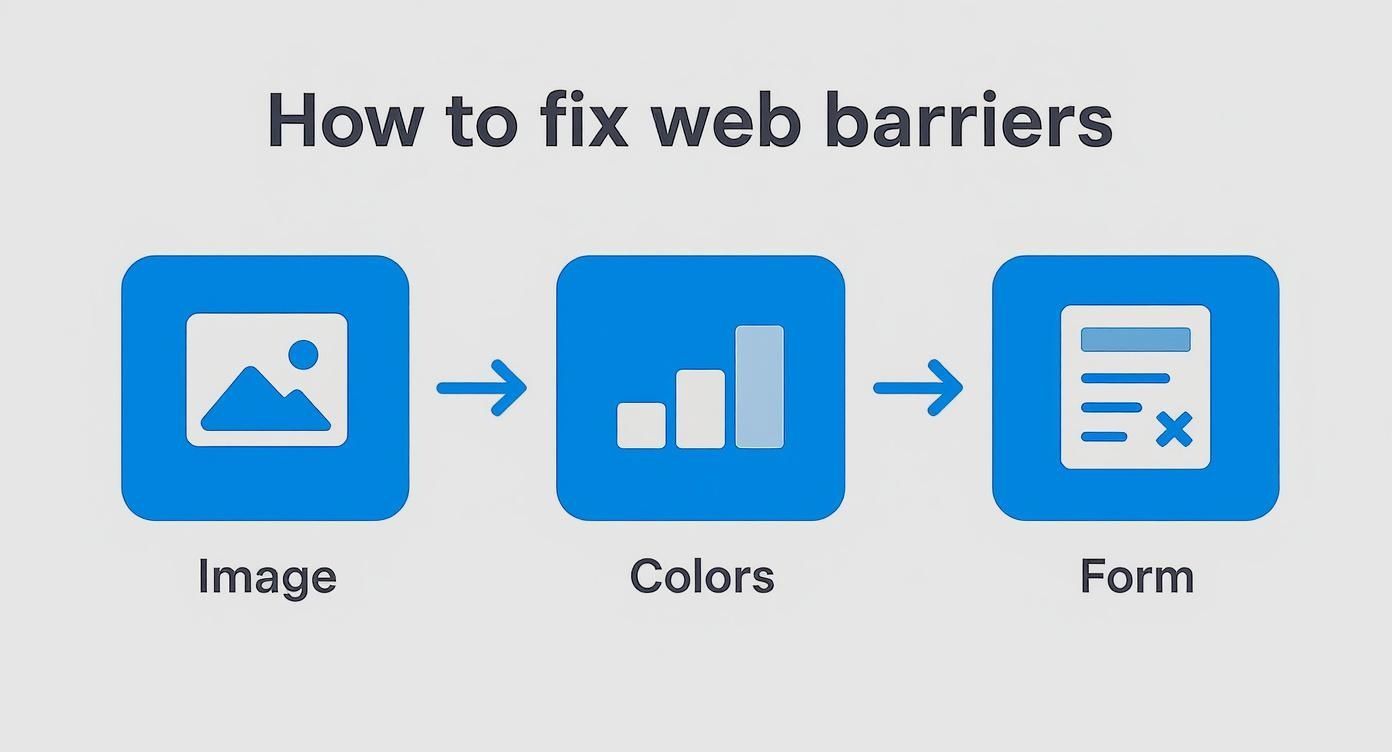
As you can see, resolving these barriers often comes down to addressing foundational elements like how you handle images, your color choices, and the structure of your interactive forms.
Step 2: Prioritize Your Findings
Once your audit is done, you'll probably have a list of issues. The key is not to get overwhelmed and try to fix everything at once. Instead, you need to prioritize. A smart strategy is to tackle the problems that have the biggest impact on a user's ability to navigate your site and complete key tasks.
Focus on what we call "critical path" issues first. If you run an e-commerce store, that means anything preventing a user from browsing products, adding an item to their cart, and successfully checking out. Fixing a broken "Buy Now" button for a screen reader user is far more urgent than tweaking a minor color contrast issue on a blog post from three years ago.
Step 3: Implement Fixes and Remediate Issues
Now it's time to roll up your sleeves and make the changes. How you do this really depends on your technical comfort level and how complex the problems are. Simple fixes, like adding alt text or adjusting colors, are things you can often handle yourself right inside your website's content management system.
For more complex, code-level problems, you might need to bring in a web developer. Another route is using an accessibility platform or widget, which can add a layer of remediation and user-facing tools to your site. The goal is to choose a solution that fits your budget and resources while making real, tangible progress.
Step 4: Publish an Accessibility Statement
Transparency is a powerful thing. An accessibility statement is a public-facing page on your website that clearly communicates your commitment to inclusivity. It’s a signal to your visitors that you're aware of accessibility and are actively working to make your site better for everyone.
Your accessibility statement should be easy to find and written in plain, simple language. It's where you can outline the standards you're aiming for (like WCAG 2.1 AA), mention any known issues you're working on, and provide contact information for users who run into a barrier.
This statement does more than just tick a box—it builds trust and shows good faith. It tells all users, especially those with disabilities, that you value them and are dedicated to providing an equitable experience.
Step 5: Maintain and Monitor Compliance
Finally, remember that accessibility isn’t a one-and-done project. It’s an ongoing process. Every time you add a new blog post, launch a new product, or add a new feature, you have to make sure it's also accessible.
The best way to do this is to weave accessibility into your regular workflow. Train your team on the basics so that new content is created with accessibility in mind from the very beginning. It's also a good idea to re-audit your site regularly—maybe once a quarter—to catch any new issues that have cropped up. This proactive approach is what keeps your digital doors open to everyone, all the time.
The Growing Legal Risks for Small Businesses
To really protect your business, you first have to understand the current legal climate. Digital accessibility lawsuits aren't just a problem for big-name corporations anymore; they've become a direct and growing threat to small businesses everywhere. The hard truth is that your website is one of your most public-facing assets, which unfortunately makes it an easy target for legal action.
Leaving your website's accessibility unaddressed is a bit like leaving the back door of your shop unlocked overnight. It creates a serious vulnerability that can lead to steep financial penalties and a damaged reputation. The point isn't to scare you, but to give you the knowledge you need to get ahead of the risk.
The Rise of Automated Scans and Serial Litigants
So, why the sudden explosion in lawsuits? A big part of it is how efficiently plaintiffs' attorneys can now find non-compliant websites. They're often using sophisticated software that automatically scans thousands of sites a day, flagging common accessibility issues on a massive scale.
This technology lets them cast an incredibly wide net, pinpointing potential targets in minutes. A small business with a slightly outdated site or common barriers—like missing image descriptions or poor color contrast—can easily get flagged by one of these scans. The next thing you know, a demand letter or a lawsuit arrives with little to no warning.
This shift to automated detection means that flying under the radar is no longer a viable strategy. Even small, local businesses are now in the spotlight, making ADA compliance for small business an absolutely critical part of operating in today's world.
A Nationwide Issue Beyond California and New York
While states like California and New York have always been hotspots for ADA litigation, this is now very much a nationwide issue. In March alone, a staggering 457 digital accessibility lawsuits were filed across the country. The breakdown shows just how widespread this has become:
New York: 256 cases
Florida: 113 cases
California: 25 cases
What's really telling, though, is that states like Texas and Ohio are seeing a noticeable spike in cases. This proves the legal challenge is spreading.
Nationally, digital accessibility lawsuits are on pace to jump by nearly 20% this year, with over 2,000 cases filed before we even hit the halfway mark. This really highlights why it's so important to understand the specific website accessibility laws that affect your business, no matter where you're located. Taking a proactive approach to your site's accessibility is truly the best defense against this growing legal risk.
Common Questions About ADA Compliance
Getting into the weeds of ADA compliance always brings up a few head-scratchers. Let's tackle some of the most common questions I hear from small business owners to clear the air and help you focus on what really matters.
Does ADA Compliance Apply If I Have No Employees?
Yes, it absolutely does. This is probably the biggest point of confusion out there. The part of the ADA that deals with your website is Title III, and it’s all about “public accommodations”—basically, any business that serves the public.
Unlike the employment rules in Title I, there’s no employee count threshold for Title III. If your business is open to the public in any way, shape, or form, your website has to be accessible. That holds true even if you're a one-person shop.
Are Accessibility Plugins and Widgets Enough for Compliance?
Accessibility plugins and widgets can be a helpful part of a broader accessibility strategy. They can quickly add user-facing tools and address certain code-level issues, making your site more usable for many people.
These tools are most effective when they are part of a comprehensive approach that also includes manual testing and direct remediation of your website's underlying code. Combining automated solutions with manual oversight ensures you are creating the most robust and accessible experience possible.
Think of it this way: a widget can add helpful features to your digital storefront, which is a great step. At the same time, you'll want to ensure the store's fundamental structure, like the width of the aisles and the height of the checkout counter, is also built to be accessible.
How Much Does It Cost to Become ADA Compliant?
The cost really runs the gamut. It all boils down to your website's size, how complex it is, and its current accessibility level. A simple five-page website might just need a few small, inexpensive tweaks.
On the other hand, a sprawling e-commerce store with thousands of products will naturally require a bigger investment. The key is to think of this not as an expense, but as an investment in your business—one that protects you from risk and opens you up to a wider audience. The price of a lawsuit, between the legal fees, potential settlement, and damage to your reputation, is almost always far higher than the cost of getting it right from the start.
Ready to build an inclusive website and protect your business? The AI-powered accessibility platform from WebAbility.io makes achieving and maintaining ADA compliance simple. Start your free trial today and see how our tools can help you.
Quick Questions
Tap to ask AI about this article