ADA Hotel Compliance: Your 2026 Roadmap to Full Access

Sidharth Nayyar
An accessibility complaint usually doesn't arrive when your team has extra capacity. It shows up during a renovation, a brand refresh, a booking engine migration, or a busy season when operations are already stretched. One guest can't confirm whether a room has a roll-in shower. Another reaches the property and finds the route from parking to check-in harder than it should be. Then leadership asks the same question every hotel group asks: what does full ADA hotel compliance look like in practice?
The short answer is that it's both physical and digital, and it only works when operations supports both.
If you treat accessibility as a narrow facilities issue, you'll miss the website, booking flow, and front-desk interactions that shape the guest experience before arrival. If you treat it as only a website issue, you'll create expectations your property can't reliably deliver. The hotels that handle this well connect design, operations, revenue, and guest service into one system.
The Business Case for Full ADA Compliance
A common scenario looks like this: the property has a few accessible rooms, the website has an “accessible” filter, and staff believe they're covered. Then a guest reports that the booking path didn't describe the room clearly enough, or that a promised feature wasn't available at check-in. Suddenly, what looked like a compliance checkbox becomes an executive issue involving legal exposure, brand trust, and lost direct bookings.
TLDR
Prioritize three things together: physical audits, digital accessibility across the website and booking engine, and staff training with usable policies. When those three stay aligned, hotels reduce risk, remove booking friction, and create a smoother path to direct conversion.
That's the shift leadership teams need to make. ADA hotel compliance isn't only about avoiding complaints. It also improves how guests find information, compare room types, complete forms, and book with confidence. Friction in any of those moments hurts conversion.
Why compliance and CRO belong in the same conversation
An accessible booking experience is usually a better booking experience. Clear labels, better contrast, keyboard support, room descriptions that answer real guest questions, and fewer dead ends help guests with disabilities. They also help older travelers, mobile users, tired users, and anyone trying to make a decision quickly.
For hotel groups, that matters because direct revenue depends on trust. When a guest can understand exactly what an accessible room includes, they're less likely to abandon the process, call the property for clarification, or book through a third party just to reduce uncertainty. That's why executive teams should think about accessibility as both risk mitigation and conversion infrastructure.
The strategic work starts with building an accessibility business case that ties compliance to guest experience, marketing efficiency, and operational consistency.
What executive teams should expect
The strongest programs use an E-E-A-T lens. They show experience through real operational procedures, expertise through standards-based audits, authoritativeness through clear documented policies, and trustworthiness by delivering the same accessible experience they advertise.
Hotels rarely get into trouble because they lacked good intentions. They get into trouble because the website, the building, and the front desk weren't working from the same playbook.
Mastering Physical Facility Accessibility
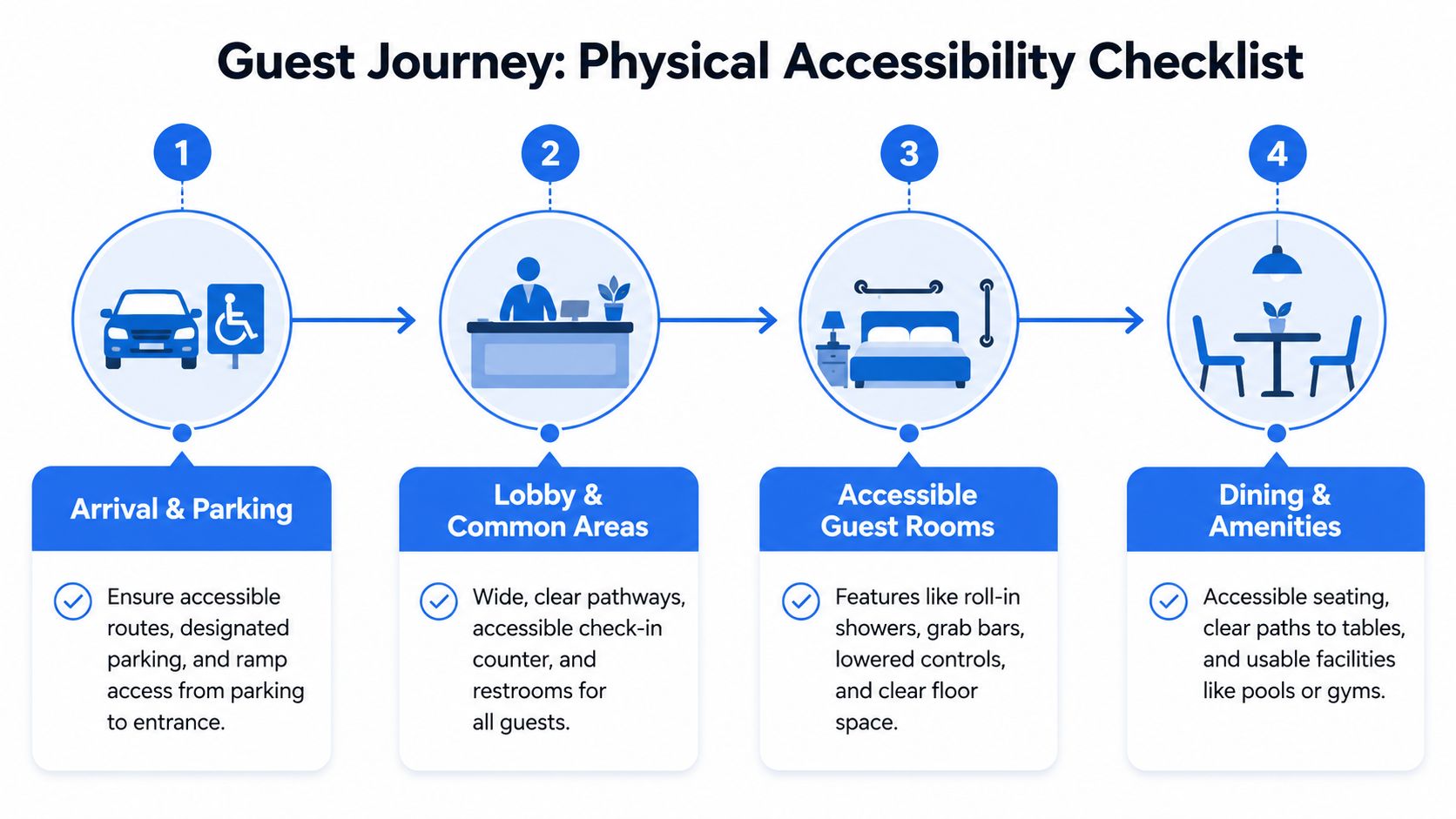
A guest arrives after a long trip, sees the accessible symbol on the reservation, and still cannot get from the parking area to the room without help. That is the failure pattern hotel groups need to prevent. Physical accessibility is not a box on a capital project checklist. It is part of the product the guest believes they bought, and it has a direct effect on satisfaction, complaint volume, brand trust, and whether that guest books direct again.
Start with inventory and route continuity
Executive teams should verify two things early. First, the property has the required accessible room inventory under the ADA Standards. Second, those rooms are connected to the spaces guests use through an accessible route that remains usable in daily operations.
The room count matters because it sets the baseline for legal exposure and revenue capacity. An inaccessible route creates a second problem. You can have the right number of designated rooms on paper and still deliver a poor guest experience if the path from parking or drop-off to the entrance, check-in, elevator, guest room, restroom, restaurant, pool area, or meeting space breaks down in practice.
I advise owners to inspect the route as a guest would, not as a plan reviewer would. Walk it with housekeeping carts out, seasonal décor in place, queue stanchions set up, and luggage traffic moving. That is where hidden barriers show up.
Measure the spaces that fail most often
Older properties and phased renovations usually create the same trouble spots. Door clearances drift. Corridors narrow because furniture or displays migrated over time. Bathrooms pass a drawing review and then fail once grab bars, vanities, and accessories are installed.
The measurements below deserve early review because they affect whether a guest can use the room independently, according to the ADA Standards for accessible design and related hospitality guidance from the ADA National Network:
Door openings need at least 32 inches of clear width.
Accessible routes such as corridors generally need at least 36 inches of clear width.
Bathrooms need turning space that supports wheelchair use.
Furnished layouts must preserve clear floor space from entry to bed to bathroom.
Inside the guest room, furniture placement often causes the main failure. A model room may pass. The live room may not. Replacement chairs, oversized nightstands, luggage benches, and rollaway storage can cut off transfer space or force awkward routing that the guest should not have to negotiate.
One practical discipline helps here. Audit furnished rooms in service condition, not empty rooms staged for inspection.
Guest room usability depends on layout, not labels
Accessible room design affects booking conversion because guests remember the details that make the stay workable. They want to know whether they can transfer to the bed, turn in the bathroom, reach controls, and move through the room without calling the front desk for assistance.
That creates a clear business trade-off. Tighter room layouts may protect key count in a renovation, but layouts that frustrate wheelchair users also increase service recovery costs, room-change requests, and refund pressure. In portfolio reviews, I usually see the best results when design, operations, and e-commerce teams use the same room attributes and photos. If the room is marketed as accessible, the physical setup has to support that claim every day, not only after an inspection.
For renovation teams reviewing bathrooms and related spaces, this practical reference on 2026 ADA compliance requirements can help align layout decisions before they become expensive rework.
Doors, hardware, and maintenance discipline
Door compliance affects access more often than many teams expect. Width is only one part of the review. Opening force, maneuvering clearance, hardware type, closer speed, threshold condition, and whether the door can be operated with one hand all shape whether the entrance works for a guest traveling independently.
Accessible guest room and common-area doors should be checked in the field, not assumed compliant because they were once installed correctly. Hardware changes, closer adjustments, warped frames, floor finish buildup, and deferred maintenance can all turn a compliant opening into a recurring barrier. The U.S. Access Board ADA guide on doors, doorways, and gates is the right reference point for technical review.
Automatic operators can improve usability at main entrances and other high-traffic locations, especially where wind pressure, door weight, or traffic patterns create recurring access issues. Facility teams evaluating upgrades may find these insights for facility managers on door access useful when deciding where automation improves access most effectively.
Field rule: If a feature only works when a staff member steps in, the hotel is relying on a workaround, not delivering consistent accessibility.
The properties that handle this well do one thing consistently. They treat physical accessibility as an operating standard tied to maintenance, room setup, and guest communication. That is where legal compliance, guest confidence, and direct booking performance start to reinforce each other.
Achieving Digital Compliance for Websites and Bookings
A guest finds your hotel on a phone during a layover, tries to confirm whether an accessible room has a roll-in shower, opens the date picker, and gets stuck. The room may be compliant on property, but the sale is already at risk. For hotel groups, digital accessibility sits at the intersection of ADA exposure, direct booking conversion, and guest trust.
The booking flow needs to work for real users, not just pass a widget check
The website, booking engine, mobile flow, and confirmation path all need to support assistive technology, keyboard use, readable contrast, clear labels, and predictable error handling. In practice, I look for basics that directly affect conversion: can a guest search dates without a mouse, understand room differences without guessing, enlarge text without breaking the interface, and complete payment without losing focus inside a modal or calendar?
Hotels also need accurate accessible room content in the reservation path. A generic "accessible" tag does not give a guest enough information to book with confidence. It also creates avoidable calls to the property, abandoned sessions, and post-booking disputes.
Treat accessible room details as conversion content
The strongest hotel teams manage accessibility data with the same discipline they apply to rate, inventory, and cancellation policy. If a guest needs a transfer shower, visual alarm, lower peephole, or hearing-access kit, the booking flow should say so clearly before checkout.
Use room descriptions that specify features such as:
Bathing configuration: Roll-in shower, transfer shower, grab bars, shower seat details.
Communication features: Visual alarms, TDD support, and other communication equipment where applicable.
In-room usability: Clear descriptions of the actual access features available, not vague assurances.
That level of detail does more than reduce legal risk. It improves qualified bookings because guests can select the right room type without calling reservations to fill in missing information.
Small interface failures create expensive booking friction
Digital accessibility failures often look minor in design review and expensive in production.
| Digital issue | What it causes |
|---|---|
| Placeholder-only form labels | Guests lose context when fields are read by assistive technology or when errors appear |
| Keyboard traps in calendars or popups | A user can browse but can't complete the reservation |
| Low-contrast pricing or policy text | Key details become harder to read on mobile and in poor lighting |
| One generic “accessible” filter | Guests still can't tell whether the room fits their access needs |
These are usability problems first. They are also ADA and WCAG problems. That overlap is why hotel groups should stop treating digital compliance as a narrow legal exercise. The same fixes that reduce complaints also tend to improve completion rate, especially on mobile.
If your team builds with Elementor, this checklist on Exclusive Addons for Elementor WCAG compliance is a useful implementation reference for common front-end issues that affect accessibility and usability.
Reservation rules have to match what the site promises
Compliance does not end at the front-end interface. The reservation system has to preserve accessible room inventory correctly, remove reserved accessible rooms from general sale at the right time, and keep room attributes consistent across the CMS, CRS, booking engine, and confirmation emails. If those systems drift apart, the guest experiences one broken promise, not four separate technical issues.
That is the trade-off executives need to see clearly. A cheap patch on the website may reduce visible errors, but it will not fix inaccessible inventory logic or vague room data feeding the engine. Better results come from one cross-functional standard for content, UX, inventory controls, and QA.
A fast way to identify obvious digital issues is to run an ada website checker before deeper manual testing begins. That will not replace expert review with screen readers, keyboard-only testing, and booking-path validation, but it will surface common failures in contrast, structure, and basic semantics.
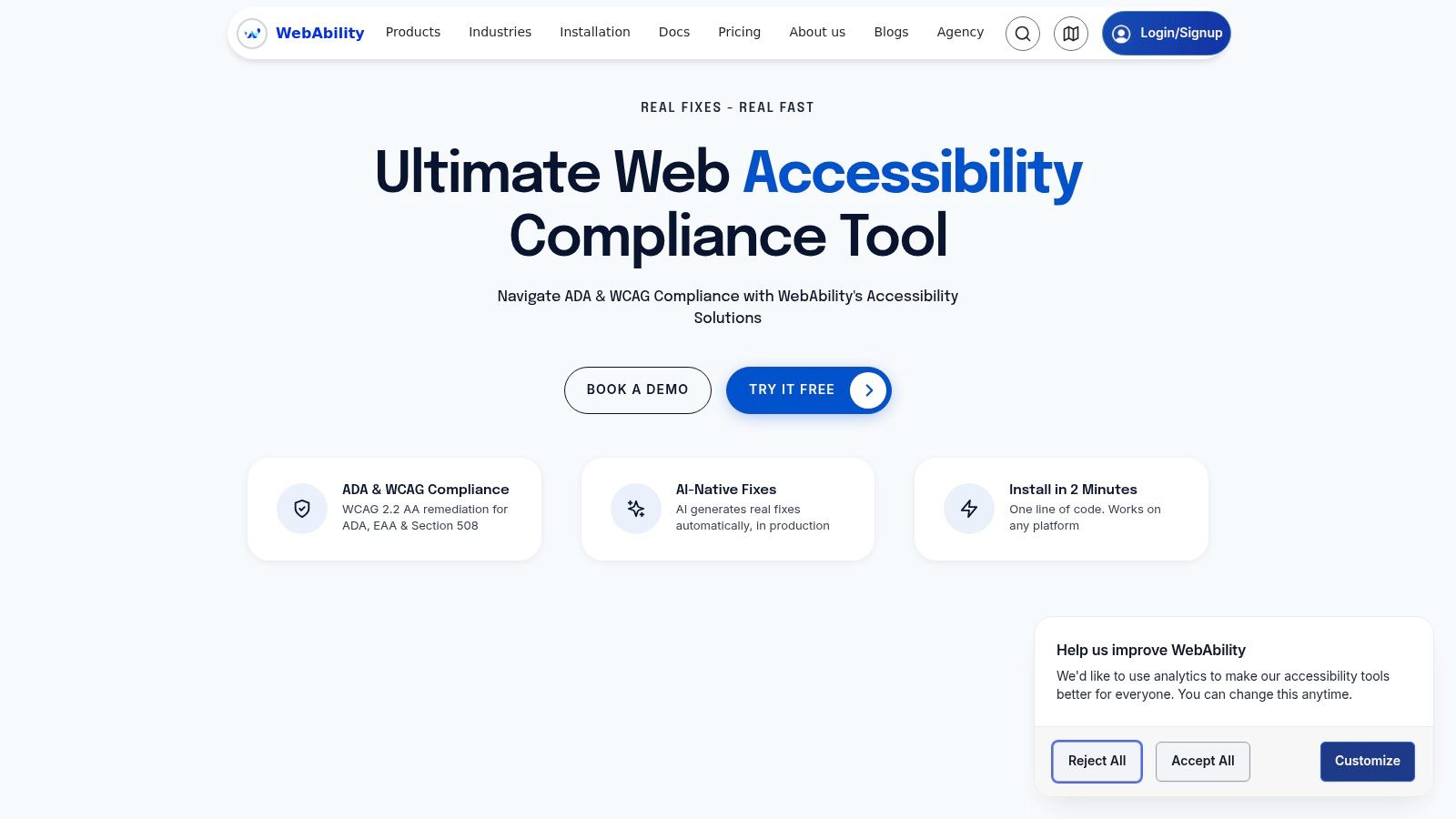
WebAbility can get your site ADA compliant end to end, from audit to fixes.
Your Step-by-Step Compliance Audit Workflow
A guest books an accessible room online, arrives after a long flight, and finds a heavy door, a bathroom layout that does not work for their needs, and a front desk team that cannot explain the discrepancy. That is not three separate failures. It is one broken operating system across digital, physical, and service delivery.
A useful audit workflow has to catch that chain before the guest does. For hotel groups, the goal is not to produce a report once a year. The goal is to create a repeatable process that reduces legal exposure, protects conversion, and gives each property a clear standard for what "accessible" means in practice.
Build one workflow across departments
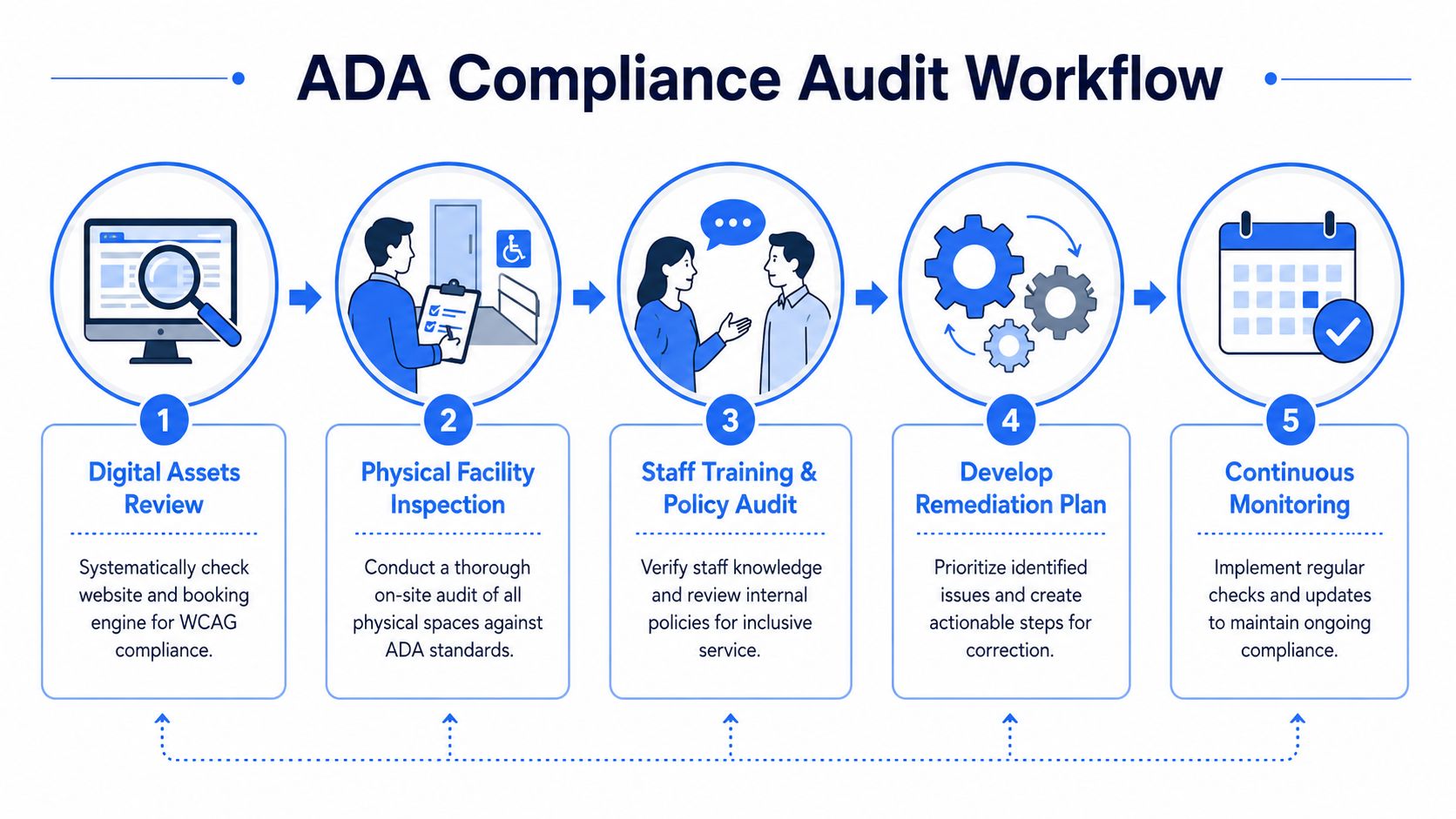
The strongest audit programs follow the guest journey, not the org chart. I recommend a five-step workflow that starts where guests make decisions and ends with ownership and re-testing.
Review guest-facing digital touchpoints first. Check the main website, room detail pages, policy pages, forms, booking engine, and post-booking emails. If the booking path mislabels room features or hides accessibility information, the property inherits a service failure before arrival.
Inspect the on-site experience in sequence. Audit arrival, parking, entrances, check-in, elevators, guest rooms, bathrooms, dining areas, meeting space, and amenities in the same order a guest would encounter them.
Test operating practices. Ask staff real booking and arrival questions, review written policies, and confirm that teams can explain accessible features accurately.
Prioritize remediation. Sort findings by guest impact, complaint risk, revenue impact, and cost to fix. A broken booking flow and a misleading room description often deserve faster action than lower-risk cosmetic issues.
Re-test after changes. Renovations, CMS updates, furniture swaps, and vendor changes can all create new barriers.
This cross-functional structure matters because accessibility failures rarely stay in one department. A facilities issue can suppress bookings. A content issue can increase front desk escalations. A training gap can turn a minor defect into a formal complaint.
Use measurements, photos, and booking-path evidence
Physical audits work best when they document observable conditions, not impressions. Record clear widths, reach ranges, maneuvering space, hardware type, signage placement, and any obstruction introduced by furniture or temporary fixtures. As noted earlier in this guide, guest room and common-area reviews should be tied to ADA-based dimensional checks, then documented at the room or location level.
Good documentation is specific. "Hallway near east elevator is narrow" does not help anyone. "Second-floor east corridor outside rooms 214 to 218 is obstructed by added casegoods, reducing clear passage and affecting wheelchair travel" gives facilities and operations a fixable item.
Apply the same standard online. Save screenshots, note the page template, capture the device and browser used, and document the exact booking step where a guest would hit friction. A formal website accessibility audit is useful when you need a stronger baseline across multiple properties, especially when brand templates and third-party booking tools vary by location.
Assign ownership before the audit report goes cold
Findings lose value fast when no one owns the next action. Every issue should be assigned the same day with three decisions attached:
Responsible team: facilities, IT, marketing, revenue systems, operations, or property leadership
Resolution path: immediate fix, scheduled maintenance, capital project, or legal review
Proof of completion: updated measurements, screenshots, vendor confirmation, policy revision, or staff sign-off
I also advise executive teams to separate quick wins from structural fixes. Rewriting vague accessible room descriptions can happen this quarter. Reconfiguring bathrooms or replacing doors may need capital planning. Both matter, but they should not compete in the same queue.
Temporary operations deserve their own check. Banquet setups, conference registration tables, buffet lines, and pre-ordered food service often create barriers in properties that perform well day to day. Teams managing those programs can use this essential guide for hospitality event planners, because accessibility and event execution often intersect at the operational level.
Audit on a schedule, not in reaction to complaints
One audit is a baseline. Control comes from repetition.
Set review triggers for website releases, booking engine changes, renovations, room refreshes, seasonal furniture layouts, policy updates, and ownership transitions. For multi-property groups, I usually recommend a standard audit template at the brand level and local validation at the property level. That gives leadership a portfolio view of risk while still catching the details that affect an individual guest stay.
The hotels that perform best treat accessibility the same way they treat life-safety, brand QA, and preventive maintenance. It is part of how the business runs. That approach lowers complaint risk and improves the booking experience guests remember.
Empowering Your Staff Through Training and Policy
A hotel can have compliant dimensions and still deliver a poor accessibility experience if staff can't answer basic questions accurately. Guests don't judge compliance as a set of technical standards. They judge it by whether your team can help them book, arrive, check in, and use the property without confusion.
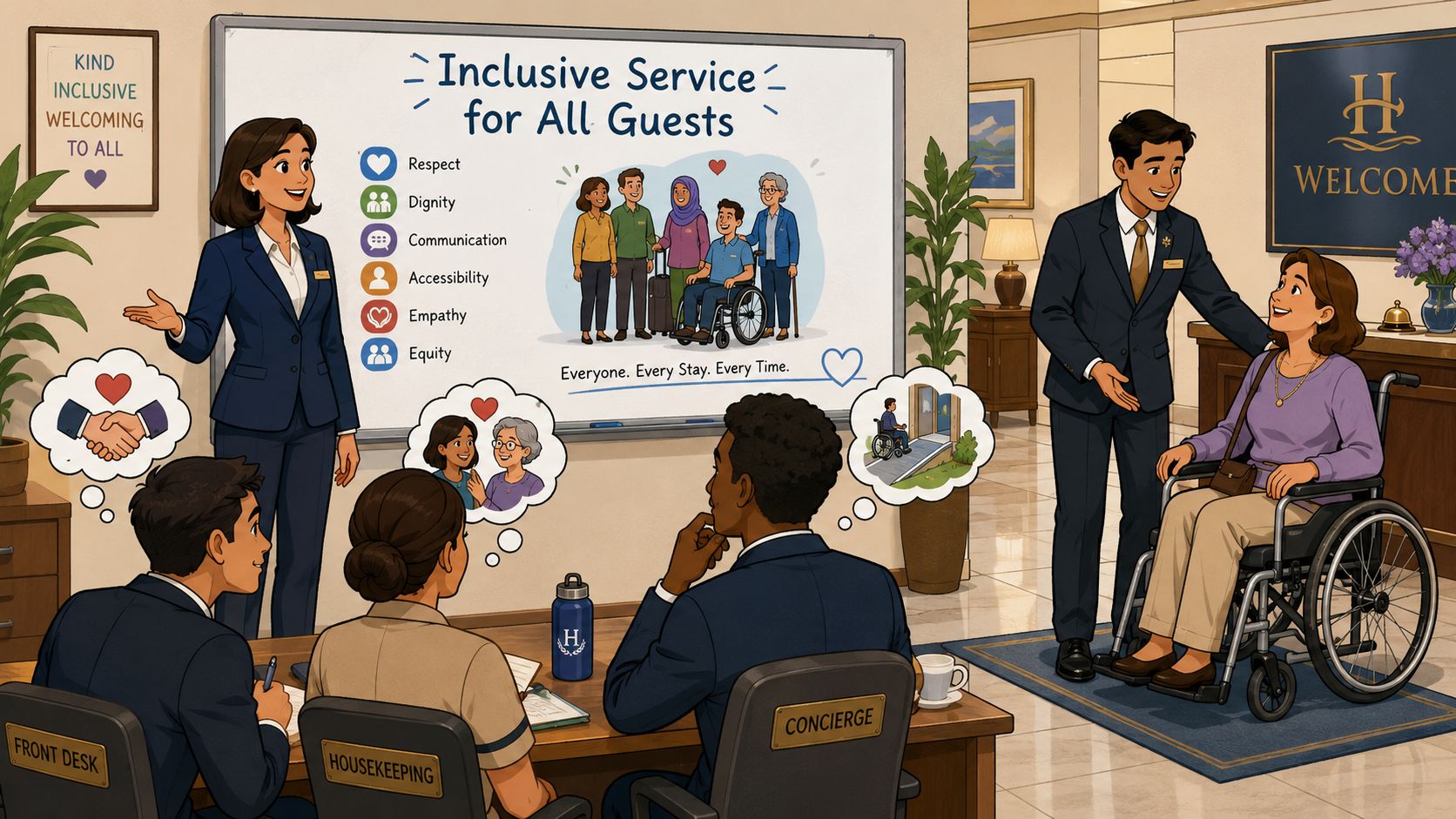
Recent developments show that 55% of guests with disabilities who attempted to book service animal-friendly rooms reported being unable to locate clear, screen-reader-accessible policy statements on hotel websites, and 79% of lodging establishments fail to train staff on auxiliary aid protocols, according to ADA lodging guidance. That combination is where many otherwise capable hotel teams get exposed. The website is unclear, and the front desk can't recover the situation.
Train staff on scenarios, not slogans
The best training programs are short, specific, and repeated. Staff shouldn't memorize legal language. They should practice common guest interactions.
Core topics should include:
Service animal handling: Staff must know that service animals are permitted even if the hotel has a no-pets policy, and they should know how to explain that calmly and consistently.
Accessible feature descriptions: Front-desk and reservations teams should be able to describe room features in practical terms, without guessing.
Auxiliary aids: Teams need a clear process for handling requests related to communication access and in-room support items.
Real-time problem solving: When an accessible feature is unavailable, staff need an escalation path immediately, not after a manager returns a call.
One mistake I see often is over-reliance on a policy binder. If staff have to search for the answer while a guest waits, the policy may exist but the experience still fails.
Make policies visible and usable
Policies should live in the places staff already use. That means the PMS notes, pre-arrival templates, booking confirmations, internal knowledge bases, and shift checklists. If a service animal policy exists only as a PDF buried on a corporate page, it won't help a guest using a screen reader or an agent trying to answer a reservation question quickly.
A practical training approach includes role-play at the front desk, call-handling scripts for reservations, and shift-level accountability for accessible equipment readiness. Managers should test these interactions the same way they mystery-shop brand standards.
This short training video is a useful reset for service expectations in hospitality settings.
What good execution sounds like
A poor response sounds like this: “I think all ADA rooms are the same.” Or, “You'll have to ask when you arrive.” That creates uncertainty immediately.
A stronger response sounds like this:
“This room has a roll-in shower, grab bars, and communication features listed in the reservation. If you need a specific feature confirmed before arrival, I can verify it now and note it on your booking.”
That answer is clear, useful, and operationally grounded. It respects the guest's need to make an informed decision without turning the conversation into a defensive compliance exercise.
Budgeting and Prioritizing Your Compliance Roadmap
A guest books an accessible room online because the listing says it has the features they need. At arrival, the room assignment has shifted, the front desk cannot confirm the bathroom setup, and the guest leaves frustrated. Finance sees a service recovery cost. Operations sees a staffing problem. Legal sees exposure. The revenue team should see something else too. Accessibility failures break conversion before arrival and loyalty after the stay.
A workable budget starts with that full picture. ADA compliance is not only a facilities line item. It touches your website, booking flow, room inventory controls, maintenance routines, and staff execution. Executive teams get better results when they fund accessibility as a coordinated operating strategy instead of a patchwork of one-off fixes.
Prioritize by risk, revenue, and effort
The right sequence is usually clear once teams stop grouping every issue into the same bucket.
Start with barriers that create immediate guest harm or obvious reservation friction. Then move to fixes that improve booking accuracy, reduce staff workarounds, and prevent repeat failures. Larger construction items can follow a capital schedule, but they should still be scoped early so they do not sit unplanned for another budget cycle.
A practical model looks like this:
| Priority tier | Typical examples | Why it comes first |
|---|---|---|
| Immediate operational fixes | Inaccurate room feature descriptions, broken accessible room hold process, inaccessible PDFs, missing escalation steps | Reduces booking friction, complaints, and day-of-arrival failures quickly |
| Near-term digital remediation | Booking engine form errors, keyboard traps, weak alt text, low contrast, inaccessible policy content | Improves direct conversion and lowers abandonment for guests using assistive tech |
| Planned facility upgrades | Door hardware changes, signage corrections, route improvements, bathroom fixture adjustments | Often requires purchasing, scheduling, and coordination with maintenance or ownership |
| Capital project scope | Room reconfiguration, major restroom work, circulation changes tied to renovation cycles | Best managed through PIP planning, design review, and owner approval |
That order reflects real trade-offs. A bathroom remodel may cost more and take longer, but a bad booking flow can lose revenue every day until it is fixed.
Build the budget in three buckets
Separate the roadmap into digital, physical, and operational spending.
Digital remediation covers your website, booking engine, room content, testing, and monitoring. This category often produces the fastest return because it affects how guests research, trust, and complete a reservation. If accessible room details are hard to find or impossible to use with a keyboard or screen reader, direct bookings suffer and call volume rises.
Physical modifications include path-of-travel issues, guest room changes, bathroom work, hardware replacement, signage, communication features, and accessible equipment. These items usually need property-level scoping and owner alignment. They also benefit from bundling. If a hotel is already replacing doors or renovating bathrooms, accessibility corrections should be folded into that scope instead of handled later at a higher unit cost.
Operational costs cover audits, policy updates, staff refreshers, vendor oversight, and periodic verification. This bucket gets underfunded often. It is also what prevents backsliding after the first round of fixes.
Protect the budget from false savings
Policy cleanup and inventory controls are often delayed because they do not look like capital improvements. That is short-term thinking. If the hotel cannot accurately describe an accessible room, hold that room correctly, or preserve the promised features through check-in, the property creates risk even when the physical room is technically compliant.
I usually advise leadership teams to ask one simple question for each proposed fix: will this reduce legal exposure, improve guest confidence, or increase booking completion? The best projects do all three.
Budget for the barriers guests hit first. Then fund the controls that keep the same problem from returning six months later.
The strongest roadmap is phased and disciplined. Fix the failures that block booking or access now. Schedule larger property changes with design, ownership, and renovation planning. Track accessibility the same way you track other brand and revenue risks, because in practice it is both.
Frequently Asked Questions on Hotel ADA Compliance
Some hotel ADA compliance questions don't fit neatly into facilities, digital, or training buckets. They sit at the edges of operations, where teams tend to improvise. That's where clear answers help most.
Common Hotel ADA Compliance Questions
| Question | Answer |
|---|---|
| Do accessible rooms need more than an “accessible” label online? | Yes. Guests need room-specific feature details that let them decide whether the room fits their needs before booking. Generic labels create uncertainty and drive calls, abandonment, or complaints. |
| Should a hotel audit third-party listings too? | Yes. If your direct site is accurate but major distribution channels use outdated or vague accessibility descriptions, guests still experience your brand as unreliable. |
| Is bed height specifically mandated for hotels? | No specific ADA standard for hotel bed height is identified in the verified data. The focus is on functional accessibility and whether the room can be used effectively. |
| What's one of the biggest operational mistakes with accessible inventory? | Letting the reserved room or room type drift because inventory control, front desk assignments, and booking rules aren't aligned. |
| Are service animal policies only a front-desk issue? | No. The policy must be clear online, usable by assistive technology, and supported by staff who know how to apply it consistently. |
| Can a hotel rely only on automated testing for website accessibility? | No. Automated testing is useful for surfacing common issues, but hotels still need manual review of booking flow, room content, keyboard behavior, and real user tasks. |
| How often should a property re-check accessibility? | Re-check after website updates, booking engine changes, room refreshes, renovations, policy changes, and staff turnover. Accessibility is part of ongoing operations, not a one-time project. |
| What should executives ask for in a portfolio-level report? | Ask for issue severity, property ownership, status by department, proof of remediation, and a list of recurring failures across locations. That turns accessibility into a management system instead of a one-off task. |
The practical standard
A key test is simple. Can a guest discover the right room, reserve it confidently, arrive without unnecessary barriers, and get consistent support from staff?
If the answer is inconsistent across channels or properties, the compliance program isn't finished yet.
Where many teams improve fastest
The fastest gains usually come from tightening room descriptions, aligning reservation rules with real accessible inventory, and training staff to answer accessibility questions without escalation. Those changes won't solve every structural problem, but they improve trust quickly and create momentum for larger remediation work.
If your group is trying to standardize accessibility across multiple sites, booking flows, and property teams, WebAbility.io can help you centralize monitoring, identify issues earlier, and support a more consistent accessibility program across the guest journey.
Quick Questions
Tap to ask AI about this article