Accessibility Policy Template: Customize and Roll It Out

Sidharth Nayyar
Sidharth Nayyar
Ready to make your website accessible? Engage with our team or start a free trial today.
You're probably staring at a policy draft that's half legal language, half wishful thinking, and someone wants it signed tomorrow. That's the wrong document to rush. An accessibility policy template only works when it acts like an internal control, with named owners, a standard to measure against, and evidence that survives audit review.
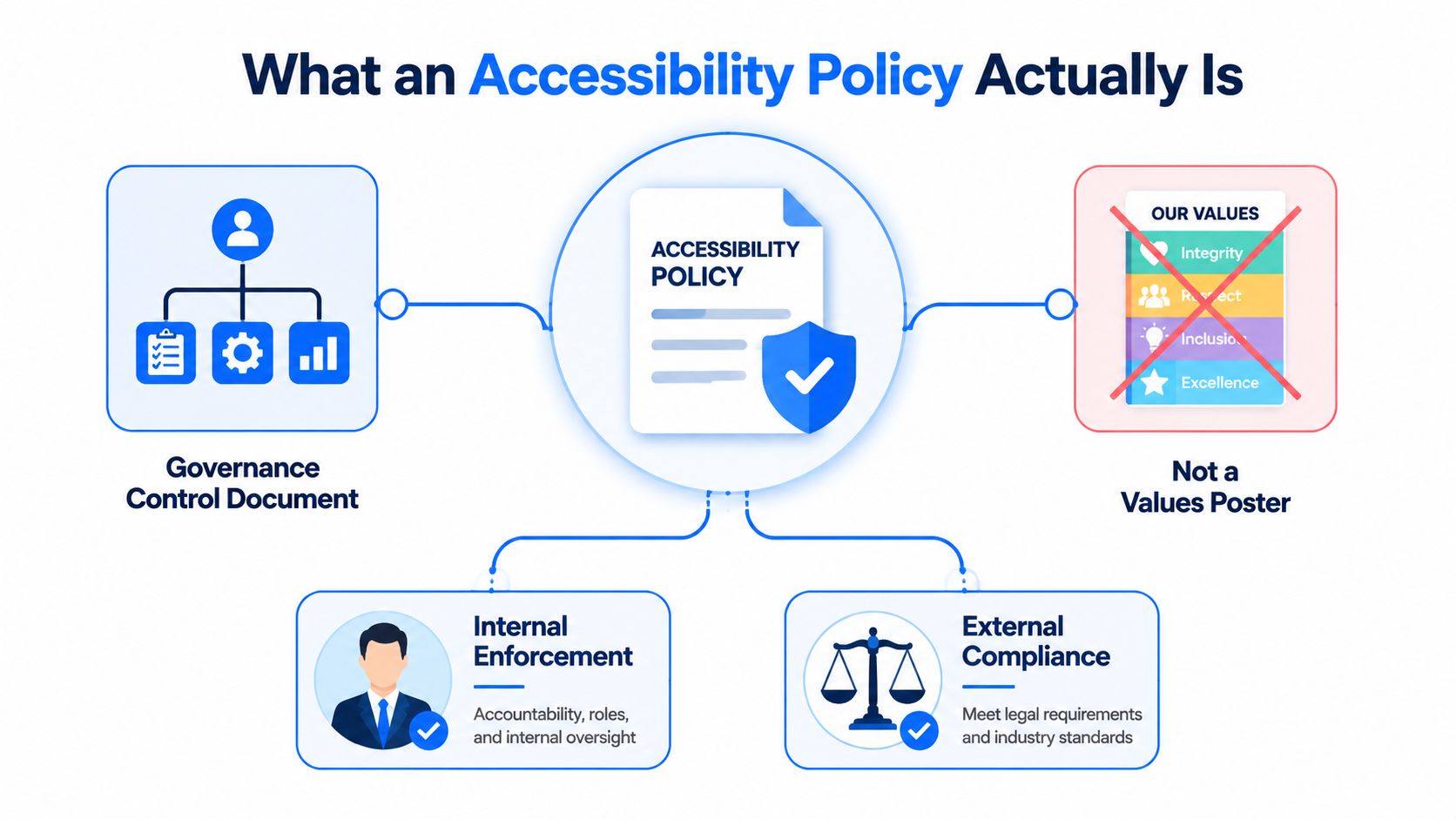
TL;DR: treat the policy as a governance document, not a values poster. It needs to commit the organization to a standard, govern who does what, evidence the work through procurement and monitoring, and review on a fixed cadence. If it can't drive action in procurement, product, HR, and IT, it's not finished.
A compliance lead usually gets asked for two things at once, and they're not the same document. The first is the internal accessibility policy, which tells the organization what standard it follows, who owns enforcement, how procurement is gated, and how issues move through escalation. The second is the public accessibility statement, which tells users what's currently true, what limitations exist, and how to contact the organization.
That distinction matters because the policy is the control surface. It's the document legal, HR, IT, product, and procurement can all point to when they need a decision, not a slogan. If you want a plain-language explanation of the technical side of accessibility before you finalize policy language, the plain English WCAG breakdown is useful background for non-specialists.
The best policies are written to be enforced, not admired. They name the standard, assign accountability, and make review cycles explicit. That's why the internal policy pairs well with the internal page on what is digital accessibility, because one explains the concept and the other tells the company how to operate.
Practical rule: if a clause doesn't change a decision, a purchase, a release, or a review, it belongs in guidance, not in policy.
The reason this has become more formal is obvious once you look at the evidence gap. In Canada, 34.9% of persons with disabilities or long-term conditions experienced ICT barriers, and 24.2% encountered barriers during onboarding. The same source shows 2,535,950 people required ICT assistive aids, devices, and technologies in 2022, while 637,710 people did not have needed ICT-related aids because of cost. That's exactly the scale of real-world friction a policy should govern, not just acknowledge. Accessibility Statistics Hub data
The fastest way to create policy chaos is to make one document do four jobs. The policy sets the internal rules. The statement faces the public. The VPAT describes product conformance for buyers. The roadmap sequences the fixes. Separate them, or you'll end up with a policy that reads like marketing and a statement that reads like legal defense.
| Artifact | Audience | Owner | Refresh cadence | Format |
|---|---|---|---|---|
| Internal Policy | Employees, leadership, vendors | Compliance or legal governance | On a fixed review cycle | Internal control document |
| Accessibility Statement | Website users, customers, the public | Web or compliance owner | When conformance or contact details change | Public web page |
| VPAT | Procurement teams, customers, sales ops | Product compliance owner | Per product release or buyer request | Product conformance report |
| Accessibility Roadmap | Delivery teams, executives | Program owner | Continuous execution tracking | Working plan |
The handoff is simple. The policy says procurement can't close a contract without current conformance evidence, which is where VPAT discipline matters. If your team needs a practical reminder on the product side, use VPATs to avoid compliance fines is a better internal anchor than a generic checklist.
The statement does not replace the policy. It discloses what users need to know, including known limitations and contact paths. That's also why the policy should point to a maintained statement page such as /statement, while the evidence trail lives with testing artifacts in /audit.
A good policy also keeps the roadmap honest. The roadmap is where fixes get sequenced, owned, and reviewed, but the policy is what makes that roadmap mandatory instead of aspirational. When the policy names a review cadence, assigns a product owner, and requires an evidence refresh, the roadmap stops being a slide deck and becomes the execution layer.
For teams teaching accessibility across digital learning content, it helps to see how policy, statement, and product evidence interact in practice. The test your online course accessibility resource is a solid example of how accessibility expectations show up in content workflows, not just web pages.
A defensible accessibility policy template needs structure. If any of these blocks is missing, the document is easy to ignore and hard to audit.
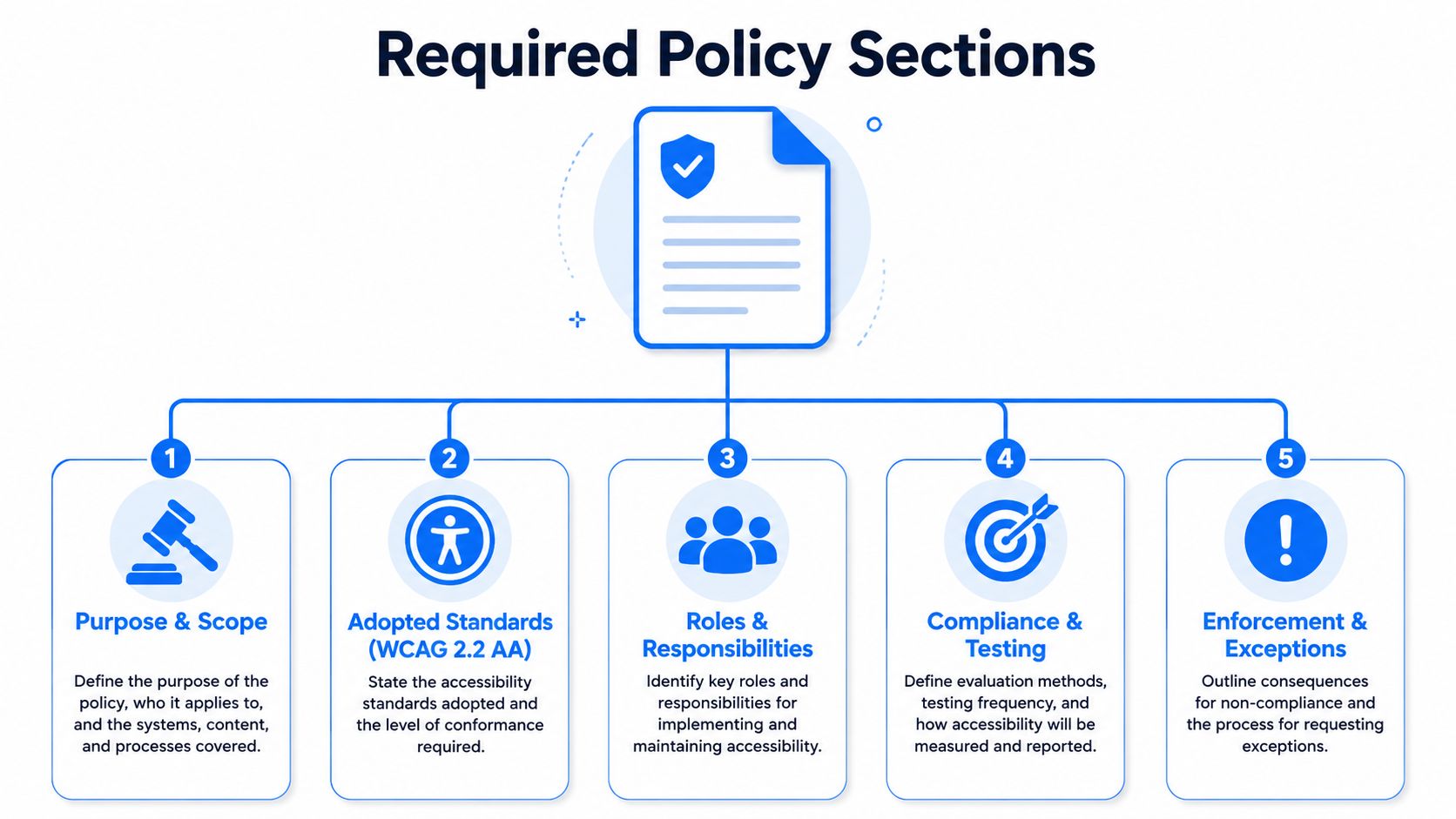
Purpose and scope should answer what the policy covers, who it applies to, and which assets are in scope. Write that it applies to websites, applications, PDFs, vendor content, templates, and any digital service the company publishes or buys. Then name the standard baseline clearly, with WCAG 2.2 AA as the default, EN 301 549 for EU obligations, and Section 508 where federal procurement applies.
Roles need names, not generic committees. Assign a Chief Accessibility Officer, product owners, design leads, procurement, IT security, and HR responsibilities so no one can claim surprise later. Procurement should require current VPATs, scored against your internal threshold, plus contract clauses that require remediation, evidence refresh, and cooperation during testing.
A policy that skips procurement only shifts the burden downstream, where legal risk gets more expensive.
Training, incident response, and review cadence round out the document. Training should be mandatory for the teams that make decisions, not just optional awareness for everyone else. Incident handling should define how barriers are reported, who triages them, and how quickly the response moves. If you need a legal comparator for accessibility-related workplace duties, the accommodations for disabled California staff resource is useful for understanding how accommodation obligations get documented and managed.
For the standards section, don't bury the mechanics. The policy should say what gets tested, what environments count as verified, and how exceptions are approved. If you want the policy to survive scrutiny, point teams to the 87 WCAG success criteria explained resource as the educational reference, then keep the policy itself crisp and enforceable.
The review cycle belongs in the policy body, not in an appendix no one opens. Include when it's reviewed, who signs off on exceptions, and how issues are escalated if a release or vendor slips. Public-sector guidance also expects accessibility plans and policy language to be published in accessible formats, including large print and Easy Read, which is exactly why the strongest templates treat publication itself as part of the control, not an afterthought. Accessible Canada regulations template
Use the right shape for the organization in front of you. A mid-market SaaS needs speed and clear ownership. A global enterprise needs shared governance and vendor discipline. A public agency needs traceability, publication readiness, and formal accountability.
Mid-market SaaS: “We maintain an accessibility program to ensure our digital products and customer-facing services meet our adopted accessibility standard and are continuously improved.”
Global enterprise: “This policy establishes the company's governance requirements for accessible digital products, employee-facing systems, and third-party services across business units and regions.”
Public agency: “This policy defines the organization's commitment, governance, and operational requirements for accessible digital services, procurement, and public information.”
Editable tokens: [DigitalProperties], [EmployeeSystems], [VendorTools], [PublicationFormats]
Use bold for the scope nouns, not the filler. Leave the tokens editable so legal can swap in the actual business units. The strongest version names websites, mobile apps, PDFs, templates, portals, and AI-generated content in the same sentence.
Mid-market SaaS: “The baseline standard is WCAG 2.2 AA.”
Global enterprise: “The organization adopts WCAG 2.2 AA globally, with EN 301 549 for EU operations and Section 508 where federal procurement or customer obligations apply.”
Public agency: “The agency will align to the relevant jurisdictional standard, including WCAG 2.2 AA, EN 301 549, and Section 508 as applicable.”
Name the owner. Don't write “a cross-functional team.” Use Chief Accessibility Officer, product owners, design leads, procurement, legal, HR, and IT. For enterprises, add regional owners. For agencies, add a formal executive sponsor.
Example language: “No contract may proceed without current accessibility conformance evidence, documented remediation commitments, and accessibility clauses in the final agreement.”
If you have a VPAT scoring model, keep it as a controlled attachment. That belongs in the policy repository at /compliance, not in a separate spreadsheet no one audits.
Set the cadence, the audience, and the proof. Designers, engineers, content authors, procurement, and support staff should have role-based training. Keep the phrase training is required before production access if your organization wants actual enforcement.
Add a short clause for barrier reporting, triage, and escalation. For a public agency, specify response ownership and publication obligations. For SaaS, tie the response to customer support and release management.
Audit evidence and dashboards belong here. A policy that doesn't require reporting doesn't create pressure to improve. If you want one operational reference point for compliance reporting and centralized oversight, WebAbility.io can serve as one implementation option through its monitoring and reporting features, but the policy should still name the control, not the tool.
Use placeholders like [ConformanceTargetDate], [PolicyOwner], and [NextReviewDate]. End with approval lines for legal, HR, IT, and the executive sponsor. The sign-off block should be visible, not hidden.
The approval workflow should be boring and formal. Legal reviews liability language, jurisdiction, and exception handling. HR reviews accommodations, training, and staff obligations. IT checks technical scope and monitoring language. The executive sponsor signs off on budget, priority, and KPI ownership. If one of those functions doesn't approve, the policy isn't done.
That sequence matters because each group redlines a different risk. Legal will push back on vague enforcement language. HR will want the training and accommodations sections to match how managers work. IT will care whether the policy creates impossible obligations for releases, vendors, or monitoring. The executive sponsor should care whether the policy can be funded and measured, not whether it sounds polished.
Operational rule: if a clause can't be measured in a dashboard or proven in an audit trail, it's too weak to be policy language.
The control layer should be centralized. Findings, exceptions, remediation plans, and evidence files need one home, not scattered inboxes. That is where a centralized monitoring dashboard becomes useful, because it turns the policy from a signed PDF into a live control set. For teams building that operating model, the enterprise compliance program framework is a practical reference point for governance structure and ongoing monitoring.
Remediation timelines should reflect severity, not hope. Critical barriers need immediate escalation and executive visibility. High-priority issues need a tracked fix window. Lower-priority items still need ownership, a due date, and evidence of completion. Put those expectations into the policy so no one improvises during a release freeze.
The audit trail should prove three things. First, who found the issue. Second, who owned the fix. Third, when it closed. Keep screenshots, scan results, approval notes, and exception records in one controlled repository. /audit should be the place leadership goes when it wants proof, not a summary slide.
The policy won't matter if managers hear about it three months late. Send a memo the same day it's approved. Keep it short, explicit, and action-oriented.
Memo template: “Effective [Date], accessibility is a mandatory governance requirement for digital products, vendor selection, and public content. All product, design, procurement, HR, and IT teams must follow the adopted standard and reporting process.”
The town hall opening should say two things in the first minute. Accessibility is a legal obligation, and it's also product quality. Don't spend the first slide on philosophy. Put the adopted standard, the reporting channel, and the next training date on screen immediately. That's what people will remember.
The training kickoff should be role-based. Designers need patterns and review checkpoints. Engineers need testing expectations and defect triage rules. Procurement needs contract language and VPAT review discipline. Managers need the FAQ that tells them where exceptions go and who can approve them. If leadership wants to see post-launch evidence, send the test results to /audit after the initial rollout so the discussion stays grounded in facts.
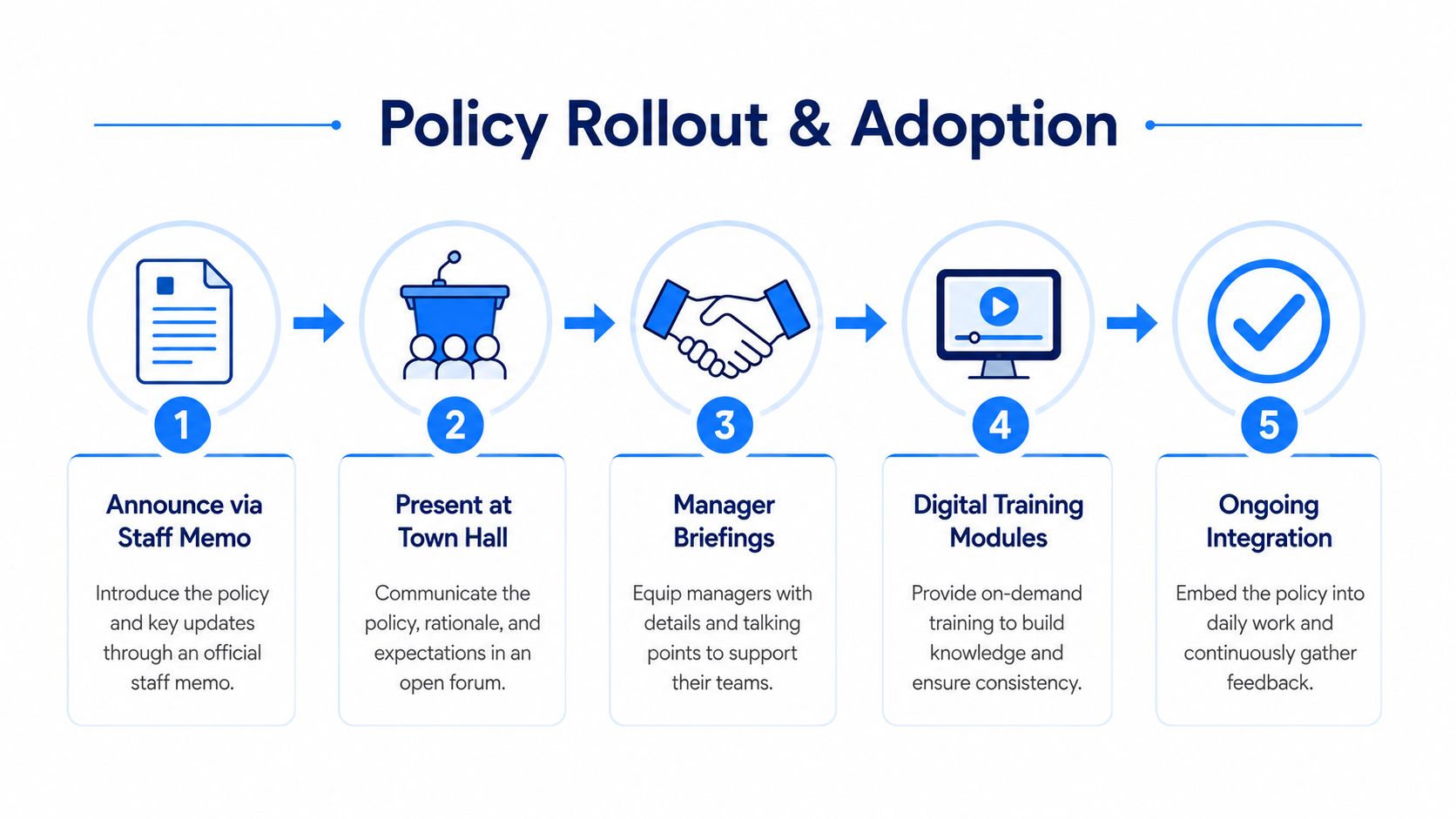
The manager FAQ should answer the same four questions every time. What counts as in scope. Who approves exceptions. Where training lives. How problems get escalated. Keep the tone calm and specific. If the policy is signed and no one knows how to use it, the rollout failed.
Use this checklist before you circulate the final draft.
FAQ
Should the policy cover AI-generated content and third-party widgets? Yes. If it ships to users, it belongs in scope. That includes vendor scripts, templates, PDFs, mobile apps, and AI-produced content.
How often should audit evidence be refreshed? On a fixed cadence tied to release and review cycles. The policy should say when evidence is current, who owns it, and where it's stored.
What belongs in the internal links cluster? The policy home belongs in /compliance, the user-facing disclosure belongs in /statement, and testing evidence belongs in /audit.
What's the core point of the template? To force governance into daily operations so compliance isn't just declared once and forgotten.
If you need a policy that legal can sign, product can follow, and leadership can audit, WebAbility.io gives you the monitoring, reporting, and governance support to keep the document alive after launch. Visit WebAbility.io if you want the policy connected to ongoing scans, evidence capture, and executive reporting instead of sitting in a folder.
Tap to ask AI about this article