Unlocking Your Accessibility Maturity Model for Business Growth

Sidharth Nayyar

TL;DR: An accessibility maturity model is a strategic roadmap for embedding digital inclusion into your organization's DNA. It helps you assess your current capabilities and outlines clear, data-driven steps to advance. By moving from reactive fixes to a proactive, integrated approach, you can enhance user experience, increase conversion rates, and unlock new growth opportunities. The ultimate goal is to transform accessibility from a compliance task into a core business strategy that drives innovation and brand loyalty. Curious where you're starting from? Our free accessibility scanner can give you a quick snapshot.
Why an Accessibility Maturity Model Is Your Strategic Blueprint
Let’s be honest: for a lot of organizations, accessibility is a game of whack-a-mole. A complaint comes in, a bug is found, and a developer scrambles to fix it. This is not only stressful but also incredibly inefficient. An accessibility maturity model offers a way out by giving you the architectural blueprint you were missing.
It provides a clear, structured way to look at your entire accessibility practice, from your code to your company culture. Instead of wondering what to do next, the model helps you see the whole picture. It lays out a clear path from just being aware of accessibility to making it a natural part of how your teams design, build, and innovate. This guide, drawing upon years of first-hand experience in digital strategy and accessibility program management, aims to provide an expert perspective on leveraging this model for tangible business success.
From Cost Center to Growth Engine
Many leaders still see accessibility as just another line item on the compliance budget—a cost to be managed. But that’s a limited view. Adopting a maturity model reframes accessibility as a powerful driver of business growth. As organizations intentionally climb the maturity ladder, they consistently unlock real-world benefits:
- A Better User Experience: When your digital properties are easy for everyone to use, you build trust and fierce customer loyalty.
- Higher Conversion Rates: An accessible website is a usable website. More people can successfully sign up, check out, or contact you.
- Expanded Market Reach: You can genuinely connect with the global disability community, which holds a massive $13 trillion in disposable income.
By viewing accessibility through a maturity model, you transform it from a perceived cost center into a powerful engine for innovation, brand reputation, and commercial success.
Ultimately, a maturity model gives you the framework to make real, measurable progress year after year. To get a better handle on your current standing, a great first step is to schedule a personalized demo. Our experts can help you find your place on the map and plan your journey forward.
The Five Stages of Accessibility Maturity
To make real, lasting progress in accessibility, you first need to know where you stand. An accessibility maturity model is essentially a map for that journey, breaking it down into five clear stages. Think of it like cultivating a garden: you can't go from a patch of weeds to a thriving botanical garden overnight. There are steps along the way.
This model helps you pinpoint your organization's current stage, anticipate the challenges ahead, and identify the concrete actions needed to level up. Each stage marks a huge shift in how your company thinks about, manages, and builds accessible experiences.
Stage 1: Initial
Every journey starts somewhere, and for accessibility, it often begins in firefighting mode. At the Initial stage, accessibility is only on the radar because something went wrong—a customer complaint, a lawsuit, or a failed audit. All efforts are reactive.
- Characteristics: You won't find a formal strategy, a dedicated budget, or an accessibility team. Fixes are slapped on ad-hoc, usually by a few well-meaning people working in silos with zero organizational backing.
- Analogy: This is like finding a bare spot in your yard and tossing a handful of seeds at it, hoping for the best. There's no plan for watering, weeding, or preparing the soil.
Getting out of this stage means admitting that putting out fires isn't a strategy. It’s the moment you decide to stop patching problems and start building something intentional.
Stage 2: Managed
Moving into the Managed stage is where organizations finally start getting organized. There's an understanding that a structured process is necessary, and some resources are set aside to make it happen. This is where the crucial pivot from pure reaction to proactive planning begins.
This shift is all about moving from simply fixing what's broken to creating a blueprint for building things right from the start.
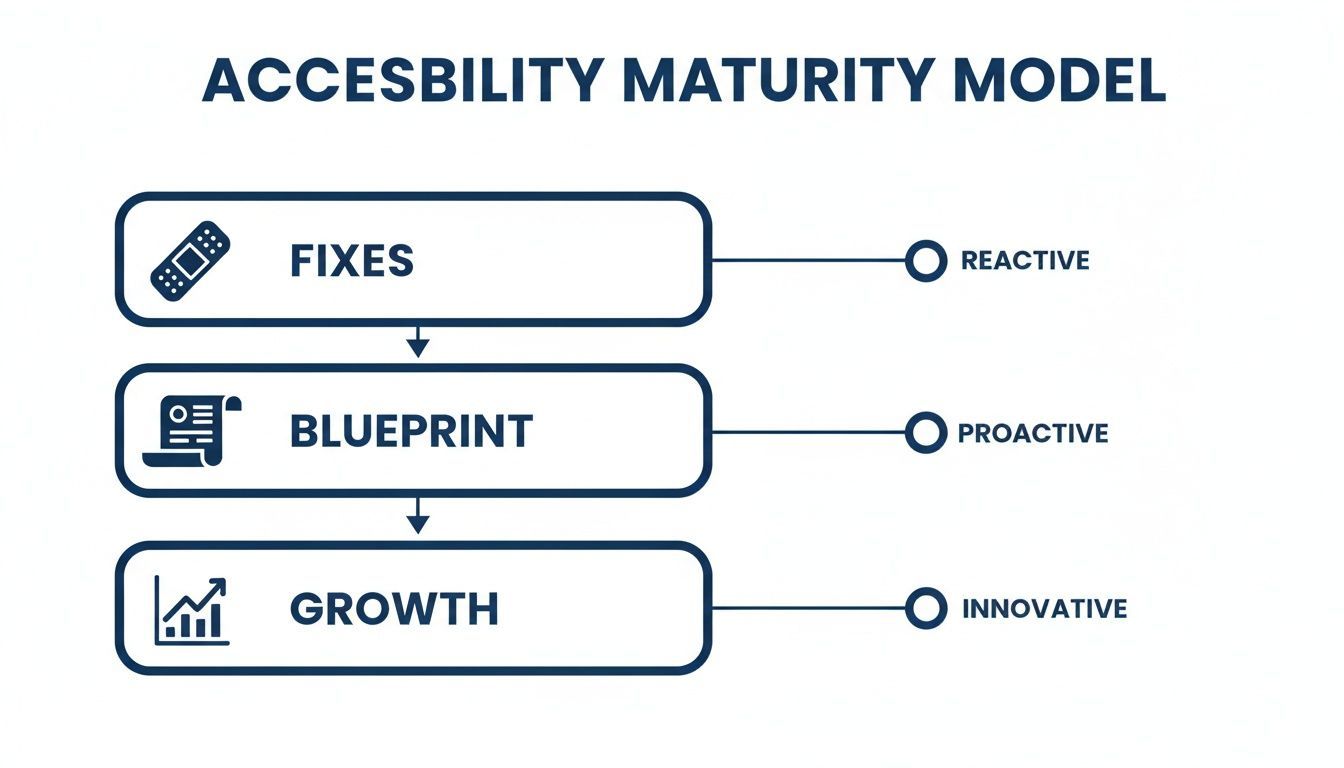
As the image shows, climbing the maturity ladder isn't about working harder—it's about working smarter with a system designed for sustainable success.
- Characteristics: Some projects might have accessibility requirements baked in, and there's probably a basic policy document floating around. The problem is, these practices are totally inconsistent from one team to the next, with no real oversight.
- Analogy: You’ve now tilled a proper garden bed. You remember to water it most of the time and have a vague idea of what you want to plant, but your efforts are still hit-or-miss, and weeds keep finding their way in.
Stage 3: Defined
The Defined stage is a massive turning point. Here, an organization finally documents and standardizes its accessibility process. There's a formal policy that people actually know about, roles are clearly defined, and a real budget is in place.
This is where accessibility stops being a special project and becomes a formal, repeatable part of how you do business. It's no longer about isolated efforts; it's an organizational standard.
This is a huge leap, and frankly, it's where most programs get stuck. In fact, a staggering 95% of accessibility initiatives are mired in the lower stages. Only about 1% make it to this critical third stage where proactive, strategic work truly begins.
Stage 4: Measured
At the Measured stage, accessibility isn't just a defined process—it's managed with data. The organization is now actively tracking the effectiveness of its program with key performance indicators (KPIs).
- Characteristics: Automated scanning, regular user testing, and formal audits are just part of the routine. Teams use data to measure progress, spot trends, and make smart decisions to improve their workflows. Crucially, leadership has a clear view of how the program is performing.
- Analogy: Your garden is now flourishing. You're testing the soil's pH, measuring plant growth, and using that data to create the perfect watering and fertilizing schedule for an amazing harvest.
Stage 5: Optimized
Finally, we arrive at the peak of accessibility maturity: the Optimized stage. At this point, accessibility isn’t just a process; it’s woven into the very DNA of the company. It's a core component of the culture, a driver of innovation, and a central part of the business strategy.
Continuous improvement is simply how things are done. The organization is always looking for new ways to create more inclusive experiences, not just to stay compliant but to gain a competitive edge. Here, accessibility fuels innovation, leads to better products for everyone, and cements the brand's reputation as a leader. Your garden is now a self-sustaining ecosystem that thrives on its own and even produces seeds for new gardens.
Ready to figure out where your organization is on this map? The best way to start is with an expert evaluation. Book a demo with our team to get a clear assessment of your current maturity level and a personalized plan to help you grow.
Key Dimensions for Assessing Your Accessibility Program
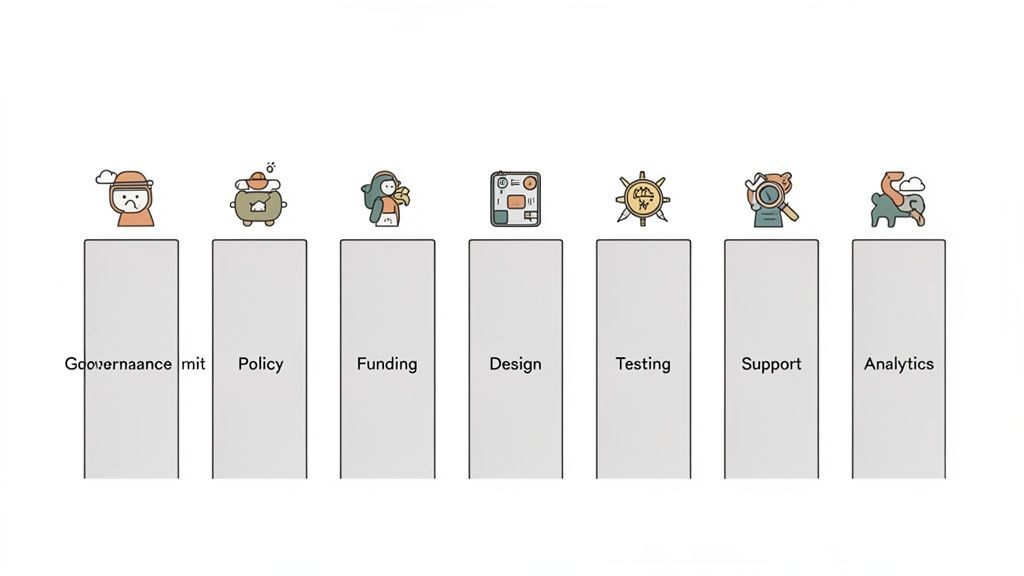
Knowing the five maturity stages gives you a great roadmap for your accessibility journey. But now it’s time to get under the hood. To truly make progress, you have to measure the right things. Think of it like this: your accessibility program is a high-performance engine. You can't just check the fuel gauge; you have to monitor the oil pressure, temperature, and a dozen other systems to keep it running at its peak.
A solid accessibility maturity model helps you do just that by breaking down your entire program into core dimensions. These are the vital signs of your organization's accessibility health. By assessing yourself against these pillars, you move beyond a gut feeling of "we're doing better" and pinpoint exactly where to focus your resources for the biggest impact.
Ownership and Governance
Everything starts with leadership. The first and most foundational dimension is ownership and governance. Our extensive experience has shown countless accessibility initiatives fizzle out simply because no one was truly in charge. This pillar is all about establishing clear accountability and giving people the authority they need to make real change happen.
Strong governance looks like this:
- An Executive Champion: You need a leader in the C-suite who believes in the mission, fights for the budget, and connects accessibility to the company's bottom line.
- A Centralized Accessibility Office (A11yO): This is your command center—a dedicated team or person who owns the strategy and coordinates the work happening across different departments.
- Clear Roles and Responsibilities: Everyone, from designers and developers to marketers and writers, must know exactly what their role is in creating accessible experiences.
If your program is a ship, governance is the captain at the helm. They're the ones charting the course and making sure the entire crew is rowing in the same direction. This is where a platform like WebAbility.io can be a game-changer, offering centralized dashboards and team roles that give leaders the visibility they need to steer effectively.
Policy and Standards
Once you have a captain, you need a map and a rulebook. The policy and standards dimension is where you formalize your commitment and define precisely what "accessible" means for your teams. A well-written policy is the bedrock of consistency.
This isn’t about creating a vague mission statement. It’s about building clear, actionable guidelines that your teams can actually use day-to-day, turning accessibility from a fuzzy ideal into a concrete checklist.
A documented accessibility policy is the single source of truth that aligns your entire organization. It ensures everyone is building to the same standard, eliminating confusion and inconsistency.
To nail down this dimension, you'll want to:
- Create a Formal Accessibility Policy: This is a public document declaring your organization's commitment to building inclusive digital products.
- Define Your Technical Standard: Be specific. State your target—like WCAG 2.1 AA—and provide clear instructions and examples for meeting it.
- Integrate Standards into Workflows: Don't let your standards live in a forgotten folder. Weave them directly into your design systems, developer handbooks, and content style guides.
Fiscal and Risk Management
This is where the rubber meets the road. The fiscal and risk management dimension covers how you fund your program and manage your legal exposure. A mature organization doesn't treat accessibility as an occasional, unexpected expense. It’s a planned, strategic investment.
This pillar is all about being proactive. A great framework for this is the Digital Accessibility Maturity Model, which provides a structured way to evaluate progress across seven key areas, including fiscal management. Adopting such models helps organizations benchmark their efforts and see tangible results. We're already seeing this work at a macro level, with website failure rates slowly ticking down from 96.8% in 2022 to 96.3% in 2023.
Other Core Dimensions of Your Program
Beyond the big three of governance, policy, and funding, a comprehensive accessibility maturity model must also examine four other critical areas:
- Design and Development: How deeply is accessibility baked into your product lifecycle? Are your teams trained and equipped to build inclusive experiences from the very beginning, or is it an afterthought?
- Testing and Validation: How do you find and fix barriers? A robust strategy here involves a mix of automated tools, expert manual audits, and, critically, usability testing with people who have disabilities.
- Support and Documentation: What happens when a user hits a wall? You need a clear, accessible process for them to report issues and get help. Your product documentation should be accessible, too.
- Procurement: Are you accidentally buying inaccessible tools? This pillar ensures you evaluate third-party software for accessibility before you purchase it, preventing you from importing new problems into your ecosystem.
Building Your Roadmap with the Right Tools
So you've done the self-assessment and you know where your organization stands. That's a great start. But theory only gets you so far. An accessibility maturity model is just a map—you still need a vehicle to actually make the journey.
This is where the right tools come in. A modern accessibility platform is what translates your strategic goals into real, day-to-day progress, turning your roadmap from a document into a living, breathing plan.
Establish Your Baseline Instantly
Before you can plan a route, you need to know exactly where you are on the map. Instead of guessing or relying on subjective feelings about your accessibility, platforms like WebAbility.io give you that starting point with hard data.
Think of it like an initial diagnostic. Automated scanning and compliance dashboards evaluate your digital assets against WCAG standards, instantly giving you a baseline maturity score. This isn't a vague estimate; it's an objective look at your current state.
This first pass provides a full inventory of your accessibility problems, neatly sorted by severity. It finally answers the big questions: "How big is our problem?" and "Where on earth do we start?" This kind of clarity is what helps an organization climb from the Initial stage to the Managed stage.
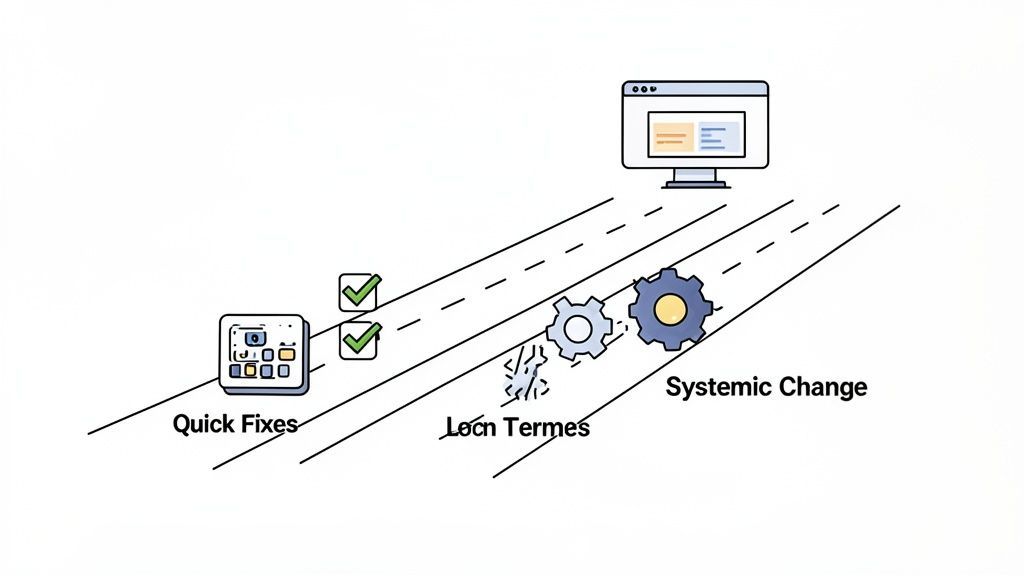
As you can see, a solid strategy isn't just about one thing. It's about handling quick fixes, long-term systemic problems, and everything in between, all from one central place. This balanced approach is the key to moving up the maturity ladder faster.
Chart Your Progress with Historical Reporting
Once your baseline is set, the real work begins—and you need to prove it's paying off. This is where historical trend reporting becomes your best friend. A single audit report is just a snapshot in time; trend reporting is the movie of your accessibility journey.
It’s how you build momentum and make the case for continued investment. By tracking key metrics over time, you can:
- Show a decrease in critical errors: This is the kind of KPI that gets leadership’s attention. It’s tangible proof that you're reducing risk.
- Monitor compliance scores: Watching your overall accessibility score climb is a powerful motivator for the whole team.
- Identify recurring issues: Are the same types of bugs popping up again and again? Trend reports help you spot patterns, pointing directly to gaps in developer training or design processes that need to be fixed.
Effective reporting transforms accessibility from a series of one-off fixes into a measurable business function. It provides the data needed to justify budgets, secure resources, and prove the ROI of your efforts to stakeholders.
This data-driven focus is the hallmark of organizations moving into the Measured and Optimized stages. The conversation shifts from a reactive "Are we compliant?" to a proactive "How are we improving, and what can we do better?"
To show how this works in practice, the table below connects specific platform features to the maturity dimensions we've been discussing. It’s a clear illustration of how the right tool doesn’t just find problems—it actively builds your program's capabilities.
Mapping Key Platform Features to Maturity Dimensions
| Maturity Dimension | Supporting Platform Feature | How It Helps |
|---|---|---|
| Governance & Policy | Centralized Dashboards & User Roles | Creates a single source of truth, allowing you to assign specific responsibilities and track accountability across teams. |
| Knowledge & Skills | Code-Level Remediation Guidance | Provides developers with "in-context" learning, showing them not just what is wrong but how to fix it properly. |
| Communication | Automated Reporting & Trend Analysis | Delivers consistent, data-backed updates to stakeholders, proving the program's value and building momentum. |
| Technology & Tools | Dev-Workflow Integrations (e.g., Jira, CI/CD) | Embeds accessibility checks directly into the development lifecycle, preventing new issues from being introduced. |
| Process & Operations | Prioritization Filters (by severity, impact) | Helps teams focus on the most critical fixes first, ensuring resources are applied where they matter most for users. |
As you can see, each feature is designed to address a specific organizational need. By putting these tools to work, you're not just fixing bugs; you're systematically embedding accessibility into your culture and operations.
A Two-Pronged Strategy for Accelerated Growth
The most successful accessibility programs we've seen don't choose between quick wins and deep, systemic fixes—they do both at the same time. This two-pronged strategy delivers a better user experience immediately while you build a foundation for sustainable, long-term accessibility.
First, you can tackle immediate user-facing problems. AI-powered solutions can add an accessibility layer, offering features like screen reader adjustments and text customization. This gives visitors the ability to adjust the experience to their needs right away, scoring an important quick win while you work on the underlying code.
Simultaneously, your development team gets to work on the deep, code-level fixes. Using the detailed analytics and remediation guides from your accessibility platform, they can resolve issues at the source. This is the systemic work that ensures your digital products are "born accessible," cutting down on future rework and technical debt. It’s the long-term play that moves you toward the highest stages of maturity. To support this effort, you can explore various accessibility tools for websites designed for everyone from developers to content editors.
This combination of immediate relief and deep-code remediation is what makes an accessibility platform a true command center. It allows you to manage both streams of work in a coordinated way, ensuring every action is a deliberate step toward greater maturity and a genuinely inclusive experience for everyone.
How to Measure Success and Demonstrate ROI
Proving your accessibility program is working is the single most important step in making it a permanent part of your business. If you can’t show that your efforts are paying off, any momentum you’ve built will eventually fizzle out. To get lasting buy-in from leadership, you have to speak their language—the language of results and return on investment (ROI).
The key is to measure what matters right now. As you move through the accessibility maturity model, your focus will shift, and so should your metrics. This is how you change the conversation from seeing accessibility as a burdensome cost to recognizing it as a smart investment that reduces risk, opens up new markets, and builds a stronger brand.
Matching KPIs to Your Maturity Stage
The metrics you track in the beginning will look very different from the ones you use once your program is well-established. Trying to measure everything at once is a recipe for frustration. Instead, align your key performance indicators (KPIs) with your current maturity level to show meaningful progress.
Think of the early days as triage—you're focused on building a stable foundation and tackling the most urgent risks.
- Early Stages (Initial & Managed): Your main job is to get your digital house in order. The KPIs here should be straightforward and technical.
- A steady drop in critical and severe WCAG errors: This is your most direct proof that you're reducing risk.
- An increase in your overall compliance score: Use your platform's dashboard to visualize this upward trend.
- The percentage of new projects that include accessibility requirements: This shows that your new processes are actually being adopted.
As your program becomes more sophisticated, you can shift your focus from technical fixes to tangible business and user impact.
- Later Stages (Defined, Measured, & Optimized): Now you can start measuring efficiency, user experience, and the real-world effects of your work.
- Fewer accessibility-related support tickets: This is a clear indicator of a better user experience and directly translates to lower operational costs.
- Higher task completion rates: Use your analytics to prove that more people, including those using assistive tech, can successfully buy a product or fill out a form.
- Positive feedback and higher user satisfaction scores: Nothing speaks louder than qualitative data from real users who are having a better experience.
Building Compelling Reports for Leadership
Raw data is rarely convincing on its own. You need to weave it into a story that resonates with executives. This is where clear, concise reporting becomes your superpower. An accessibility platform like WebAbility.io can help by generating reports that connect technical progress to bottom-line business value.
A powerful report doesn't just show numbers; it answers the "so what?" question for leadership. It connects a 15% reduction in critical errors to a measurable decrease in legal exposure and a stronger, more inclusive brand.
This focus on structured programs is a clear industry trend. Recent research shows that by 2025-2026, 77% of digital experience professionals reported their companies have a defined policy, a dedicated budget, and an accountable leader. More importantly, these well-governed programs are 57% more likely to adopt AI-powered accessibility tools, proving that a solid foundation unlocks future innovation.
Framing your wins in financial terms can also be incredibly effective. Learning how to calculate marketing ROI can give you a great model for demonstrating the financial return of your accessibility initiatives. For more specific guidance, check out our deep dive on How to Measure the Success of Your Web Accessibility Efforts. By tracking and reporting on the right metrics, you give yourself the evidence needed to make accessibility a celebrated part of your company's success.
Your Next Steps Toward Accessibility Leadership
We've covered a lot of ground, but it all boils down to this: advancing through the accessibility maturity model is a journey, not a sprint. It’s about making consistent, measurable progress. The blueprint is in your hands, but it all starts with one honest question: where are you right now?
Think of the stages and dimensions we explored not as abstract theories, but as signposts on a real-world map. They guide you from simply reacting to problems toward proactively building inclusion into everything you do. Every step you take, no matter how small, creates momentum.
Discover Your Starting Point
The single most important thing you can do now is figure out your baseline. You wouldn't start a road trip without knowing your current location, and the same logic applies here. This initial assessment cuts through the noise and gives you the clarity to focus your energy and resources where they’ll make a real impact.
Achieving accessibility leadership isn't about a single grand gesture. It begins with an honest look at where you are today. That baseline is the foundation for your entire strategy, turning vague goals into a concrete, actionable plan.
Getting this baseline doesn’t have to be some drawn-out, complex project. Modern tools can provide an immediate snapshot of where you stand, helping you move from awareness to action in no time. If you need more guidance, you can also learn from our experts on digital accessibility consulting.
Take Your First Step Today
We want to give you the tools to get moving. Here are three simple ways to take that crucial first step toward creating more inclusive digital experiences right now:
- Get an Instant Assessment: Start a free trial of WebAbility.io for a data-driven look at your current accessibility score and see which critical issues need attention first.
- Talk to an Expert:Book a personalized demo with one of our specialists. We'll walk you through your results and help you map out a practical path for improvement.
- Use a Free Tool: Run your site through our free accessibility scanner for a quick health check. It's a fast, no-strings-attached way to spot immediate opportunities for improvement.
Taking one of these steps will give you the confidence and the data to make your next move, opening up new opportunities for growth and showing a genuine commitment to all of your users.
Frequently Asked Questions
TL;DR: Moving through the accessibility maturity model is a journey of continuous improvement, not a sprint. Your organization's commitment sets the pace, but having the right tools can absolutely accelerate your progress. You can—and should—pair immediate user-facing solutions with deeper, systemic fixes. Ultimately, strong leadership and clear ownership are what truly drive lasting change.
How Long Does It Take to Advance to the Next Maturity Stage?
There’s no magic number here. How quickly you move up the accessibility maturity ladder really depends on your company's size, your budget, how much technical debt you're carrying, and—most importantly—how committed everyone is. From our experience with diverse organizations, small, focused teams can outpace larger corporations due to agility and strong executive backing.
But you can definitely speed things up. Using a dedicated accessibility platform gives you a clear baseline on day one, which helps you prioritize what to fix first and automate ongoing monitoring. This turns a once-overwhelming goal into a series of clear, manageable steps.
The secret to moving faster isn't just about working harder; it's about working smarter. A structured approach, supported by good tools and clear reports, helps you build momentum and show consistent, measurable progress.
Can We Use Accessibility Overlays and Still Advance Our Maturity?
Absolutely. An effective accessibility strategy often involves a multi-layered approach. User-facing solutions like accessibility interfaces provide immediate improvements for website visitors, which is a valuable first step in enhancing the user experience. This directly addresses some goals of the early stages of the accessibility maturity model.
Think of it as a two-track strategy. The user-facing tool provides immediate support while your development team works on the deeper, code-level fixes needed to reach higher maturity. This approach creates a powerful combination for both short-term progress and long-term, sustainable accessibility.
What Is the Most Important Factor for Improving Accessibility Maturity?
Hands down, it's executive buy-in. While you need skilled developers and the right tools, our first-hand experience confirms that nothing truly moves forward without genuine support from the top.
When you have an executive champion in your corner, everything else falls into place. It’s the key to:
- Unlocking a real budget: This is what pays for the tools, training, and people needed to build a successful program.
- Shifting the company culture: Leadership signals that accessibility isn't just a side project—it’s a business priority.
- Ensuring accountability: When leaders are invested, they help establish the governance structures and clear ownership required to get everyone on the same page.
Governance and reporting tools, like those in a platform such as WebAbility.io, are built to demonstrate this value back to leadership, making it easier to show progress and prove the program's worth.
Ready to find out where you stand on the accessibility maturity model? Start a free trial and get an instant, data-driven assessment of your digital assets. Get your free assessment from WebAbility.io
Quick Questions
Tap to ask AI about this article