What Is Digital Access? Your Guide to an Inclusive Digital World

Sidharth Nayyar
TLDR
Digital access ensures everyone, regardless of ability, location, or background, can use the internet and digital resources. It involves four key pillars: reliable Connectivity, affordable devices and services (Affordability), the know-how to use technology (Skills), and websites designed to be usable by people with disabilities (Accessibility). For businesses, creating accessible digital experiences expands market reach, strengthens brand reputation, and ensures legal compliance with standards like the ADA and WCAG.
Decoding The Pillars Of Digital Access
Think of the internet as a massive public library, holding nearly all of the world's information and opportunities. But what good is it if the front doors are locked for certain people, the books are written in a language they don't understand, or the shelves are just too high to reach?
This is exactly the problem digital access aims to solve. It’s not about just handing someone an internet connection. It’s about building the digital ramps, providing the audiobooks, and creating clear signage so that everyone gets to participate on equal footing.
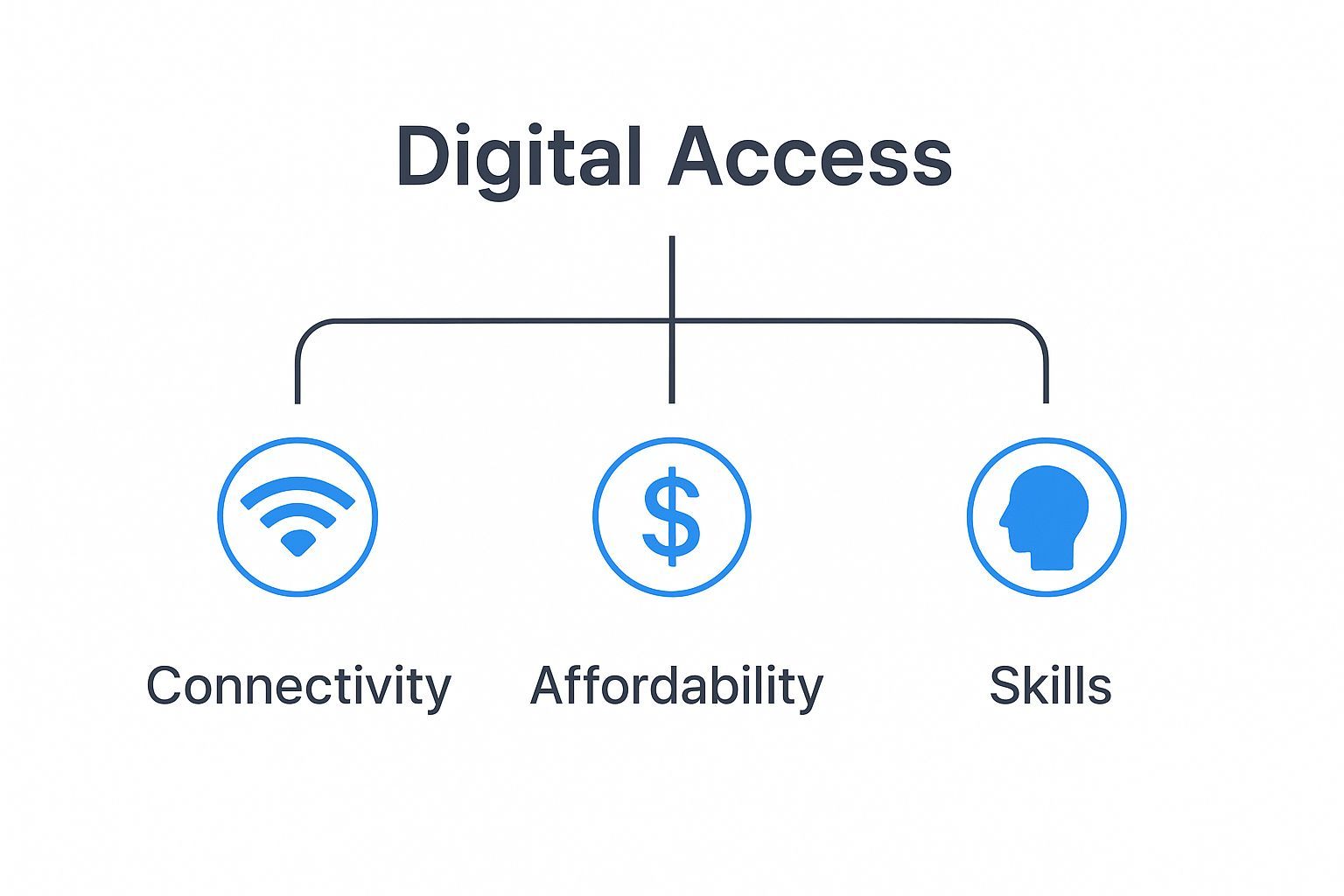
True digital access stands on four critical pillars. If even one of these is weak, the whole structure becomes unstable, and people inevitably get left behind.
The Four Pillars of True Digital Access
To create a truly inclusive online world, we need to focus on four distinct but interconnected components. Each one tackles a specific barrier that can lock people out of the digital opportunities many of us take for granted.
| Pillar | What It Means | Real-World Example |
|---|---|---|
| Connectivity | Having a reliable, high-speed internet connection. | A student in a rural community having stable enough broadband to join a live online lecture without constant buffering. |
| Affordability | Being able to pay for internet service and the necessary devices without it causing a financial strain. | A low-income family finding a reasonably priced home internet plan and a laptop for their kids' schoolwork. |
| Skills | Knowing how to use digital tools effectively and safely. | A senior learning how to use a smartphone to video chat with grandkids or manage their prescriptions online. |
| Accessibility | Websites and apps being designed so that people with disabilities can use them without barriers. | Someone with a visual impairment using a screen reader to navigate an e-commerce site and complete a purchase independently. |
When you see them all together, it becomes clear that just one piece of the puzzle isn't enough. You can have the fastest internet in the world, but it doesn't matter if you can't afford the device to use it or if the websites you visit are impossible to navigate.
Of these four pillars, accessibility is often the one that requires the most intentional effort from businesses and developers. It's an active process of designing and building digital experiences that work for everyone, from the very beginning.
To dig deeper into this crucial pillar, you can explore our guide on what is accessibility on a website. Making that commitment is what truly props the digital door wide open for all.
Why Global Connectivity Is No Longer a Luxury
In our hyper-connected world, we've started treating internet access a lot like electricity or running water. It's not just a nice-to-have anymore; it's a fundamental utility. This is the main line through which we connect with the world, get essential services, and chase new opportunities. Take that away, and you're essentially cutting people off from the fabric of modern life.
Think about what this means for education. A student in a tiny, remote village can now tune into a live lecture from a top-tier university thousands of miles away. That kind of access to knowledge used to be locked behind gates of privilege and geography. Now, those doors are swinging open.
It’s the same story in healthcare. Patients can now chat with specialists over video calls, get prescriptions refilled through an online portal, and even keep an eye on chronic conditions right from their living room. For someone with mobility challenges or who lives far from a clinic, this isn't just about convenience—it's a lifeline.
Economic Empowerment Through Digital Channels
Beyond our personal lives, connectivity is a serious engine for economic growth. A local artisan can set up a simple e-commerce shop and suddenly have a global customer base, turning a side hobby into a full-blown business. The internet tears down old-school market barriers, giving everyone a better shot at success.
The job market has been completely remade by our reliance on digital tools.
- Job Searching: Good luck finding a job without the internet. The overwhelming majority of applications are submitted online, making access a basic requirement for employment.
- Remote Work: The boom in remote work has freed countless professionals from being tied to a specific city, letting them use their skills from anywhere with a decent Wi-Fi signal.
- Skill Development: Need to upskill? Online courses and certifications offer flexible pathways to advance your career, even if you’re already juggling a full-time job.
The Scale of the Digital Divide
While the benefits are obvious, we can't forget that billions of people are still on the outside looking in. The gap between the connected and the disconnected—what we call the digital divide—is creating some serious inequalities. This isn't just about not being able to watch videos; it's about being locked out of the economy, education, and civic participation.
The latest numbers paint a pretty clear picture. As of early this year, roughly 5.56 billion people—that’s about 67.9% of the global population—were online. That's a huge step forward, but it also means 2.63 billion people are still completely offline. These gaps in global connectivity are shrinking, but they’re still significant. You can dig into the full report for more insights on the global state of digital.
The digital divide isn't just about a lack of technology anymore—it's a gap in opportunity. Closing it is about making sure everyone gets a fair shot at participating in society, no matter who they are or where they live.
From Isolation to Inclusion
Picture a senior citizen learning to use a tablet for the first time. Suddenly, they can video chat with grandkids halfway across the world, instantly easing the ache of loneliness and strengthening those family ties. Or imagine someone who doesn't speak the local language using translation apps to access government services, helping them feel more at home in their new community.
Each of these stories highlights a simple truth: digital access is really just a bridge to human connection and a tool for empowerment. When we make universal connectivity a priority, we’re not just building infrastructure; we’re investing in a fairer, more prosperous future for all of us. We're making sure no one gets left behind.
Making the Web Work for Everyone
Having a fast internet connection doesn't mean much if the websites and apps you're trying to use are impossible to navigate. For millions of people, a poorly built website turns a high-speed connection into a digital dead end. This is where the idea of digital accessibility stops being a concept and becomes a hands-on practice.
Think about it like constructing a new public library. You wouldn't just throw up some walls and call it a day. You'd have to follow a strict building code, one that requires things like wheelchair ramps, accessible restrooms, and clear emergency exits. These aren't just nice-to-haves; they’re requirements that make the building safe and usable for every single person who wants to enter.
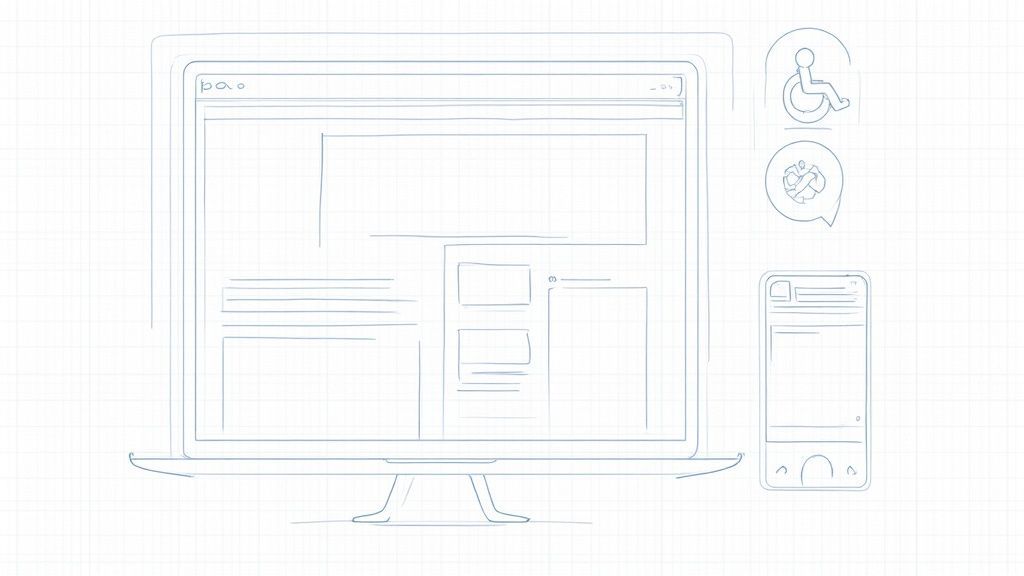
Digital accessibility follows the exact same logic. The internet has its own set of "building codes" that dictate how websites, apps, and software should be put together. These standards are what ensure people with disabilities can browse, understand, and interact with the digital world on their own terms.
The Blueprint for an Accessible Web
When we talk about these digital building codes, the gold standard is the Web Content Accessibility Guidelines (WCAG). Developed by the World Wide Web Consortium (W3C), WCAG is the globally recognized benchmark for making the web accessible. It’s not a vague suggestion list but a detailed framework for creating web content that works for people with a massive range of disabilities.
At its heart, WCAG is built on four core principles, which you can remember with the acronym POUR:
- Perceivable: Can users take in the information? This means providing text alternatives for images and adding captions to videos so the content isn’t lost on someone who can't see or hear it.
- Operable: Can users actually navigate and use the interface? This involves simple things, like making sure the entire site works with just a keyboard, no mouse required.
- Understandable: Is the information and the way the site works easy to comprehend? This is about clear language, predictable navigation, and consistent layouts.
- Robust: Can the content be reliably interpreted by different browsers and, crucially, by assistive technologies like screen readers? Your site needs to be built to modern standards to ensure it plays nice with the tools people rely on.
These aren't just technical details for developers. They are the fundamental pillars of a user experience that truly includes everyone.
Following WCAG is like making sure your digital "building" has the ramps, clear signage, and working elevators it needs. It’s the blueprint that turns a standard website into a welcoming public space.
Legal Frameworks and Why They Matter
Beyond being the right thing to do, digital accessibility is a legal requirement in many parts of the world. These laws don't just suggest best practices; they codify digital access as a civil right.
In the United States, two key laws drive this conversation. The Americans with Disabilities Act (ADA) has long prohibited discrimination in public life, and courts have increasingly ruled that this protection extends to digital spaces. Your website or app can be considered a "place of public accommodation," just like a physical storefront.
Then there's Section 508 of the Rehabilitation Act, which mandates that all federal agencies make their technology accessible to people with disabilities. This covers everything from public-facing websites to internal software, ensuring all citizens have equal access to government services.
These legal standards, paired with guidelines like WCAG, create a powerful mandate. Building an accessible website isn't just about good design; it's a non-negotiable part of legal compliance and social responsibility. And creating a truly inclusive space also means prioritizing privacy for everyone, building a foundation of trust and security.
Together, these frameworks give us a practical answer to the question, "What is digital access?" They provide a shared language and a clear rulebook for making the web finally work for everyone.
Closing the Gaps in Our Digital World
The term "digital divide" can sound a bit academic, but it’s really just a collection of real, everyday roadblocks that keep people from participating fully in modern life. These gaps pop up in places we might not expect, creating genuine hurdles for millions of people.
Think about a senior citizen trying to book a doctor's appointment through a new healthcare app. If the interface is a mess of tiny text and confusing menus, it's not a helpful tool—it's a source of frustration. That's not a personal failure; it's a design failure, and it makes the digital divide wider.
Or consider a family in a rural area where fast, reliable internet is still more of a dream than a reality. Their kids can’t finish online homework, and the parents are locked out of remote work opportunities. For them, the digital world is something they can see but can't quite reach, which only deepens existing economic and educational inequalities.

Unpacking the Barriers to Digital Access
The obstacles standing in the way of true digital access are complex, and they often overlap and make each other worse. Getting a handle on these specific challenges is the first step toward building solutions that actually work.
- Geographic Barriers: Plenty of rural and remote communities still don’t have the physical infrastructure for broadband internet. This leaves people stuck with painfully slow, unreliable connections—if they have one at all.
- Socioeconomic Hurdles: High-speed internet and the devices needed to use it aren't cheap. For low-income households, the monthly bill can force a choice between staying connected and paying for other necessities.
- Skills and Literacy Gaps: Just having a connection isn't enough. Without proper training or support, many people, especially older adults, don't have the skills or confidence to navigate the web safely and effectively.
- Accessibility Failures: When websites and apps aren't designed for everyone, they become dead ends for people with disabilities. This effectively locks them out of online services, information, and commerce.
This isn’t just a local problem; it’s a global one. The gap is stark when you look at the numbers. Only 27% of people in low-income countries have internet access, a sharp contrast to the 93% in high-income nations. This data, which you can explore further in a report on global internet usage on Statista.com, shows just how much work there is to do.
Building Bridges to a More Inclusive Future
Thankfully, the conversation is shifting from just pointing out the problems to creating real, tangible solutions. All over the world, communities, nonprofits, and forward-thinking companies are launching initiatives to close these gaps. Their work proves that with focus and commitment, we can make a real difference.
Bridging the digital divide is an investment in human potential. When we connect one person, we open up a world of opportunities not just for them, but for their entire community.
This is where the real work happens—taking practical steps to tear down the barriers that keep people offline and out of the conversation.
Inspiring Solutions in Action
From local neighborhoods to nationwide programs, some truly effective initiatives are making an impact right now. They’re all focused on one thing: giving people the resources, skills, and tools they need to thrive online.
1. Community Wi-Fi and Municipal Broadband
To tackle the problems of geography and cost, some cities and towns are just building their own networks. These projects often provide free or low-cost internet in public spaces, libraries, and even entire neighborhoods, treating connectivity like a public utility, not a luxury.
2. Digital Literacy and Navigator Programs
A growing number of organizations are creating programs that offer one-on-one help for building digital skills. These "Digital Navigators" act as personal guides, teaching everything from basic computer use to how to search for jobs online. They empower people with the confidence to use technology on their own.
3. Advancements in Assistive Technology
Innovations in assistive technology are leveling the playing field for people with disabilities. Tools like screen readers, voice recognition software, and adaptive keyboards are breaking down barriers, making it possible for everyone to navigate the web with independence and dignity.
Taken together, these solutions light a clear path forward. By tackling the core challenges of infrastructure, cost, skills, and design, we can actively dismantle the digital divide and build a future where everyone has a seat at the table.
Why Smart Businesses Champion Digital Access
Thinking about digital access as just a "nice-to-have" or a box to check for corporate goodwill is a major misstep. It’s actually one of the sharpest, most forward-thinking business strategies you can adopt. When companies get intentional about building inclusive digital platforms, they aren't just doing the right thing—they're gaining a serious competitive edge that fuels growth, builds rock-solid brand loyalty, and shields them from expensive legal headaches.
Viewing accessibility as an investment rather than a cost is the key. It’s a direct line to a bigger market, a better experience for every customer, and a more robust business model. This mindset is what separates the leaders from the laggards.
Expand Your Market Reach
One of the most obvious wins from embracing digital access is the instant market expansion. Globally, over one billion people live with some form of disability. That's a massive, often ignored, group of consumers with real spending power. If your website or app isn’t built for them, you’re basically hanging a "Closed" sign on your digital storefront for a huge chunk of the population.
When you design with accessibility in mind, you're rolling out the welcome mat for all those potential customers. This single decision can dramatically grow your audience and open up new revenue streams that your competitors are likely leaving on the table.
A business that designs for accessibility isn't just widening its welcome mat; it's unlocking a market segment with an estimated disposable income of over $13 trillion globally. This isn't just inclusion—it's intelligent growth.
Build an Unshakeable Brand Reputation
In today’s crowded market, your reputation is gold. Companies that don't just talk about inclusion but actually live it out online earn a kind of trust and loyalty that you simply can't buy with advertising. Customers are smarter than ever; they want to spend their money with businesses that align with their own values of fairness and respect.
When a user with a disability can navigate your site smoothly and independently, you've created more than a customer—you've created a fan. That positive experience builds deep loyalty and generates the kind of authentic, positive word-of-mouth that spreads to their friends, family, and social circles. An inclusive experience sends a clear message: we care about all of our customers.
Mitigate Serious Legal and Financial Risks
Putting aside the market and brand benefits for a moment, there's a very practical, dollars-and-cents reason to get this right: legal compliance. Laws like the Americans with Disabilities Act (ADA) are now consistently applied to digital spaces, and the number of web accessibility lawsuits has been climbing year after year.
Getting hit with one of these lawsuits is a nightmare. They bring crippling legal fees, costly settlements, and court orders forcing you to fix your site on someone else's timeline. Beyond the financial drain, they can do lasting damage to your public image. The smartest move is to invest in accessibility proactively. It's about future-proofing your business by aligning with clear legal standards from the start.
Ultimately, this approach shows that accessibility boosts more than just your website's UX and sales; learn more about how accessibility boosts your website's UX and sales in our detailed guide.
Your Action Plan for Better Digital Accessibility
Improving digital access is a journey, not a one-time fix. The key is to start with a clear picture of where you are now, then focus on high-impact changes that make a real difference—like adding alt text to images, making sure your site works with a keyboard, and captioning videos. From there, you can lean on helpful tools to stay on track and build a more inclusive experience for everyone.
https://www.youtube.com/embed/e2nkq3h1P68
Moving from knowing about digital access to actually doing something about it is where the magic happens. It’s all about taking practical steps, one at a time, to build a more welcoming online space. Don't worry, this isn't some complex process reserved for huge corporations. Any organization can start making meaningful improvements right away.
The journey starts with a simple question: "Where are we now?" Before you can chart a course forward, you need to understand your starting point. That’s where a digital accessibility audit comes in. Think of it as a comprehensive health check for your website, pinpointing the specific barriers that might be getting in the way for users with disabilities.
An audit usually involves a mix of automated scanning tools and, just as importantly, manual testing by real people to catch the subtle issues that software can miss. The result is a prioritized list of action items, giving your team a clear and manageable roadmap.
Start with High-Impact Best Practices
Once your audit gives you a game plan, you can dive into some of the most critical best practices. These foundational fixes tackle the most common barriers and deliver the biggest bang for your buck in terms of user experience.
Here are three key areas to tackle first:
- Provide Alternative Text for Images: To someone using a screen reader, an image without alternative (alt) text is just a blank space. Adding descriptive alt text explains the context and purpose of every image, making your visual content meaningful to everyone.
- Ensure Full Keyboard Navigation: Many people with motor disabilities can't use a mouse and rely completely on their keyboard. Go through your site and check that every interactive element—links, buttons, forms—can be reached and used with only the Tab, Enter, and arrow keys.
- Caption and Transcribe Media: Every video and audio clip needs synchronized captions and a full transcript. This is non-negotiable for users who are deaf or hard of hearing. A crucial part of this is converting spoken words into text; to learn more about how this works, you can explore the basics of audio transcription and speech-to-text technology.
Making your website accessible isn't about achieving perfection overnight. It's about making a commitment to consistent, incremental progress that builds a better experience for every user over time.
Leveraging Tools for Consistent Improvement
Trying to manage accessibility by hand can feel overwhelming, but you don't have to go it alone. There are plenty of tools that can support your team and help streamline the process, ensuring your site stays accessible as it evolves.
Managed accessibility solutions can provide ongoing monitoring and real-time feedback, helping you catch problems before they become significant issues. These platforms often offer a central dashboard where you can track progress and generate compliance reports, which is invaluable for demonstrating a commitment to inclusion.
You may also come across accessibility widgets that add a layer of user-facing adjustments. These allow visitors to customize their experience with options like different contrast settings or larger text. These tools can work alongside core accessibility efforts to offer additional support and user choice.
By combining a clear strategy with the right tools, you can shift from putting out fires to proactively building an inclusive foundation. For a more detailed walkthrough, check out our guide on getting started with web accessibility. It’s all about taking that first step.
Got questions? Let's clear a few things up. We've covered a lot of ground, and it's natural for some common questions to pop up. Think of this as your quick-reference guide to the most frequent queries we hear.
Your Digital Access Questions Answered
Diving into the world of digital access can feel a bit overwhelming at first. The concepts seem big, but the core ideas are actually quite simple. Let’s tackle a few of the most common questions to make sure everything is crystal clear.
This is all about moving from theory to practice. Once you’ve got these fundamentals down, you’ll have the confidence to take the next practical steps on your own accessibility journey.
What Is the Difference Between Digital Access and Digital Equity?
These two terms are often used in the same breath, but they aren't interchangeable. They're two sides of the same coin, and knowing the difference helps you see the bigger picture.
Digital Access is all about the infrastructure and the tools. Can people get online? Do they have a reliable internet connection, a device to use, and the basic skills to navigate the web? It also means ensuring websites are built so that assistive technologies can actually use them. It’s the "how."
Digital Equity is all about the outcomes. This is the ultimate goal. It's the measure of whether digital access is actually creating a fairer society. Equity asks, "Now that people are online, does everyone have a genuine shot at success?" It's about ensuring a person's background, income, or ability doesn’t limit their opportunities in a digital world.
Here's a simple analogy: access is giving everyone a key to the library. Equity is making sure the library has books in braille, ramps for wheelchairs, and resources that speak to everyone's experiences, so all can learn and grow.
How Much Does It Really Cost to Make a Website Accessible?
This is a bit like asking, "How much does it cost to build a house?" There's no one-size-fits-all answer. The investment depends entirely on the size and complexity of your digital property. A small, five-page informational site will be far simpler to update than a massive e-commerce platform with thousands of dynamic pages.
The primary cost drivers usually are:
- The Initial Audit: First, you need a blueprint. An audit tells you exactly what and where the problems are.
- Remediation Work: This is the actual "construction"—fixing the code, redesigning elements, and adding necessary features.
- Ongoing Maintenance: Accessibility isn’t a "set it and forget it" task. As you add new content and features, you need to ensure they remain accessible.
But framing this as just a "cost" misses the point. It’s an investment. The expense of making your site accessible is almost always dwarfed by the potential cost of a lawsuit or the massive loss of revenue from excluding the 1 in 4 adults in the U.S. with a disability.
Where Is the Best Place to Start My Accessibility Journey?
With so much to learn, it's easy to feel paralyzed. But the starting line is always the same for everyone: start with an audit.
You can't fix a problem you don't understand. A professional accessibility audit gives you a clear, prioritized roadmap. It takes the guesswork out of the equation and shows you the most critical barriers that are blocking users right now. This data-first approach ensures your time and resources are focused where they’ll make the biggest impact, fast.
Ready to turn these answers into action? WebAbility.io provides an end-to-end platform to help you achieve and maintain compliance with confidence. Our AI-enhanced tools and expert services make it simple to start your accessibility journey, from a comprehensive audit to ongoing monitoring. Discover how WebAbility.io can help.
Quick Questions
Tap to ask AI about this article