Your Guide to Web Accessibility Certification

Sidharth Nayyar
TLDR: A web accessibility certification is official proof that your website meets standards like WCAG, making it usable for people with disabilities. The process involves auditing your site, fixing any issues, and getting verified by a third party. This certification helps reduce legal risks (like ADA lawsuits), improves brand reputation, expands your market reach to millions of new users, and enhances the user experience for everyone. To stay certified, you need to practice continuous monitoring and integrate accessibility into your regular workflows.
A web accessibility certification is the official proof that your website meets the standards needed for everyone to use it, including people with disabilities. Think of it as a formal stamp of approval, showing the world your site is inclusive and compliant with key accessibility rules like the Web Content Accessibility Guidelines (WCAG).
Understanding Web Accessibility Certification
Getting a web accessibility certification is about more than just adding a logo to your footer. It’s a powerful signal that your organization is serious about serving all customers. This certification confirms that your website works for people with disabilities, a global community with an estimated $13 trillion in annual disposable income.
Earning that seal of approval involves a thorough audit, followed by fixing any issues found, and finally getting verified against globally accepted standards. The whole point is to make sure your site is easy to navigate and understand for people who use assistive tech, like screen readers or keyboard-only controls.
Of course, to even get to the certification stage, you need to get the basics right. Building your site with website accessibility best practices from the start is the best way to lay a strong foundation.
The Four Pillars of Certification
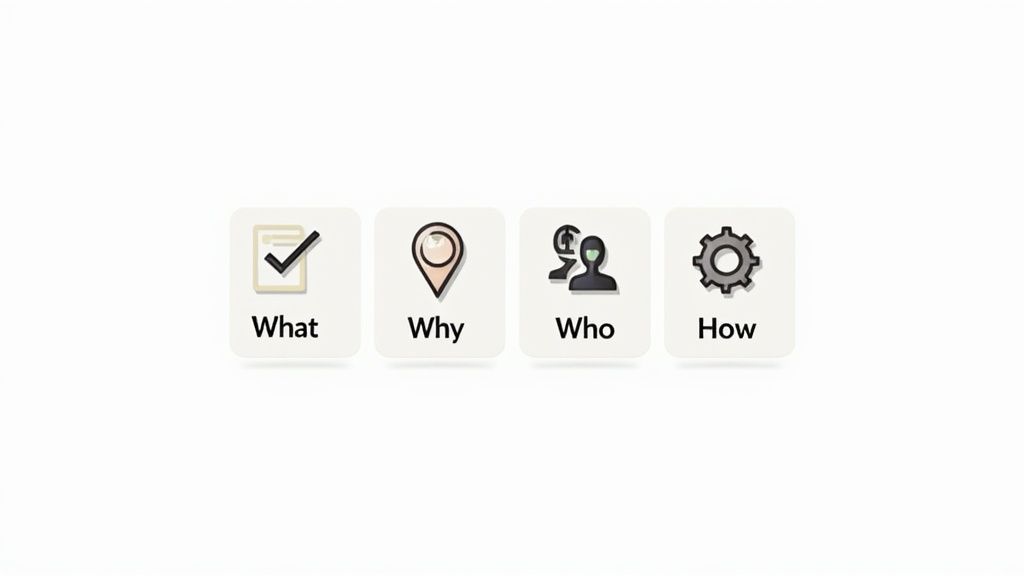
When you boil it down, web accessibility certification really comes down to answering four key questions. Each "pillar" helps you frame your approach and understand exactly what you need to do to create a digital space that works for everyone.
To simplify this, here’s a quick overview of what certification entails.
Web Accessibility Certification at a Glance
| Component | Description |
|---|---|
| What | The formal audit and testing process that proves a website meets specific accessibility criteria, most commonly WCAG 2.1 AA. |
| Why | To lower your legal risk from lawsuits under laws like the ADA, build a positive brand image, and open your doors to a much wider audience. |
| Who | Any organization with a website—from businesses and government agencies to schools and non-profits that need to ensure equal access. |
| How | A multi-step journey: an initial audit identifies problems, your team fixes them, and an independent third party verifies the fixes are complete. |
By thinking through these four areas, you can build a clear and effective plan to not only achieve certification but also maintain a real, lasting commitment to digital inclusion.
In a nutshell:
Getting a web accessibility certification is like putting a "welcome, everyone" sign on your digital front door. It’s a public statement that your website works for all users, including the 1.3 billion people worldwide living with a significant disability. But this is more than just a compliance checkbox; it’s a smart business decision. It builds a brand people trust, opens up a huge, often ignored market, and genuinely improves the online experience for every single visitor. Better experience leads to better engagement, and that's good for growth.
Why Web Accessibility Certification Matters
Let's go deeper than just a simple definition. Think of a web accessibility certification like a building's certificate of occupancy. It's a formal verification that your digital space is functional, safe, and ready to welcome everyone, no matter their abilities. Earning this isn't just a technical exercise—it’s a direct investment in your company's innovation, inclusivity, and future.
When you make this commitment, you send a powerful message. It shows your organization truly values every user, which builds incredible trust and loyalty. In today's market, customers are actively looking to support socially responsible brands. A certification is clear, undeniable proof that you’re committed to digital equality.
Strengthen Your Brand Reputation
A web accessibility certification is one of the most powerful ways to show your commitment to corporate social responsibility. It's proof that you don't just talk the talk—you've taken concrete action. This kind of tangible evidence builds a positive brand image that connects deeply with customers, partners, and even your own employees.
When your site is certified, it tells a story of inclusion. It signals that you're an organization that cares about community and equal access, setting you apart from the competition. For many people, this can be the deciding factor when choosing who to do business with.
By making your digital presence accessible, you are not just complying with standards; you are actively building a more equitable digital world. This dedication to inclusivity fosters a brand identity that is both respected and admired.
Unlock New Market Segments
Globally, the community of people with disabilities represents a massive, and largely untapped, market. With a collective disposable income estimated at over $13 trillion, this group has incredible economic power. If your website isn't accessible, you're essentially putting up a "closed" sign for this huge audience.
A web accessibility certification is your key to opening that door. By making sure your site works for people with visual, auditory, motor, or cognitive impairments, you immediately expand your potential customer base. If you run an e-commerce store, that means more shoppers. If you're a service provider, that means more clients.
And don't forget the ripple effect. The friends, family, and colleagues of people with disabilities are far more likely to support businesses that are inclusive. This multiplies the positive impact on your reach and revenue, making certification a smart financial move.
Improve User Experience For Everyone
Here's something a lot of people miss: the principles of good accessibility benefit every single person who lands on your site, not just users with disabilities. Time and again, we see that accessible design is simply better design. For instance:
Clear Contrast and Readable Fonts: Sure, this is essential for people with low vision, but it also makes your content easier for anyone to read, especially on a phone screen in bright sunlight.
Logical Navigation and Structure: A well-organized site is crucial for screen reader users, but it also helps all visitors find what they're looking for without getting frustrated.
Video Captions: While critical for users who are deaf or hard of hearing, captions are used by an astonishing 80% of viewers who watch videos with the sound off—think crowded coffee shops or quiet offices.
Web accessibility certification also plays a vital role in making digital content usable for neurodivergent individuals. A deeper understanding of autism, for example, highlights how clear and predictable interfaces can significantly improve how people navigate online spaces. By focusing on creating a universally intuitive experience, you cut down on frustration, boost engagement, and improve conversions across your entire audience.
Understanding the Legal Landscape
Think of web accessibility standards as the building codes for the internet. They’re not just helpful suggestions—they're the legal and technical rules that ensure your digital spaces are safe, functional, and genuinely open to everyone.
Without a solid grasp of these rules, you're not just creating a frustrating experience for users with disabilities; you're also opening your organization up to serious legal trouble. Enforcement is getting stricter worldwide, and a formal web accessibility certification is one of the best ways to show you're taking your obligations seriously.
WCAG: The Global Gold Standard
At the core of almost every accessibility law on the planet, you'll find the Web Content Accessibility Guidelines (WCAG). Developed by the World Wide Web Consortium (W3C), WCAG is the universal benchmark for building accessible websites and apps. It’s a detailed technical framework that, when followed, ensures people with disabilities can actually use your digital products.
WCAG is built on four foundational principles, easily remembered by the acronym POUR:
Perceivable: Can users see and hear your content? This means adding text alternatives for images and captions for videos so everyone gets the full story.
Operable: Can users actually navigate and interact with your site? This includes making sure everything works with a keyboard and giving people enough time to complete tasks without being timed out.
Understandable: Is your content and navigation straightforward? It’s about writing clearly, avoiding jargon, and making sure the website behaves in predictable ways.
Robust: Does your site play well with different technologies? Your content needs to be compatible with a wide range of browsers and, most importantly, assistive technologies like screen readers.
For most organizations, the target is WCAG 2.1 Level AA. Hitting this standard is what most web accessibility certification efforts are all about.
Key Accessibility Laws Driving the Need for Certification
While WCAG explains how to make a site accessible, various laws provide the why. Each region has its own legislation, but they all share the same goal: digital equality.
In the United States, two key laws set the standard:
The Americans with Disabilities Act (ADA): Even though the ADA was written before the web was a part of daily life, U.S. courts have repeatedly affirmed that it applies to websites and apps. It treats digital accessibility as a civil right.
Section 508 of the Rehabilitation Act: This law is more specific. It requires all federal agencies to make their technology accessible. Crucially, it also extends to any organization doing business with the federal government or receiving federal funds.
Across the Atlantic, the European Accessibility Act (EAA) is a game-changer. It standardizes accessibility rules for products and services across the entire EU, covering everything from e-commerce sites and banking services to smartphones and computers.
Legal pressure is mounting. With the European Accessibility Act (EAA) enforcement kicking off in mid-2025, Member States are already acting. A €50,000 fine was reportedly issued in Germany before August 2025 was even over. Considering that over 500,000 EU businesses are estimated to fall under the EAA's scope, it's no surprise that the demand for formal proof of accessibility is skyrocketing.
A web accessibility certification acts as proactive evidence of your due diligence. It formally documents your efforts to meet these legal requirements, significantly reducing the risk of costly lawsuits and regulatory fines.
Getting a handle on these regulations is your first step. For a deeper dive into these laws and others around the world, check out our guide on the legal landscape of web accessibility. Once you know what's required, you can build a smart strategy to not only meet the standards but to lead the way in creating a truly inclusive digital world.
Navigating the Certification Process Step by Step
Getting a web accessibility certification can feel like a monumental task, but it’s really just a logical, step-by-step journey. Think of it like building a house: you need a solid blueprint, a thorough inspection, the actual construction, and a final sign-off. The path to digital accessibility follows a surprisingly similar structure, breaking down a big goal into manageable stages.
This roadmap ensures nothing gets missed. It guides your team from the initial planning huddle all the way to the final, formal validation of your hard work. By following these steps, you’re creating a structured game plan for a successful and comprehensive outcome.
The frameworks that drive this process are all interconnected. You have global standards like WCAG that inform regional laws like the ADA and EAA, as you can see below.
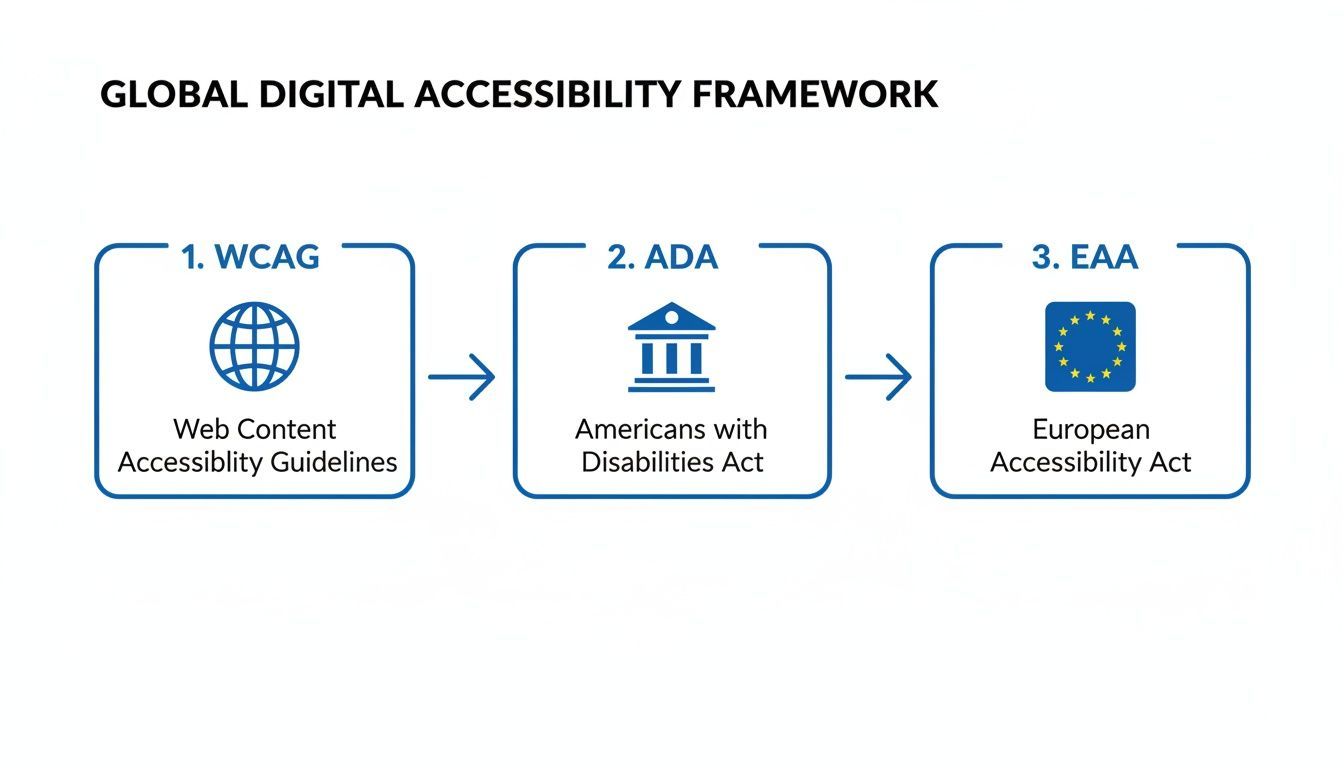
This really just shows how WCAG acts as the technical foundation for most major accessibility laws around the world.
Stage 1: Discovery and Scoping
First things first, you have to draw the lines on the map. You wouldn't start building that house without deciding how many bedrooms it will have. In the same way, you need to decide exactly which parts of your digital footprint are part of this certification effort.
During this phase, you need to nail down the answers to a few key questions:
What's the scope? Are we certifying the entire website, just a critical user flow like the checkout process, or a mobile app?
What's the target? For most organizations, the goal is WCAG 2.1 Level AA. Your specific legal or industry requirements, however, might point to a different standard.
Who's on the team? Get your developers, designers, content creators, and project managers in the same room from the start.
Getting this initial planning right is absolutely critical. It sets clear expectations, helps you budget resources effectively, and creates a realistic timeline for earning your web accessibility certification.
Stage 2: Comprehensive Auditing
With the scope locked in, it’s time for a deep-dive inspection. A proper accessibility audit is more than a quick scan; it’s a forensic investigation to uncover every single barrier that could stop someone with a disability from using your site.
A truly robust audit always uses a two-pronged attack:
Automated Scanning: Specialized tools are great for quickly sweeping your site to catch common, code-level problems like missing alt text or incorrect heading structures. Think of it as the first pass.
Manual Testing: This is where the real magic happens. Human experts, including people who actually use assistive technologies daily, navigate your site to find the nuanced issues that automated tools will always miss—things like confusing workflows or keyboard traps.
To get a better feel for what this entails, our guide on conducting a thorough accessibility audit breaks it all down. This dual approach is the only way to get a complete, honest picture of your site's accessibility health.
Stage 3: Remediation and Fixing Barriers
Now that you have a detailed audit report, it’s time for your team to roll up their sleeves. This is the "construction" phase, where your developers systematically fix every issue flagged in the audit.
This is often the most time-consuming part of the whole process. It involves developers rewriting code, designers tweaking color contrasts, and content writers crafting better descriptions. The work is usually prioritized by severity, so you’re tackling the biggest roadblocks first and making the most immediate impact on usability.
This is where your commitment to accessibility truly comes to life. Every bug fixed and every barrier removed is a tangible step toward a more inclusive and functional digital world for millions.
Stage 4: Verification and Certification
Once your team has worked through the entire list of fixes, it's time for the final sign-off. An independent third party—often the same agency that did the initial audit—comes back in to perform another full review of your site or app.
This verification audit confirms that all the fixes were implemented correctly and that your digital property now officially meets the target accessibility standard. Once you pass this final inspection, you’re awarded your web accessibility certification. It’s the formal proof of your achievement, demonstrating a real commitment to digital inclusion and legal compliance.
This final check has become more crucial than ever as testing gets smarter. For instance, AudioEye’s 2025 Digital Accessibility Index scanned 15,000 websites and found an average of 297 accessibility issues per page in late 2024. That's a huge jump from the 37 issues per page found in 2023, which the report credits to more advanced automated testing. You can read more about these findings and the expanded automated test coverage on AudioEye.com. This data underscores why a structured, four-step process isn't just helpful—it's essential for success.
Choosing Your Path to Certification
So, you’re committed to getting a web accessibility certification. That’s a huge first step. The next critical question is, how do you actually get it done?
There’s no single "right" way to do this. The best path for your organization really boils down to your resources, your timeline, your team's existing skills, and what you're trying to achieve in the long run.
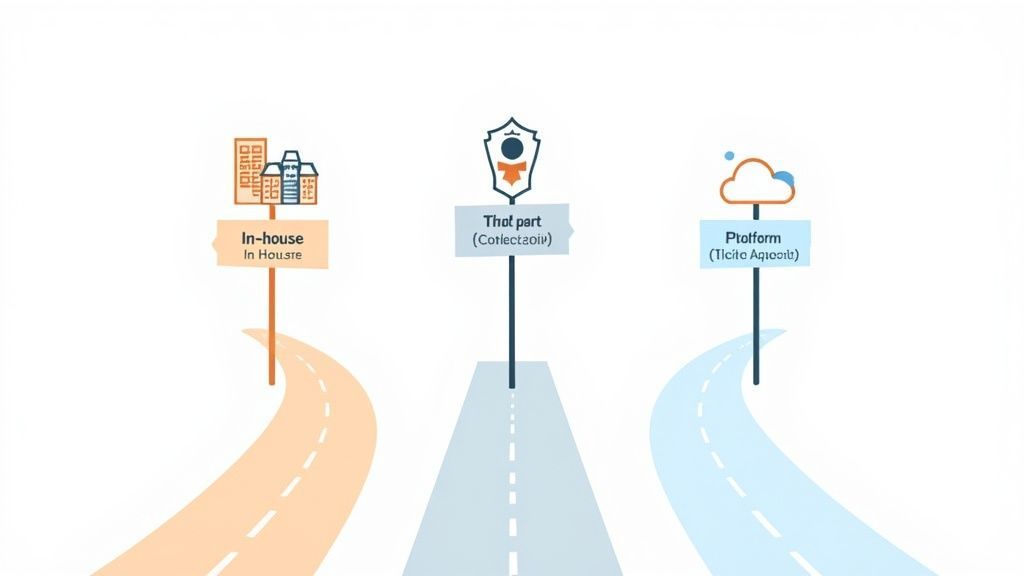
Think of it like deciding how to build a house. You could assemble your own crew and manage every detail yourself (in-house), hire a high-end architectural firm to handle everything (consultants), or use a state-of-the-art modular home builder with proven blueprints (a technology platform). Each path leads to a finished house, but the cost, effort, and timeline are completely different.
Let's break down these three main approaches to see which one makes the most sense for you.
The In-House Program
Going the in-house route means building your own dedicated accessibility team from the ground up. You’d hire or train experts, embed them directly into your design and development cycles, and cultivate accessibility as a core company value. This approach gives you maximum control and builds deep, lasting knowledge within your organization.
But it’s also the most demanding path. You're looking at a significant investment in salaries, ongoing training, and specialized tools. It can take a good while to assemble a team that really knows what it's doing.
Partnering with Third-Party Consultants
A lot of companies choose to bring in specialized accessibility consulting firms. These experts live and breathe WCAG, assistive technology, and the legal landscape. They can run comprehensive audits, provide clear guidance on fixing issues, and train your internal teams to build their own skills.
This gets you instant access to elite expertise without the long-term cost of full-time hires. Consultants also bring an objective, outside perspective that’s incredibly valuable for validation. The main downside is the price tag—expert services aren't cheap, and you'll be reliant on their schedule.
An impartial audit from a third party is almost always required for a credible web accessibility certification. Their validation is the formal proof you need for documents like an Accessibility Conformance Report, which officially details how your site measures up to the standards.
Leveraging a Technology-Driven Platform
The third option is to use a comprehensive accessibility platform. These solutions typically combine automated scanning, real-time monitoring, and guided remediation tools to make the entire certification process more manageable. Everything is tracked in a central dashboard, which is great for seeing progress and staying compliant over time.
This technology-first approach is all about speed and scale. It empowers your existing team to handle accessibility far more efficiently, often at a fraction of the cost of a purely manual effort. The trick is finding a platform that gives you the right mix of automation and expert human oversight, because no tool can ever fully replace human judgment.
Comparing Certification Approaches
To help you weigh the options, this table breaks down the three models and where they shine.
| Approach | Best For | Key Benefit | Potential Challenge |
|---|---|---|---|
| In-House Program | Large enterprises with the resources for a long-term commitment. | Deep organizational knowledge and direct control. | High initial cost and a long ramp-up period. |
| Third-Party Consultants | Organizations needing deep expertise for a complex project or audit. | Immediate access to specialized, objective knowledge. | Can be expensive and creates a dependency on an external team. |
| Technology Platform | Businesses of all sizes looking for an efficient, scalable, and continuous solution. | Cost-effective speed and simplified long-term compliance. | Requires choosing the right platform to ensure full coverage. |
In the end, many of the most successful organizations use a hybrid approach. They pair the efficiency of a technology platform with the high-level strategic guidance of expert consultants. This lets them get the best of both worlds—scalable, day-to-day management backed by deep industry expertise.
Technology's role here is only getting bigger. In 2025, market research found that enterprise adoption of AI-assisted remediation was already hitting 30–35% and climbing fast. This trend points to a massive investment in tools that cut down on manual certification costs while expanding test coverage—part of a market expected to be worth nearly a billion dollars by the early 2030s. Smart tools are making the path to certification more attainable than ever.
Keeping Your Certification Valid: It’s a Marathon, Not a Sprint
Earning a web accessibility certification is a milestone, not a finish line. Websites are constantly changing with new content, features, and code updates. To stay compliant, you need a continuous approach that includes ongoing monitoring, building accessibility into your regular development cycle, and keeping your team sharp. This ensures your site remains accessible and your initial investment continues to pay off.
Getting that web accessibility certification is a fantastic achievement, but it's really just the beginning of the journey. Your website isn't a static document; it’s a living, breathing space. Every new blog post, product update, or design tweak can accidentally put up a new wall for someone.
Think of it like website security. You wouldn't just install a firewall and call it a day, right? You’d monitor for new threats constantly. Accessibility demands that same kind of vigilance to make sure your digital front door is always open to everyone.
This means certification isn't a "one-and-done" deal. It's the start of a real commitment to inclusivity. You need a solid plan to protect the hard work you put in and ensure your website stays compliant as it grows.
Weaving Accessibility into Your Workflow
The smartest way to maintain compliance is to make accessibility a reflex, just another part of your daily work. We call this "shifting left" in the industry, which is just a fancy way of saying you should think about accessibility from the very beginning of a project, not as an afterthought.
When accessibility is baked into your design and development process, it stops being a chore and becomes second nature. This approach stops new problems before they ever go live.
Here are a few ways to make that happen:
Design Reviews: Make accessibility a mandatory checkpoint before any design gets a green light.
Developer Checklists: Give your developers simple, clear checklists to follow as they build new features.
Automated Testing: Plug accessibility scans right into your deployment pipeline to automatically flag obvious errors.
Why Continuous Monitoring is Your Safety Net
Even with the best processes, mistakes happen. That’s where continuous monitoring comes in. Using an automated platform to regularly scan your site helps you catch new issues almost as soon as they appear.
Constant monitoring turns accessibility from a stressful, reactive fire drill into a manageable, proactive routine. It gives you the peace of mind that your site's compliance is being watched 24/7.
This ongoing oversight is what separates short-term wins from long-term success. It helps you spot patterns, fix problems before they spread, and hold onto the high standard you set with your initial web accessibility certification. By creating this rhythm of checks and balances, you build a sustainable culture of accessibility that protects your users and your business.
Getting that web accessibility certification is a huge milestone, but it’s really just the first step on a longer journey. Think of it this way: your website isn't a static brochure; it's a living, breathing part of your business. Every new blog post, product update, or minor code change can unknowingly create new barriers.
It’s a lot like website security. You wouldn't just install a firewall and assume you’re safe forever, right? You'd keep monitoring for new threats. Accessibility demands the same level of constant attention to ensure your digital front door remains wide open for everyone.
This means certification isn't a "one-and-done" checkbox. It's the beginning of a real commitment to inclusivity, and you need a solid plan to protect that initial investment and keep your site accessible as it evolves.
Weaving Accessibility into Your Workflow
The smartest way to maintain compliance is to make accessibility a natural part of your team's routine. In the industry, we often talk about "shifting left," which is just a simple way of saying you need to think about accessibility from the very start of a project, not as a clean-up task at the end.
When accessibility is baked right into your design and development process, it stops feeling like an extra burden and becomes second nature. More importantly, this proactive approach catches potential problems before they ever make it to your live site.
Here’s how you can start doing that:
Design Reviews: Make accessibility a mandatory checkpoint before any new design gets the green light.
Developer Checklists: Equip your developers with clear, straightforward checklists to reference as they build new features.
Automated Testing: Integrate accessibility scans directly into your deployment pipeline to catch obvious errors automatically.
Why Continuous Monitoring is Your Safety Net
Even with the best intentions and processes, things can slip through the cracks. That’s where continuous monitoring comes in as your ultimate safety net. Using an automated platform to regularly scan your site helps you spot new issues almost as soon as they appear.
Constant monitoring transforms accessibility from a stressful, reactive fire drill into a manageable, proactive routine. It gives you the peace of mind that your site's compliance is being watched 24/7.
This ongoing oversight is what separates a temporary fix from long-term success. It allows you to identify patterns, fix small issues before they become big ones, and maintain the high standard you set with your initial web accessibility certification. By building this rhythm of checks and balances, you create a sustainable culture of accessibility that protects both your users and your business.
Frequently Asked Questions
Navigating the world of web accessibility certification can bring up some practical questions. Here, we've gathered clear, direct answers to the most common queries we hear from organizations starting this important journey.
How Much Does Web Accessibility Certification Cost?
The cost of a web accessibility certification can vary quite a bit—there’s no single price tag. It’s like asking, "How much does it cost to build a house?" The answer really depends on the size, complexity, and materials involved.
A few key factors will influence your final cost:
Website Size and Complexity: A simple five-page marketing site will cost far less to audit and certify than a massive e-commerce platform with thousands of pages and complex user interactions.
Your Chosen Approach: A full-service engagement with a top-tier consulting firm will naturally have a higher upfront cost than using a technology platform that empowers your in-house team to do the work.
Current State of Accessibility: If your site is already in good shape, the work needed to get it certified will be much smaller—and less expensive—than fixing a site with deep, foundational accessibility problems.
How Long Does It Take to Get a Website Certified?
Just like cost, the timeline for certification isn't set in stone. The process can take anywhere from a few weeks to several months, depending entirely on the scope of the project and the resources you can dedicate to it.
For a smaller website with a focused team, you might move through the audit and remediation phases quickly, potentially earning certification in under a month. For large, complex enterprise sites, however, the process is much more involved. A thorough audit alone can take weeks, and the remediation work that follows can easily stretch across multiple development sprints, pushing the timeline to six months or more. Ultimately, your team's efficiency and how you prioritize accessibility tasks will be the biggest factors.
Is a Conformance Statement the Same as a Certification?
This is a really important distinction. While they are related, a WCAG conformance statement (often found in a VPAT or Accessibility Conformance Report) is not the same as a formal web accessibility certification.
A conformance statement is essentially a self-declaration. It's your organization’s own detailed assessment of how well your website aligns with WCAG standards. In contrast, a certification is a formal validation from an independent, expert third party. It serves as objective proof that you’ve met the required standards, giving you a much higher level of assurance and credibility.
Ready to start your journey to a more inclusive website? WebAbility.io provides the tools and expert guidance to achieve and maintain your web accessibility certification, reducing risk and opening your brand to a wider audience. Discover our end-to-end platform at https://www.webability.io.
Quick Questions
Tap to ask AI about this article