Can You Use Your Website Without a Mouse?
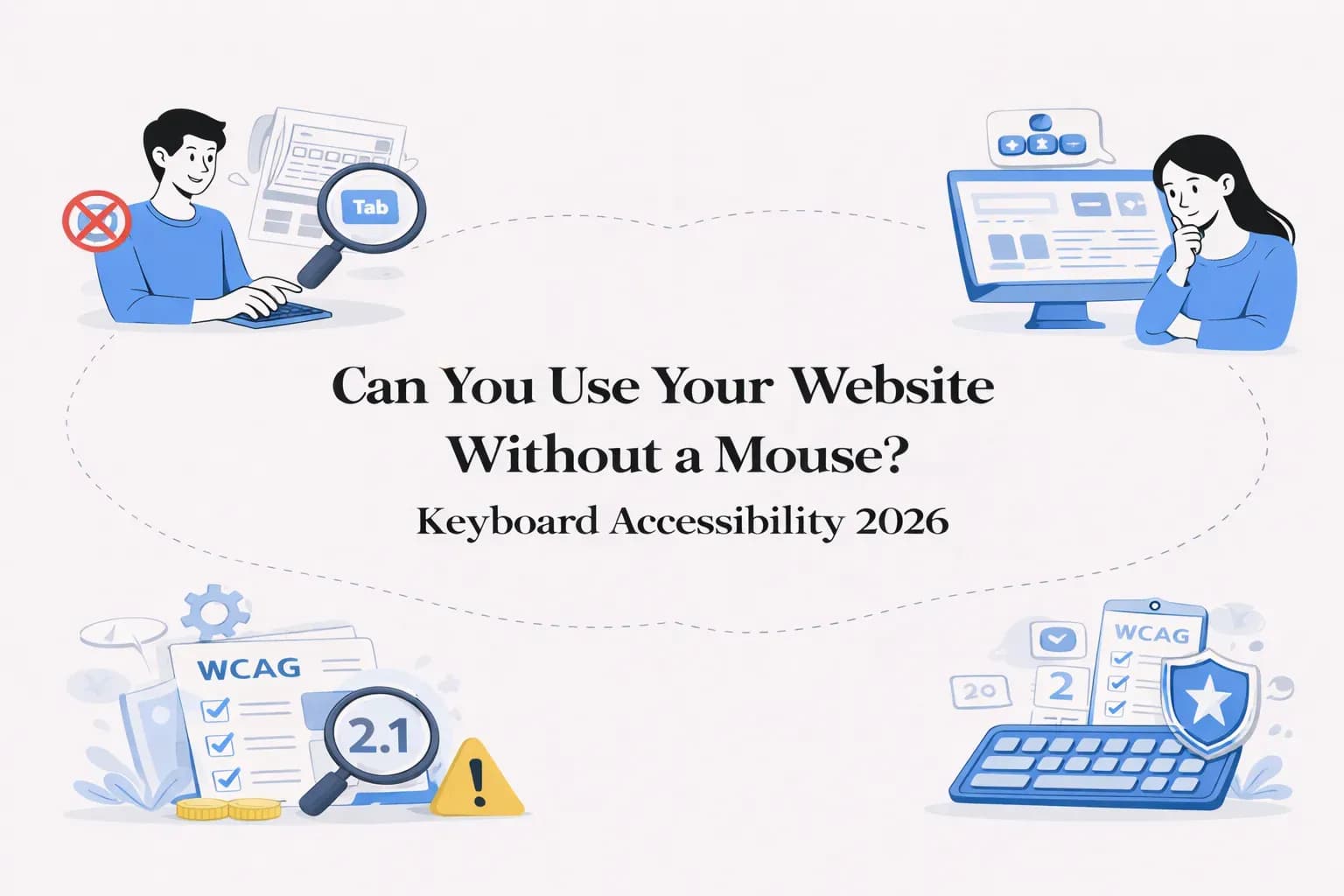
Can You Use Your Website Without a Mouse? Why Keyboard Accessibility Is Non-Negotiable in 2026
Try navigating your website without a mouse.
No clicking. No hovering. Just your keyboard.
If that simple exercise makes your website feel frustrating, slow, or outright broken, you're not alone—and more importantly, neither are your users. Every day, thousands of potential customers encounter websites they cannot fully use—not because they lack intent, but because the experience excludes them.
In 2026, this is no longer just a usability issue. It’s a revenue leak, a compliance risk, and a silent conversion killer.
What Is Keyboard Accessibility?
Keyboard accessibility refers to the ability to navigate and interact with a website using only a keyboard—without relying on a mouse, trackpad, or touch interface.
At its core, this includes:
- A logical tab order that moves through interactive elements in a meaningful sequence
- Clear focus indicators showing where the user currently is
- Fully functional interactive components (buttons, forms, menus) accessible via keyboard inputs
Under WCAG 2.2, keyboard accessibility falls under the principle of Operable—meaning users must be able to interact with all functionality through different input methods.
Direct Answer: A website is keyboard accessible if every interactive element can be accessed, understood, and operated using only keyboard inputs like Tab, Enter, Space, and Escape.
Why This Matters More Than You Think
Most businesses assume keyboard accessibility is only relevant for users with permanent disabilities. That assumption is both outdated and costly.
Yes, users with motor impairments rely on keyboard navigation. But they are not the only ones affected.
Consider the broader reality:
A user with a wrist injury temporarily cannot use a mouse. A remote worker with a malfunctioning trackpad struggles to complete a purchase. A power user prefers keyboard shortcuts for speed and efficiency. A commuter accessing your site on a constrained setup cannot rely on precise cursor movement.
These are not edge cases. They are everyday scenarios.
Keyboard accessibility is not about a niche audience—it’s about ensuring your website works in real-world conditions.
The Hidden Business Cost of Ignoring Keyboard Accessibility
Accessibility issues rarely announce themselves. Instead, they quietly erode performance.
When users cannot navigate your site efficiently, they abandon it. Not because they want to—but because they have to.
This leads to:
- Lower conversion rates as users fail to complete key actions
- Higher bounce rates due to friction-heavy experiences
- Lost revenue from inaccessible checkout flows and forms
- Damaged brand perception as users associate frustration with your business
What makes this particularly dangerous is invisibility. Traditional analytics won’t tell you why users dropped off—only that they did.
Keyboard accessibility issues are often the hidden variable behind underperforming funnels.
Legal & Compliance Risk in 2026
Accessibility is no longer optional from a legal standpoint.
Regulations across the globe increasingly reference WCAG 2.2 as the benchmark for digital accessibility. In the United States, the ADA continues to be enforced through lawsuits targeting inaccessible websites. In Europe, the European Accessibility Act (EAA) is raising the bar for compliance across digital products and services.
Keyboard accessibility is one of the most fundamental requirements within these frameworks.
If users cannot operate your website without a mouse, you are not compliant.
And unlike visual issues, keyboard accessibility failures are easy to prove—making them a frequent target in litigation.
Common Keyboard Accessibility Failures (and Why They Happen)
Most websites don’t fail accessibility intentionally—they fail due to overlooked implementation details.
Some of the most common issues include:
1. Missing Focus Indicators
Users navigating via keyboard cannot see where they are on the page. This makes interaction guesswork rather than guided navigation.
2. Broken Tab Order
When tabbing jumps unpredictably across elements, users lose context and control.
3. Non-Interactive Elements Acting as Buttons
Divs styled as buttons without proper semantics or keyboard support create dead ends for keyboard users.
4. Keyboard Traps
Users get stuck inside modals, menus, or components with no way to exit using the keyboard.
5. Inaccessible Dropdowns and Menus
Navigation systems that rely on hover interactions fail completely without a mouse.
6. Poor ARIA Implementation
Incorrect use of ARIA roles can confuse assistive technologies instead of helping them.
These are not edge-case bugs—they are systemic issues that directly impact usability and compliance.
How to Test Your Website Without a Mouse
You don’t need specialized tools to identify major accessibility gaps. Start with a simple manual test.
Use your keyboard and try this:
- Press Tab to move forward through elements
- Use Shift + Tab to move backward
- Press Enter or Space to activate buttons and links
- Use Escape to close modals or overlays
As you navigate, ask yourself:
- Can I reach every interactive element?
- Is the focus clearly visible?
- Does the navigation feel logical and predictable?
- Can I complete key actions like form submission or checkout?
If the answer to any of these is “no,” your users are already experiencing friction.
Why Accessibility Overlays Won’t Fix This
Many businesses attempt to solve accessibility with overlays or widgets. While these tools may offer surface-level improvements, they do not address core structural issues.
Keyboard accessibility is not a cosmetic layer—it is a functional requirement embedded in your code, design, and interaction logic.
Overlays cannot:
- Fix broken tab order
- Correct semantic HTML issues
- Ensure proper keyboard interaction for custom components
Real accessibility requires real fixes.
How Webability Solves Keyboard Accessibility at Scale
This is where most teams struggle—not in identifying issues, but in fixing them efficiently and at scale.
Webability approaches accessibility differently.
Instead of relying on superficial patches, it combines:
- Advanced accessibility scanning to detect keyboard navigation issues
- AI-powered remediation to resolve structural and interaction problems
- WCAG 2.2-aligned fixes that ensure long-term compliance
The result is not just compliance—but a measurable improvement in usability, engagement, and conversion rates.
Accessibility becomes a growth lever, not just a legal checkbox.
Accessibility Is a Competitive Advantage
Keyboard accessibility is one of the simplest tests—and one of the strongest signals—of whether your website truly works.
If users cannot navigate your site without a mouse, they are not experiencing your product as intended. And in a competitive digital landscape, that gap translates directly into lost opportunity.
The businesses that win in 2026 will not just be accessible—they will be usable, inclusive, and frictionless by design.
The question is simple: Can your website be used without a mouse?
If not, now is the time to fix it.
Quick Questions
Tap to ask AI about this article