Chief Accessibility Officer: A Guide to the 2026 Role

Sidharth Nayyar
Sidharth Nayyar
Ready to make your website accessible? Engage with our team or start a free trial today.
Tap to ask AI about this article
A chief accessibility officer is no longer a symbolic title, and the evidence is already visible in government hiring, enforcement pressure, and workforce data. Canada made the role formal under the Accessible Canada Act, appointed its first CAO, Stephanie Cadieux, in May 2022, and tabled the first annual report in February 2024. That report frames accessibility as a whole-of-society issue for roughly 6.2 million Canadians with disabilities and shows the federal workforce still has room to close a representation gap, with 5.2% of federal public servants self-identifying as persons with disabilities in 2019 versus 9.0% of Canadians with disabilities available for work, rising to 6.2% by 2022 (Canada's first CAO annual report).
That is why CEOs and CHROs should treat the CAO as a cross-functional risk-and-operations executive, not a compliance decorator. If your organization is also trying to manage hiring, workforce policy, and tech governance in parallel, it's worth pairing this lens with understand AI hiring regulations so accessibility doesn't get separated from broader employment risk. For teams operating across jurisdictions, the European Accessibility Act 2025 deadline guide is a useful reminder that accessibility is already becoming a market-access issue, not just an internal policy topic.
The CAO is becoming a board-level function because accessibility now sits at the intersection of market access, legal exposure, workforce inclusion, and product quality. In Canada, Canada's 2025 CAO report shows how quickly accessibility failures surface at scale, with passenger complaints rising from 67 in 2019–2020 to 433 in 2024–2025. That kind of complaint growth tells executives something simple, barriers were already in the system, but the organization lacked enough visibility to catch them early.
The same report shows the problem is concrete, not theoretical. 63% of people with disabilities surveyed encountered a barrier when using federally regulated transportation, and the share was even higher for people with hearing difficulties (78%), physical difficulties (74%), and seeing difficulties (72%) (Canada's 2025 CAO report). For job seekers, the share identifying inaccessible transportation as a barrier fell from 29% in 2017 to 24% in 2022, which is progress, but not a finish line.
A CAO is not just a policy owner. The role is emerging because accessibility decisions now affect who can apply, who can use the product, who can travel, who can get trained, and which vendors make it through procurement. If you're a CHRO, that means accessibility shapes the employee experience and the labor market. If you're a CEO, it means accessibility belongs in execution discipline, alongside quality, compliance, and delivery speed.
Practical rule: if accessibility depends on a quarterly audit, you don't have a program yet, you have a backlog.
The case for a CAO gets stronger when an organization needs one function to coordinate product, IT, HR, procurement, and legal. The better the governance structure, the faster barriers get caught before launch. That is why the role is showing up in 2026 conversations, because the operating environment now penalizes fragmented ownership. And if your organization is trying to sort out hiring controls at the same time, it should also understand AI hiring regulations so accessibility does not get separated from broader employment risk. For teams operating across jurisdictions, the European Accessibility Act 2025 deadline guide is a reminder that accessibility is already becoming a market-access issue, not just an internal policy topic.
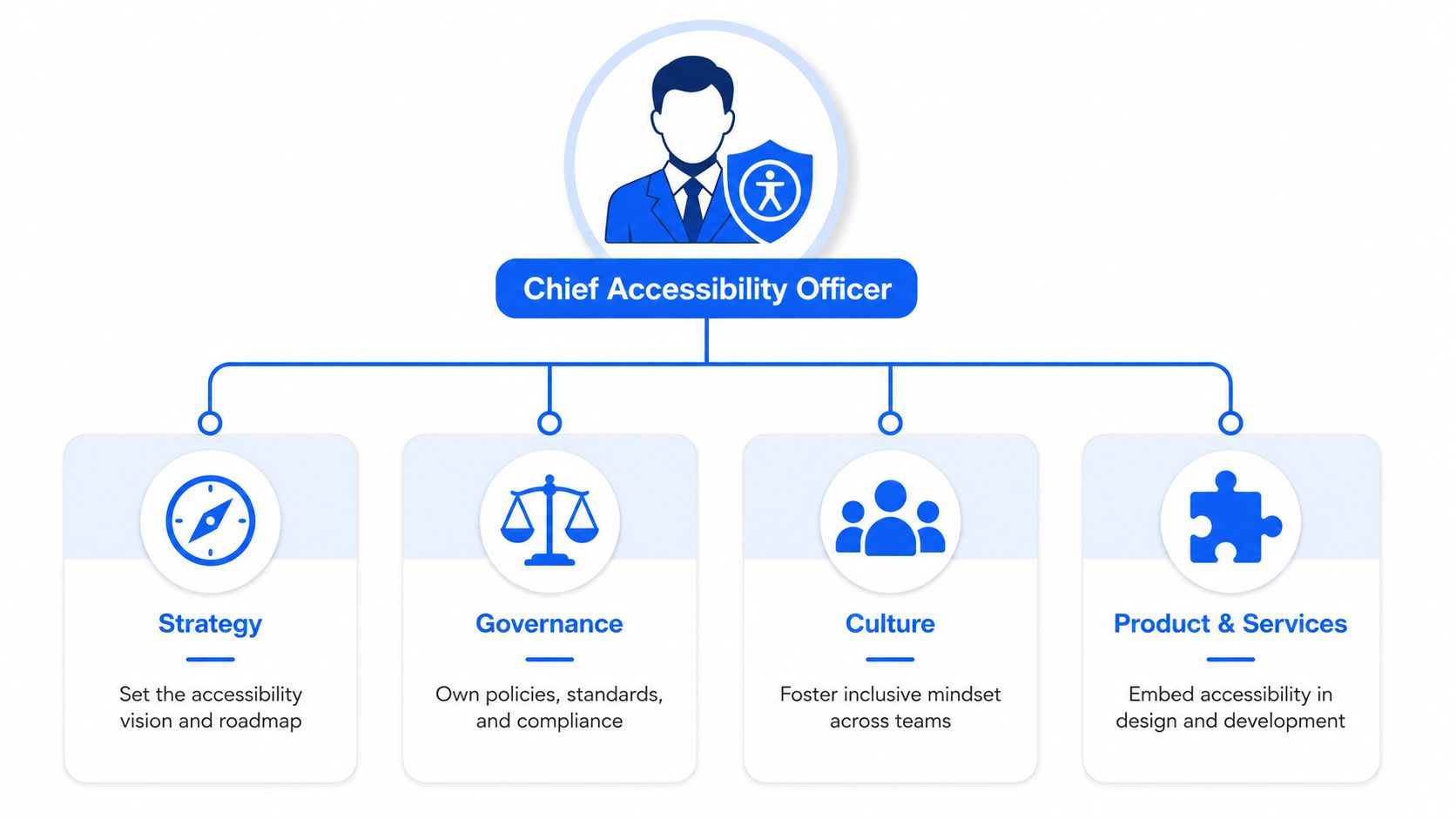
A strong CAO runs the enterprise accessibility system. That means the role sits above isolated checklists and owns how accessibility decisions get made across the business. Public-sector role descriptions frame the office as the focal point for monitoring progress, bringing cohesion across functions, and acting as a convener, collaborator, challenger, and champion for accessibility across the organization (CAO mandate). Read that carefully. The CAO is there to force decisions across product, IT, HR/DEI, procurement, legal, and marketing, not to review finished work after the fact.
The best CAOs move accessibility upstream. They set standards, define the conformance target, and push those requirements into vendor contracts, release gates, training, and budget decisions. Public-sector guidance describes the role as the point person for assessing digital products, coordinating usability and accessibility testing, maintaining exception requests and remediation plans, and ensuring websites, portals, apps, and internal systems meet accessibility standards (CAO delivery guidance). That makes the CAO the control layer for continuous compliance, and it keeps accessibility from becoming a late-stage rescue effort.
The difference between a Head of Digital Accessibility and a CAO is clear. A Head of Digital Accessibility is usually closer to testing, coaching, and product conformance. A CAO owns enterprise governance, so line-of-business leaders cannot treat accessibility as a side preference or a technical nice-to-have.
Accessibility defects cost less when you stop them in procurement and design than when you retrofit after release.
The CAO should own policy, standards, intake, remediation, and executive reporting. In a mature program, the role also ties accessibility to HR practices, supplier review, employee accommodations, marketing review, and product governance. If your organization already has a formal accommodation workflow, the Paradigm International HR risk insights are useful for connecting that process to broader disability risk management, because accommodation and accessibility are often managed as if they were separate problems.
That separation creates avoidable drift. One team handles requests, another team handles product defects, and no one owns the full operating model.
If you want a practical benchmark for enterprise scope, the playbook for Fortune 1000 accessibility is the right reference point. The job is not to own websites. It is to make accessibility a managed operating system across the business.
The reporting line determines whether the CAO has authority or just responsibility. Get that wrong, and the role gets trapped in a compliance silo while product teams, procurement, and HR continue making accessibility decisions without a common owner.
| Reports To | Primary Advantage | Best For | Risk If Mismatched |
|---|---|---|---|
| CEO | Enterprise authority across functions | Organizations that need cross-business coordination and visible executive commitment | The role can become too detached from execution if the CEO doesn't sponsor follow-through |
| CTO | Strong leverage in engineering and procurement workflows | Product-led firms where accessibility failures are mostly digital and release-driven | HR, workplace, and policy work can get underweighted |
| Chief Legal Officer | Tight compliance oversight and risk management | Highly regulated organizations or those under active litigation pressure | The role can drift into defensive review instead of operational change |
| CHRO or DEI leader | Strong culture, training, and workplace inclusion link | Employers prioritizing employee experience, accommodations, and internal policy | Product and vendor governance can become secondary |
If accessibility is a strategic growth issue, put the CAO under the CEO. That gives the role enough authority to challenge business units, procurement, and product owners without asking permission from each of them. If your biggest pain is release quality and digital delivery, the CTO reporting line can work, but only if HR and legal are formally in the operating model. If your organization is primarily responding to risk exposure, the Chief Legal Officer is a workable home, though it should never reduce the CAO to a review queue. If employee inclusion is the first priority, CHRO placement can be right, but only with an explicit mandate to influence product and vendor decisions.
Bottom line: the wrong reporting line makes the CAO polite. The right reporting line makes the CAO useful.
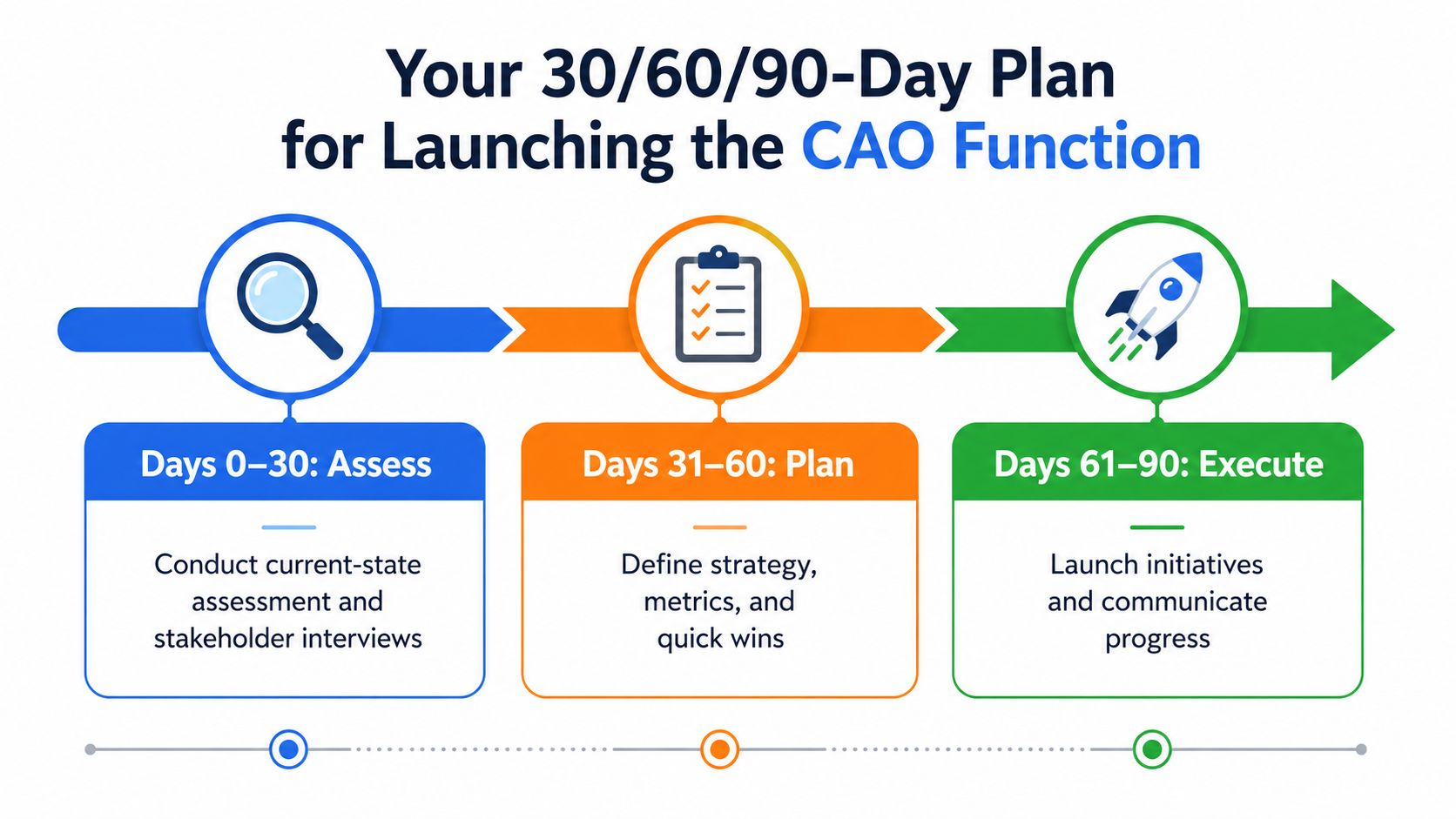
The first 90 days should prove that the CAO can create visibility, set priorities, and move teams. Don't start by promising full remediation. Start by building a clean baseline that executives can manage.
Inventory the current state. That means an accessibility audit, a policy inventory, a quick scan of procurement practices, and stakeholder interviews with product, IT, HR, legal, marketing, and customer support. You need to know where accessibility work already exists, where it's informal, and where no owner exists at all.
The deliverable by day 30 is a short baseline memo with the biggest risk areas, the most visible user barriers, and the systems that require executive decisions. It should also define the conformance target, usually WCAG 2.1 AA or WCAG 2.2 AA, so teams stop arguing about the finish line. If your organization already has tools in place, one option is to pair governance with a monitored remediation workflow, including a platform like WebAbility.io, but only as part of a broader operating model, not as a substitute for it.
Publish KPIs. Focus on metrics executives can understand, such as baseline conformance, open exception volume, remediation backlog, training coverage, and user-testing participation. Build a cross-functional accessibility council with named owners from product, engineering, HR, legal, procurement, and marketing. Give that council a cadence and a decision log.
This is also where you set the first 90-day quick-win program. Pick one visible area, such as a public website flow, procurement intake, or employee onboarding path, and fix it end to end. The goal is not perfection, it's proof that the function can move the organization.
Ship the quick win, communicate the result to executive leadership, and lock the reporting rhythm. By this stage, the CAO should have a repeatable intake process for issues, a remediation tracker, and a monthly update format that surfaces progress and blockers. The most common mistake here is audit paralysis, where leaders keep measuring and never release anything. Avoid that trap.
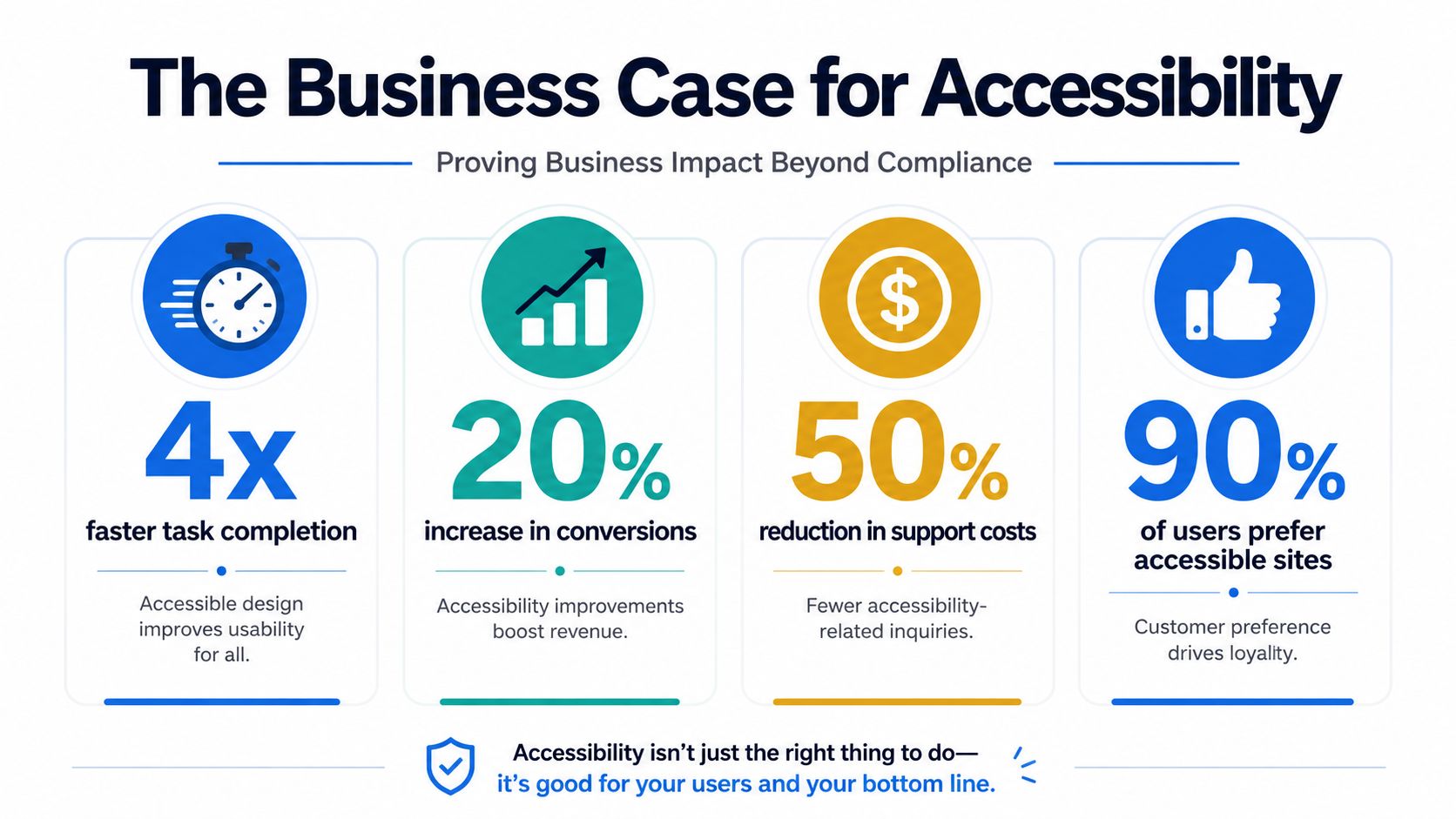
A CAO who cannot prove business impact will be the first thing cut when budgets tighten. The fix is simple, own a small set of metrics and report them every month with the same discipline finance or security would use. Start with the conformance target, then track backlog burn-down, exception volume, training coverage, and user-testing coverage.
The board does not need a wall of accessibility detail. It needs a short operating view that answers four questions, are we reducing risk, are we improving product quality, are we keeping promises to employees and customers, and are we making progress quarter over quarter. The board also needs to see where accessibility sits in the risk register, because that determines whether issues are treated as minor defects or management-level exposure.
Executives should expect the CAO to connect accessibility work to revenue, retention, and support burden only where the organization can measure those links with enough confidence. Do not guess at ROI. Build the reporting model first, then attribute impact carefully. A useful companion is accessibility ROI and risk analysis, which gives leaders a clearer way to separate business value from soft claims.
The earlier Canadian workforce data shows why this matters, because representation and access gaps are measurable, not theoretical (Canada's first CAO annual report). That is the standard a credible CAO should meet internally as well.
Accessibility is a quality system for digital products, services, and internal operations. It protects launch velocity by reducing rework, cuts legal and reputational exposure, and makes it easier for teams to ship without last-minute exceptions. A mature CAO turns that into an operating story executives understand, lower risk, cleaner launches, better employee experience, and fewer surprises after rollout.
Practical rule: if your accessibility dashboard cannot be read by a CFO, it is not an executive dashboard yet.
A strong CAO candidate sounds like a business operator who happens to know accessibility well. They should be fluent in WCAG, EAA, and Section 508, comfortable with program management, able to brief executives without jargon, and credible with disability communities. The role should also require ownership of governance, policy, cross-functional change, and measurable outcomes.
Use language like this:
Compensation should reflect the span of control. For 2026 US hiring, a typical range is $180,000 to $350,000 base plus equity for enterprise, with higher packages at Fortune 500 scale. That range belongs to a true C-suite or near-C-suite operator, not an individual contributor role. If you're hiring a lighter-weight function, pay and scope should step down together.
Ask candidates to walk through a governance failure they've corrected, a time they influenced procurement, and how they measure remediation progress. Press on executive communication, because that's where many technically strong candidates fall down. Ask how they'd prioritize exceptions, how they'd build a council, and how they'd get product, HR, and legal to act without waiting for a crisis.
If you need a starting point for policy language, you can use the WebAbility.io template through use the WebAbility.io template and adapt it to your governance model. The important part is not the template itself. It's whether the person you hire can turn policy into operating behavior.
Not every organization needs a full CAO on day one. If your business is smaller, less complex, or still proving where accessibility risk sits, a lighter governance model can work better. What matters is that ownership is explicit, not informal.
An accessibility council with a rotating chair works well when multiple functions need alignment but no single function has enough scale to justify a new executive role. A distributed accessibility leads model works when product, HR, and procurement each have a named owner and a shared reporting rhythm. A part-time accessibility director can also work if one function, usually product or compliance, is already strong enough to carry the program.
The transition point to a full CAO is clear. Create one when accessibility work spans enough teams that nobody can keep the whole system in view, or when executive reporting needs a single accountable owner. If barriers are showing up in product, employee experience, vendor management, and customer support at the same time, the organization has already outgrown informal coordination.
Don't hire the title before you've defined the operating model.
For many companies, the right first move is a council, a baseline, and a named executive sponsor. For others, especially those with broad product footprints or complex regulatory exposure, the CAO should be created now, with authority that matches the mandate.
WebAbility.io helps teams operationalize accessibility with ongoing monitoring, compliance reporting, remediation workflows, and services that support ADA and WCAG programs. If you're standing up a chief accessibility officer function, visit WebAbility.io to see how its platform and services can support governance, measurement, and sustained progress.