Overview
Website Accessibility Compliance in the UK
If your website is not accessible, your organisation may be violating UK disability discrimination law.
Website accessibility in the UK is governed primarily by the Equality Act 2010, which replaced and consolidated the earlier Disability Discrimination Act 1995 (DDA). Although the DDA is no longer in force as a standalone statute, its legal principles continue under the Equality Act. Many organisations still refer to "DDA website compliance," but today, compliance obligations fall under the Equality Act framework.
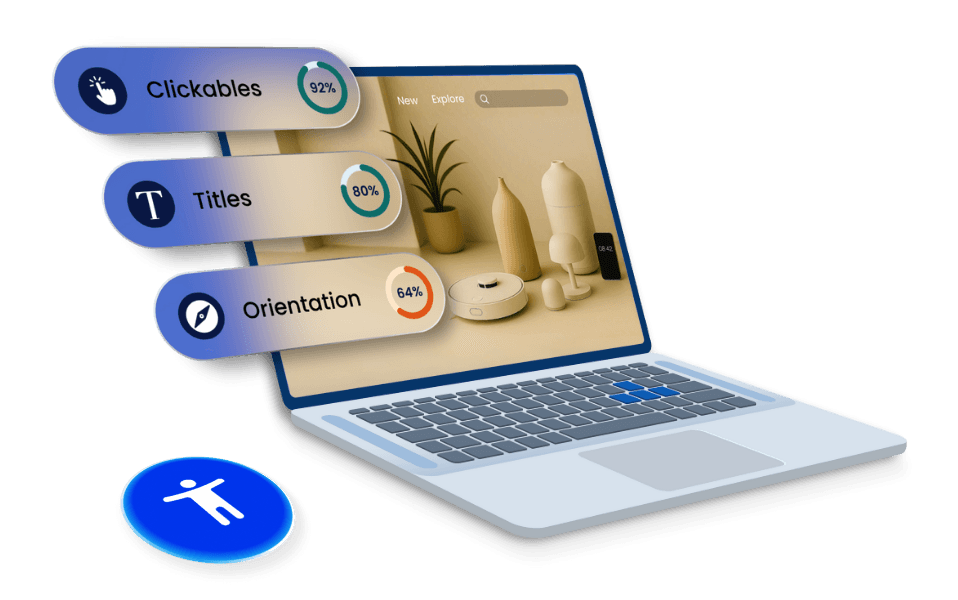
Webability helps organisations achieve structured UK accessibility compliance through WCAG 2.1 / 2.2 audits, remediation planning, accessibility statement support, and continuous monitoring.
- WCAG 2.1 AA–Aligned UK Compliance
- Manual + Automated Accessibility Testing
- Accessibility Statement Guidance
- Legal & Procurement Risk Reduction
Check Your Website for UK Equality Act Compliance
Legal History
What Was the Disability Discrimination Act (DDA)?
The Disability Discrimination Act 1995 was the UK's original legislation prohibiting discrimination against disabled people.
It required organisations to:
- Avoid discriminatory practices
- Make reasonable adjustments
- Ensure equal access to services
Although written before modern digital commerce expanded, courts interpreted "services to the public" broadly, including websites. In 2010, the DDA was repealed and replaced by the Equality Act, but the accessibility obligations continued under the new law.
Legal Foundation
What is the Equality Act 2010?
The Equality Act 2010 consolidated the DDA and other anti-discrimination laws into a single framework.
Under the Equality Act:
- Disability is a protected characteristic
- Service providers must make reasonable adjustments
- Organisations must not place disabled users at a substantial disadvantage
Websites, apps, and digital platforms are considered services to the public. If your website is inaccessible, it may constitute unlawful discrimination.
Legal Requirement
Does UK Law Require Websites to Be Accessible?
Yes.
Under the Equality Act:
- Any organisation providing goods or services to the public must make reasonable adjustments.
- Digital barriers can constitute indirect discrimination.
- Courts consider whether accessibility improvements were reasonably achievable.
Unlike some jurisdictions, enforcement typically occurs through civil claims rather than automatic fines. Proactive WCAG alignment significantly strengthens legal defensibility.
Public Sector
Public Sector Accessibility Regulations (2018)
In addition to the Equality Act, UK public bodies must comply with the Public Sector Bodies Accessibility Regulations 2018.
These regulations require:
- WCAG 2.1 Level AA conformance
- Published accessibility statements
- Feedback mechanisms
- Enforcement procedure references
Monitoring is conducted by the Government Digital Service (GDS). Public sector enforcement is structured and actively monitored.
Technical Standard
What Accessibility Standard Applies in the UK?
UK regulators rely on the Web Content Accessibility Guidelines (WCAG). Public sector bodies must meet WCAG 2.1 Level AA, while private organisations are expected to demonstrate a "reasonable adjustment" that is typically interpreted through WCAG alignment.
Forward-thinking organisations are aligning with WCAG 2.2 to future-proof compliance.
WCAG Alignment
Core WCAG Accessibility Requirements (UK Context)
Perceivable
Information must be presentable in ways users can perceive. Examples include alternative text for images, captions for video, 4.5:1 colour contrast, and resizable text. Contrast issues remain one of the most common accessibility failures.
Alt TextContrastCaptions
Operable
Interface components must be operable by everyone. Examples include full keyboard accessibility, visible focus indicators, accessible interactive components, and no keyboard traps. Keyboard failures frequently disadvantage users with motor impairments.
Keyboard NavFocus Indicators
Understandable
Content and navigation must be clear and predictable. Examples include clear instructions, accessible authentication systems, error guidance in forms, and predictable navigation. Checkout systems and login portals are common risk areas.
Clear InstructionsAccessible Forms
Robust
Content must work reliably with assistive technologies. Examples include screen reader compatibility, valid semantic HTML, and proper ARIA implementation. Improper ARIA usage can create new accessibility barriers.
Screen ReadersARIA
Enforcement
Enforcement & Oversight
The Equality and Human Rights Commission (EHRC) enforces the Equality Act, while public sector monitoring is handled by the Government Digital Service. Structured WCAG conformance strengthens defensibility against the actions below.
Investigations
The Equality and Human Rights Commission can open formal investigations into non-compliant organisations.
Compliance Notices
Regulators can issue notices requiring organisations to remedy accessibility failings.
Legal Proceedings
Individuals can bring civil claims under the Equality Act, seeking damages and remediation.
Public Reporting
Public sector monitoring findings can be published, affecting reputation and trust.
Why It Matters
Why UK Website Accessibility Compliance Matters
1 in 4
of UK people are disabled
Around 16.1 million people in the UK live with a disability, according to Scope.
£274B
Purple Pound spending power
The estimated annual spending power of disabled people and their households in the UK.
75%
walk away over access
Of disabled people and their families have abandoned a business because of poor accessibility.
86%
Improved User Experience
Companies report measurable gains in customer satisfaction after improving website accessibility.
How WebAbility Helps
From first scan to sustained conformance
Audit
Automated scanning, manual testing, keyboard-only validation, screen reader testing, and success criteria mapping.
- WCAG criteria map
- Severity-rated findings
- Evidence library
Prioritize
Issues classified by legal exposure, user impact, and remediation effort to tackle the right things first.
- Risk matrix
- Sprint-ready backlog
- Quick-win shortlist
Remediate
Developer-ready guidance with code patterns, ARIA recipes and pull-request samples.
- Code snippets
- Component patterns
- QA checklist
Validate & Report
Conformance-ready reporting, including VPAT/ACR, accessibility statement, and procurement evidence.
- VPAT 2.5 / ACR
- Accessibility statement
- Audit attestation
Monitor
Continuous scans prevent regression. Catch drift the moment it ships.
- Daily automated scans
- Regression alerts
- Quarterly expert review
Why WebAbility
Why Choose WebAbility for UK Equality Act Compliance
Professional UK Equality Act compliance requires defensible documentation, not superficial overlays. WebAbility's methodology is built on a WCAG 2.2–aligned framework that scales from small businesses to enterprise deployments, combining automated scanning with expert manual testing across keyboard-only and screen reader workflows.
Every audit maps findings to precise WCAG success criteria and produces compliance-grade reporting through transparent reporting dashboards designed for legal and procurement review, with risk-based prioritization so your team addresses what matters most first.
Manual Accessibility Testing
WCAG Success Criteria Mapping
Continuous Compliance Monitoring
Keyboard & Screen Reader Validation
Developer Remediation Guidance
Risk-Based Prioritization
Continuous Compliance
Continuous UK Accessibility Compliance
Accessibility should be treated as an ongoing process rather than a one-time project. Websites constantly change through content updates, new features, design changes, and system integrations. Ongoing monitoring ensures that accessibility improvements remain effective, strengthening compliance, usability, and digital inclusion.
UK Equality Act compliance is a proactive strategy, whether your goal is to prevent litigation, improve usability, expand market reach, or strengthen procurement eligibility. WebAbility can help.
Frequently Asked Questions
Get answers to the most common UK Equality Act compliance questions.