Digital Accessibility in Healthcare: ADA & WCAG Compliance Guide (2026)

Sidharth Nayyar
TL;DR: Digital Accessibility in Healthcare
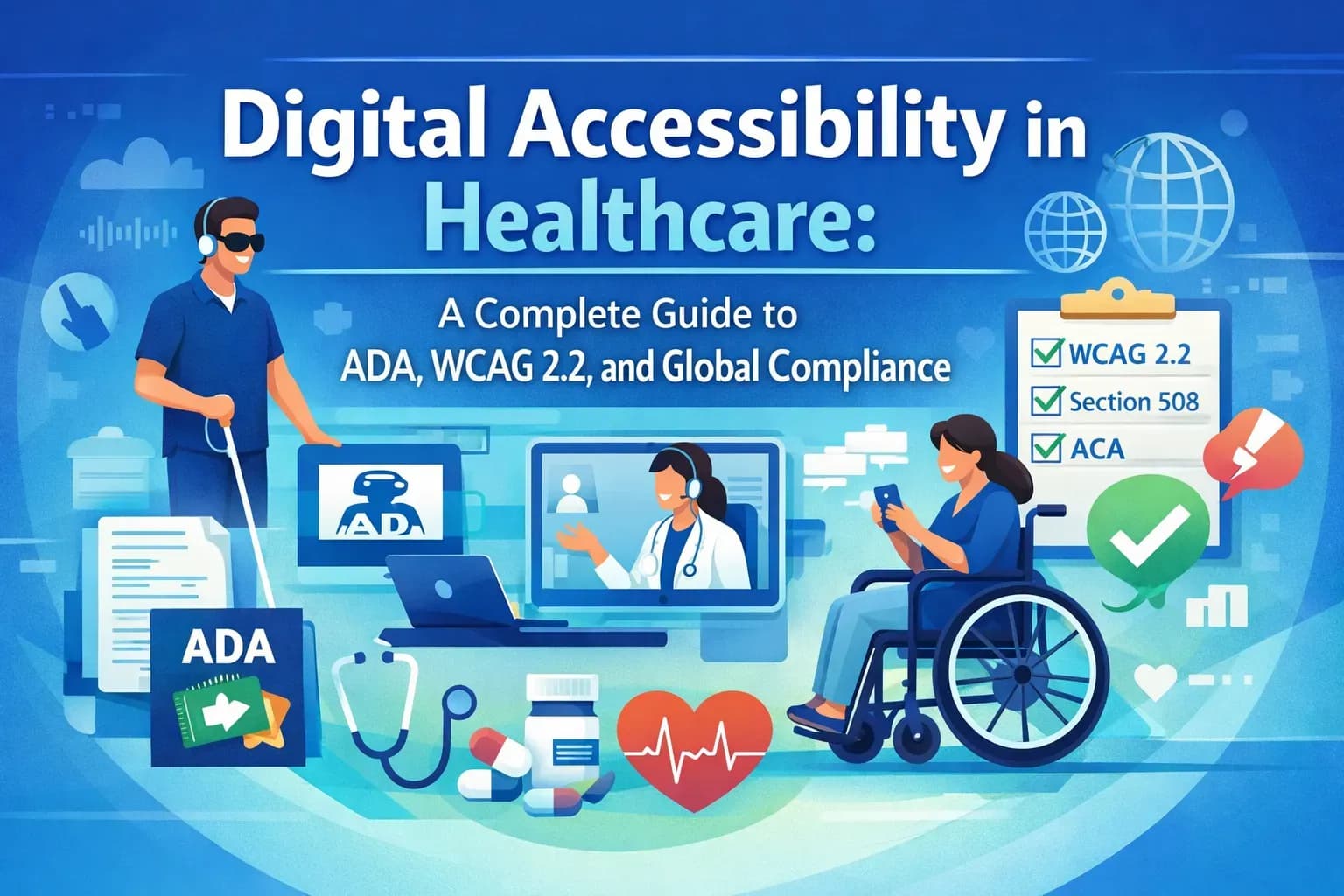
Digital accessibility in healthcare ensures that websites, patient portals, telehealth platforms, and digital medical services are usable by people with disabilities. Accessible healthcare technology allows patients to schedule appointments, access medical records, communicate with providers, and receive care without barriers.
Healthcare organizations must ensure digital accessibility to comply with regulations such as the Americans with Disabilities Act (ADA), Section 508 in the United States, and accessibility laws in countries like Canada and the European Union. These regulations commonly align with the Web Content Accessibility Guidelines (WCAG) 2.2, the global standard for digital accessibility.
Key aspects of healthcare digital accessibility include:
- Designing accessible healthcare websites and patient portals
- Ensuring compatibility with assistive technologies like screen readers
- Providing captions for telehealth services and healthcare videos
- Creating accessible medical forms and documents
- Maintaining proper color contrast and keyboard navigation
Improving digital accessibility helps healthcare providers meet legal compliance requirements, improve patient experience, and ensure equitable access to medical services for millions of individuals with disabilities worldwide.
Healthcare organizations can achieve accessibility by conducting WCAG 2.2 audits, remediating accessibility barriers, and implementing ongoing accessibility monitoring and compliance strategies.
Global Digital Accessibility in Healthcare
Healthcare has rapidly shifted into the digital world. Patients now book appointments online, access medical records through patient portals, attend telehealth consultations, and download medical reports from healthcare websites. While this digital transformation has improved convenience, it has also introduced a critical responsibility: ensuring digital accessibility in healthcare.
For millions of people living with disabilities, inaccessible healthcare websites, patient portals, or telemedicine platforms can create barriers to essential medical services. When digital healthcare platforms fail to meet accessibility standards, patients may be unable to schedule appointments, access prescriptions, or review important medical information.
Digital accessibility is no longer just a best practice—it is a legal, ethical, and operational requirement for healthcare organizations worldwide. Regulations such as the Americans with Disabilities Act (ADA) in the United States, Section 508, the Accessible Canada Act (ACA), and global accessibility standards like WCAG 2.2 are increasingly shaping how healthcare systems deliver digital services.
In this comprehensive guide, we explore what digital accessibility in healthcare means, why it matters, the laws and standards that apply globally, and how healthcare organizations can achieve accessibility compliance while improving patient experience.
What Is Digital Accessibility in Healthcare?
Digital accessibility in healthcare refers to designing and developing digital healthcare platforms so they can be used by all patients, including those with disabilities.
This includes ensuring that healthcare technologies such as:
- Hospital and clinic websites
- Patient portals
- Telemedicine platforms
- Online appointment booking systems
- Medical forms and documentation
- Healthcare mobile applications
can be accessed and used by people who rely on assistive technologies.
Patients with disabilities may use tools such as:
- Screen readers
- Voice navigation software
- Keyboard-only navigation
- Screen magnifiers
- Alternative input devices
If healthcare websites or applications are not designed to work with these technologies, patients may face barriers to accessing medical services.
For example:
- A visually impaired patient may not be able to navigate a hospital website if images lack descriptive alt text.
- A patient with mobility impairments may struggle to book appointments if forms cannot be completed using a keyboard.
- A deaf patient may miss critical information if telehealth videos lack captions.
Digital accessibility ensures that healthcare services remain inclusive, equitable, and usable for everyone.
Why Digital Accessibility Matters in Healthcare
The need for accessible healthcare systems is significant. According to the World Health Organization, more than 1.3 billion people worldwide live with significant disabilities, representing roughly 16% of the global population. Ensuring accessible digital healthcare platforms helps remove barriers that prevent patients from accessing essential medical services. Healthcare accessibility is fundamentally about ensuring that all patients can access medical services without discrimination. However, accessibility also plays a broader role in healthcare systems.
Equal Access to Healthcare Services
Healthcare is a basic human need. When healthcare platforms are inaccessible, patients with disabilities may be unable to:
- Schedule appointments
- Access medical records
- Request prescription refills
- Attend telemedicine consultations
This can directly affect patient outcomes and access to care.
A Large Population Depends on Accessible Healthcare
According to global disability statistics, more than 1 billion people worldwide live with some form of disability. Accessibility is especially important in North America. The Centers for Disease Control and Prevention (CDC) reports that 1 in 4 adults in the United States lives with a disability, meaning millions of patients rely on accessible digital healthcare services to schedule appointments, access medical records, and communicate with providers.
Healthcare organizations that prioritize accessibility ensure that these individuals can receive timely and equitable care.
Digital Healthcare Is Expanding Rapidly
Modern healthcare services increasingly rely on digital platforms, including:
- Online patient portals
- Remote monitoring systems
- Telemedicine consultations
- Digital health records
- AI-driven health tools
Without accessible design, these systems risk excluding vulnerable patient populations.
Accessibility Improves User Experience for Everyone
Accessible design benefits all users, not just those with disabilities. Features such as clear navigation, readable content, captions, and structured layouts improve usability for:
- Older adults
- Patients with temporary impairments
- Individuals using mobile devices
- Users in low-bandwidth environments
Accessibility ultimately leads to better digital experiences for all patients.
Accessibility Laws Affecting Healthcare Organizations
Healthcare providers must comply with several accessibility laws and regulations that govern digital services. These laws vary by country but generally align with global accessibility standards such as WCAG 2.2.
In the United States, healthcare providers must ensure that their services are accessible under the Americans with Disabilities Act (ADA). The U.S. Department of Justice has clarified that organizations covered under the ADA must provide equal access to their digital services, including websites and online platforms.
Healthcare websites carry overlapping obligations: the ADA (public accommodations), Section 508 (for federally funded providers and programs), and accessible patient-facing tools. Meeting them starts with knowing where you stand.
Run a free accessibility scan of your healthcare site against WCAG 2.2 to see the issues in seconds, no signup. For a documented, expert-reviewed audit a compliance officer can act on, see our accessibility audit. For the sector requirements, see Section 508 compliance and our healthcare accessibility solutions.
Americans with Disabilities Act (ADA)
In the United States, the ADA is one of the most influential laws governing accessibility.
Healthcare providers fall under two main ADA categories:
ADA Title II
Applies to public healthcare providers operated by government entities, such as public hospitals and health departments.
ADA Title III
Applies to private healthcare organizations, including:
- Hospitals
- Clinics
- Medical practices
- Diagnostic centers
These organizations must ensure their digital services are accessible to individuals with disabilities.
Although the ADA does not specify technical standards directly, courts and regulatory guidance commonly reference WCAG standards as the benchmark for digital accessibility.
Section 508 of the Rehabilitation Act
Section 508 requires federal agencies and organizations working with the U.S. government to ensure that their digital technologies are accessible.
Healthcare systems affected by Section 508 may include:
- Federal healthcare agencies
- Government-funded health programs
- Healthcare contractors serving federal agencies
Section 508 aligns closely with WCAG accessibility standards.
Accessible Canada Act (ACA)
Canada has introduced comprehensive accessibility regulations through the Accessible Canada Act.
The ACA aims to remove barriers in federally regulated sectors, including digital services. Healthcare organizations operating under federal jurisdiction must ensure their digital systems are accessible to individuals with disabilities.
Many Canadian accessibility initiatives also align with WCAG-based guidelines, making accessibility compliance a growing priority for healthcare organizations across the country.
Global Accessibility Standards: WCAG 2.2
The Web Content Accessibility Guidelines (WCAG) 2.2, developed by the World Wide Web Consortium (W3C), provide internationally recognized standards for making digital content accessible to people with disabilities.
WCAG is built on four core principles known as POUR:
Perceivable
Content must be presented in ways users can perceive.
Examples in healthcare:
- Alt text for medical images
- Captions for health videos
- Proper color contrast for readability
Operable
Interfaces must be usable through different input methods.
Examples:
- Keyboard-accessible appointment booking
- Accessible patient navigation menus
- No time-limited interactions without alternatives
Understandable
Information must be easy to understand and predictable.
Examples:
- Clear instructions for medical forms
- Simple language in patient guidance
- Consistent navigation across healthcare pages
Robust
Content must work with assistive technologies.
Examples:
- Compatibility with screen readers
- Proper HTML structure
- ARIA attributes where necessary
Many modern accessibility regulations now align with WCAG 2.2, which reflects the latest guidance for accessible web design.
Risks of Ignoring Healthcare Website Accessibility
Healthcare organizations that fail to prioritize digital accessibility face significant risks.
Legal Risks
Accessibility lawsuits against healthcare organizations have been steadily increasing, particularly in the United States.
Common claims involve:
- Inaccessible patient portals
- Online appointment systems that cannot be used with screen readers
- Medical forms that are not keyboard accessible
Legal action can lead to costly settlements, remediation requirements, and reputational damage.
Patient Exclusion
Inaccessible digital healthcare systems may prevent patients with disabilities from accessing services. This can result in delayed care, missed diagnoses, and reduced patient engagement.
Healthcare providers have a responsibility to ensure that their digital systems do not create barriers to medical services.
Reputation and Trust Issues
Patients increasingly expect healthcare providers to prioritize inclusivity and accessibility. Organizations that neglect accessibility risk losing patient trust and credibility.
Healthcare institutions that demonstrate commitment to accessibility build stronger relationships with diverse patient populations.
Operational Inefficiencies
Inaccessible systems often lead to increased support requests, manual workarounds, and administrative burdens.
Accessible design reduces friction and improves operational efficiency across digital healthcare platforms.
Common Accessibility Challenges in Healthcare Websites
Healthcare websites and digital platforms present unique accessibility challenges due to their complexity.
Complex Medical Forms
Healthcare forms often contain multiple fields, conditional logic, and validation requirements. If these forms are not properly structured, screen readers may struggle to interpret them.
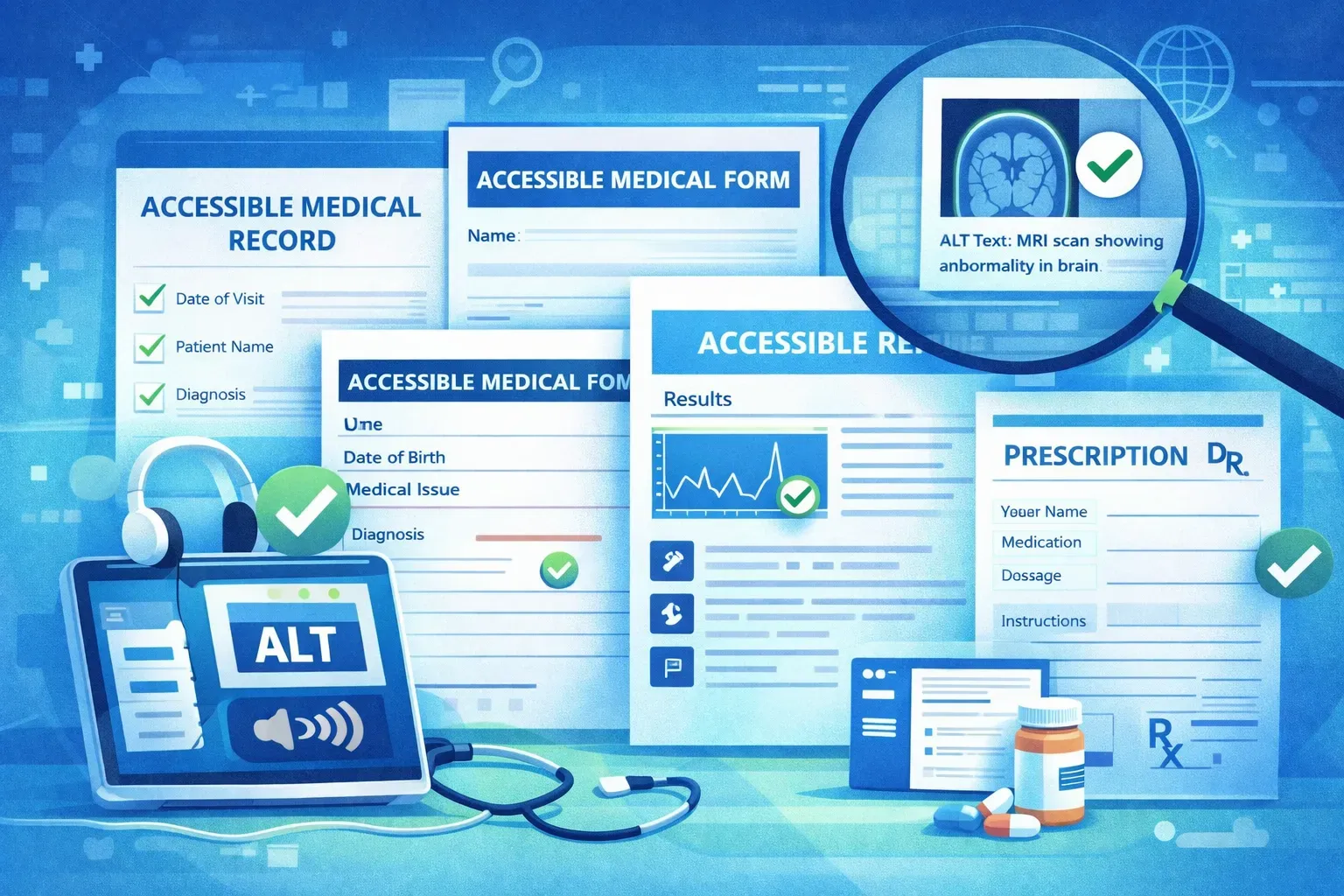
Inaccessible Medical Documents
Healthcare organizations frequently publish documents such as:
- Medical reports
- Insurance forms
- Patient instructions
- Discharge summaries
When these documents are provided as inaccessible PDFs, patients using assistive technologies may be unable to read them.
Poor Navigation Structures
Many healthcare websites contain large amounts of information. Without proper navigation structures, users relying on assistive technologies may struggle to find relevant content.
Insufficient Color Contrast
Healthcare portals often use color-coded systems for alerts, patient information, or appointment scheduling. Poor contrast can make critical information difficult to read.
Telemedicine Accessibility Barriers
Telehealth platforms must consider accessibility features such as:
- Captions for video consultations
- Screen reader compatibility
- Keyboard navigation for controls
Without these features, telemedicine may exclude patients with disabilities.
Best Practices for Healthcare Digital Accessibility
Healthcare organizations can improve accessibility by implementing several best practices.
Design Accessible Patient Portals
Patient portals should support:
- Screen reader navigation
- Keyboard access
- Clear form labeling
- Accessible login processes
Provide Accessible Medical Content
Healthcare content should include:
- Alt text for medical diagrams
- Transcripts for audio content
- Captions for healthcare videos
Ensure Accessible Forms
Medical forms should include:
- Proper labels
- Logical tab order
- Clear error messages
- Accessible validation guidance
Maintain Proper Color Contrast
Text and interface elements must meet WCAG contrast requirements to ensure readability for users with visual impairments.
Test with Assistive Technologies
Accessibility testing should include:
- Screen reader testing
- Keyboard-only navigation
- Magnification testing
- Voice command tools
Regular testing ensures healthcare platforms remain accessible as systems evolve.
Accessibility in Patient Portals and Telehealth
Patient portals and telehealth systems are among the most critical digital healthcare tools.
Accessible patient portals allow users to:
- Schedule appointments
- Access medical records
- Review lab results
- Communicate with healthcare providers
Telehealth platforms must ensure accessible video conferencing tools, allowing patients with disabilities to participate in virtual healthcare appointments.
Telehealth platforms must also support accessibility features such as captions, screen reader compatibility, and keyboard navigation. The U.S. Department of Health and Human Services emphasizes that telehealth services should be accessible to individuals with disabilities to ensure equitable access to healthcare.
Accessibility in these systems directly affects patient engagement and healthcare delivery.
How Healthcare Organizations Can Achieve Accessibility Compliance
Achieving accessibility compliance requires a structured approach.
Step 1: Conduct a Digital Accessibility Audit
A comprehensive audit evaluates healthcare websites and platforms against WCAG standards.
This assessment identifies accessibility barriers affecting patients with disabilities.
Step 2: Perform a WCAG Gap Analysis
Organizations must compare existing digital systems against WCAG 2.2 requirements to determine areas needing improvement.
Step 3: Remediate Accessibility Issues
Accessibility remediation may include:
- Updating website code
- Improving document accessibility
- Redesigning user interfaces
- Implementing ARIA attributes
Step 4: Publish an Accessibility Statement
An accessibility statement demonstrates commitment to inclusive healthcare and provides users with contact options for reporting accessibility barriers.
Step 5: Establish Ongoing Monitoring
Accessibility is not a one-time effort. Continuous monitoring and testing ensure healthcare platforms remain compliant as technologies evolve.
Digital Accessibility Checklist for Healthcare Websites
Healthcare organizations can begin improving accessibility by reviewing the following checklist:
- Ensure all images include descriptive alt text
- Provide captions for healthcare videos
- Make online forms keyboard accessible
- Maintain adequate color contrast ratios
- Ensure logical page structure with headings
- Test patient portals with screen readers
- Provide accessible PDFs and medical documents
- Ensure telehealth platforms support captions and keyboard navigation
Following these practices can significantly improve accessibility for patients.
The Future of Accessible Digital Healthcare
Digital healthcare technologies continue to evolve rapidly. Emerging trends include:
- AI-powered healthcare platforms
- Voice-enabled medical interfaces
- Remote monitoring systems
- Mobile healthcare applications
As healthcare technology expands, accessibility must remain a central priority.
Regulators and policymakers worldwide are increasingly emphasizing digital accessibility. Healthcare organizations that invest in accessibility today will be better prepared for evolving compliance requirements and patient expectations.
Partner with Accessibility Experts for Healthcare Compliance
Ensuring digital accessibility in healthcare requires expertise across web development, user experience, compliance standards, and assistive technology testing.
Healthcare organizations that partner with experienced accessibility specialists can:
- Identify accessibility risks
- Achieve WCAG 2.2 compliance
- Reduce legal exposure
- Improve patient experience
Expert accessibility consulting helps healthcare providers build inclusive digital environments that serve all patients effectively.
Frequently Asked Questions
What is digital accessibility in healthcare?
Digital accessibility in healthcare refers to designing digital healthcare platforms—such as websites, patient portals, and telehealth systems—so they can be used by individuals with disabilities.
Are healthcare websites required to be accessible?
In many regions, healthcare organizations must ensure accessibility under laws such as the ADA in the United States, the Accessible Canada Act, and other international accessibility regulations.
What accessibility standard applies to healthcare websites?
Most accessibility laws reference the Web Content Accessibility Guidelines (WCAG) as the technical standard for digital accessibility.
Why is accessibility important for patient portals?
Patient portals provide access to medical records, appointments, and healthcare communication. If these systems are inaccessible, patients with disabilities may be unable to manage their healthcare effectively.
How can healthcare organizations improve digital accessibility?
Healthcare providers can improve accessibility by conducting accessibility audits, implementing WCAG-compliant design practices, testing with assistive technologies, and maintaining continuous accessibility monitoring.
See how accessible your healthcare site is today. Scan it free against WCAG 2.2.
Sources
World Health Organization – Disability and Health
Centers for Disease Control and Prevention – Disability Statistics
U.S. Department of Justice – ADA Web Accessibility Guidance
U.S. General Services Administration – Section 508
Quick Questions
Tap to ask AI about this article