Maximize Global Accessibility Awareness Day 2026 Impact

Sidharth Nayyar
TL;DR: Your Essential GAAD 2026 Playbook
- What is GAAD? Global Accessibility Awareness Day (GAAD), on the third Thursday of May, is your annual prompt to focus on making your digital services accessible to the one billion people with disabilities worldwide.
- Why is this a massive opportunity? Beyond inclusivity, this is a business growth strategy. An accessible website taps into a $13 trillion disability market, improves user experience for everyone, boosts conversion rates, and enhances brand loyalty.
- How do you start? Don't get overwhelmed. Start with a clear goal. A great first step is running a website accessibility audit to understand your current standing. From there, you can leverage solutions like automated monitoring and user-facing tools to make immediate, meaningful improvements that turn awareness into measurable business wins.
What Is Global Accessibility Awareness Day?
Every year, on the third Thursday in May, Global Accessibility Awareness Day (GAAD) puts a spotlight on digital access and inclusion for people with disabilities. It’s a day for everyone—from developers to marketers—to talk, think, and learn about making the digital world open to all.
For any business leader, GAAD isn't just a calendar reminder. It's an annual opportunity to assess, improve, and demonstrate your commitment to serving every potential customer. Think of it as the starting pistol for your accessibility efforts for the rest of the year.
The initiative began with a single blog post. Back in 2012, web developer Joe Devon wrote about the need for a dedicated day to raise awareness around digital accessibility. Jennison Asuncion, an accessibility professional with extensive experience, saw the post and reached out. Their collaboration led to the co-founding of this global movement. You can read the full story on its Wikipedia page.
Turning Awareness Into a Growth Strategy
When you treat GAAD as an annual kickoff instead of a one-off event, you begin to see accessibility as a powerful growth engine, not just a compliance checkbox. Our experience shows that when a website and its apps are genuinely accessible, it doesn't just widen the audience; it directly impacts the bottom line.
A strategic approach to accessibility yields tangible business benefits:
- A Better Experience for Everyone: Our data repeatedly shows that an accessible website is simply a more usable website. All your users will find it easier to navigate, which keeps them engaged longer and reduces bounce rates.
- Higher Conversion Rates: Removing roadblocks from key user journeys, like your checkout process or a lead-gen form, directly translates to fewer abandoned carts and more completed actions. This is a core tenet of conversion rate optimization (CRO).
- Stronger Brand Loyalty: Demonstrating a genuine commitment to inclusion builds a level of trust and loyalty that advertising campaigns alone cannot achieve. The disability community and their allies are a powerful, vocal market segment that rewards brands who get it right.
A truly accessible experience isn't about meeting a minimum standard. It's about offering a genuinely better, more equitable experience that makes every single visitor feel welcome. That kind of commitment is a powerful way to stand out from your competition.
Weaving accessibility into the fabric of your business makes your digital presence not just compliant, but compelling. To truly excel, it's essential to understand the standards guiding this work. Our expert guide on What is WCAG is the perfect place to build a solid foundation for your GAAD plans and your ongoing strategy.
Beyond Compliance: Why Accessibility Is Your Next Big Growth Channel
For years, many companies have viewed digital accessibility as a box-ticking exercise, a task for the legal department. But this perspective overlooks a massive opportunity. It's time to reframe accessibility from a cost center to what our expert team knows it to be: a powerful engine for market expansion and revenue growth.
Global Accessibility Awareness Day (GAAD) is the perfect annual reminder to evaluate your strategy. Are you merely mitigating risk, or are you actively capturing new market share? This shift in mindset is not just about social responsibility—it's about smart business.
The Market You're Currently Ignoring
Consider this: would you ever intentionally lock the front door of your physical store to 20% of your potential customers? Unlikely. Yet, that's precisely what happens every day on inaccessible websites.
The statistics from industry-wide studies are staggering. An analysis of one million homepages found that 98.1% had at least one detectable Web Content Accessibility Guideline (WCAG) failure. The average page contained a staggering 60.9 errors. This isn't just a technical issue; it's a significant business roadblock.
The Business Case For Accessibility At A Glance
These statistics paint a clear picture of an underserved market and a direct path to ROI. Viewing accessibility through a financial lens reveals just how significant the opportunity is.
| Statistic | Impact/Opportunity | Source |
|---|---|---|
| $13 Trillion | Annual disposable income of people with disabilities and their families. | The Global Economics of Disability |
| 71% | Percentage of users with disabilities who will leave an inaccessible site immediately. | Click-Away Pound Survey |
| 82% | Of customers with accessibility needs would spend more if sites were more accessible. | Click-Away Pound Survey |
| 2-5% | Typical conversion rate lift seen after accessibility improvements. | Forrester Research |
This data isn't just about avoiding lost sales; it highlights a clear demand for inclusive experiences and a loyal customer base waiting to be won. This is a clear signal for a high-potential CRO initiative.
How Accessibility Directly Drives Revenue
Based on our extensive experience helping businesses grow, integrating accessibility into your core strategy fundamentally improves your entire operation. The return on this investment appears in the metrics that matter most to your business.
Here's how this plays out:
- Expanded Market Share: You immediately become a viable option for a huge segment of the population that your competitors are likely alienating.
- A Stronger Brand: Championing inclusion builds incredible brand loyalty. All consumers, not just those with disabilities, view inclusive companies more favorably, enhancing your E-E-A-T signals.
- Better SEO Performance: The fundamentals of accessibility—clean code, proper heading structures, descriptive alt text, and transcripts—are precisely what search engines reward. Better accessibility often leads to better rankings.
- Higher Conversion Rates: When you remove a barrier on a product page or simplify a checkout flow for one user group, you're making it easier for everyone to become a customer.
A change in mindset is all it takes. Every accessibility fix isn't about compliance—it's a conversion rate optimization. You're building a more resilient business and forging a connection with a deeply loyal customer segment.
Putting Inclusive Growth into Action
To seize this opportunity, you need a clear view of your current standing. A comprehensive website audit is the optimal starting point. It moves beyond automated scans to uncover the real friction points that cause users to abandon your site.
Once you have a baseline, tools like WebAbility.io provide the power to manage and measure your progress effectively, connecting theory to action. Start by digging into the core principles of digital accessibility for business and build a roadmap that aligns with your growth targets.
This strategic approach turns GAAD from a simple awareness day into a pivotal milestone, transforming your website from a potential liability into your most powerful asset for inclusive growth.
An 8-Week Playbook For Your GAAD 2026 Initiative
Executing a meaningful Global Accessibility Awareness Day initiative requires more than good intentions. It demands collaborative planning, cross-team alignment, and a clear vision of success. We've mapped out an eight-week timeline, based on years of expert implementation, to guide your team toward a high-impact GAAD campaign.
It’s easy to view accessibility as a compliance hurdle, but that's a limited perspective. A genuine commitment for GAAD is not just about risk avoidance—it's a strategic business opportunity.
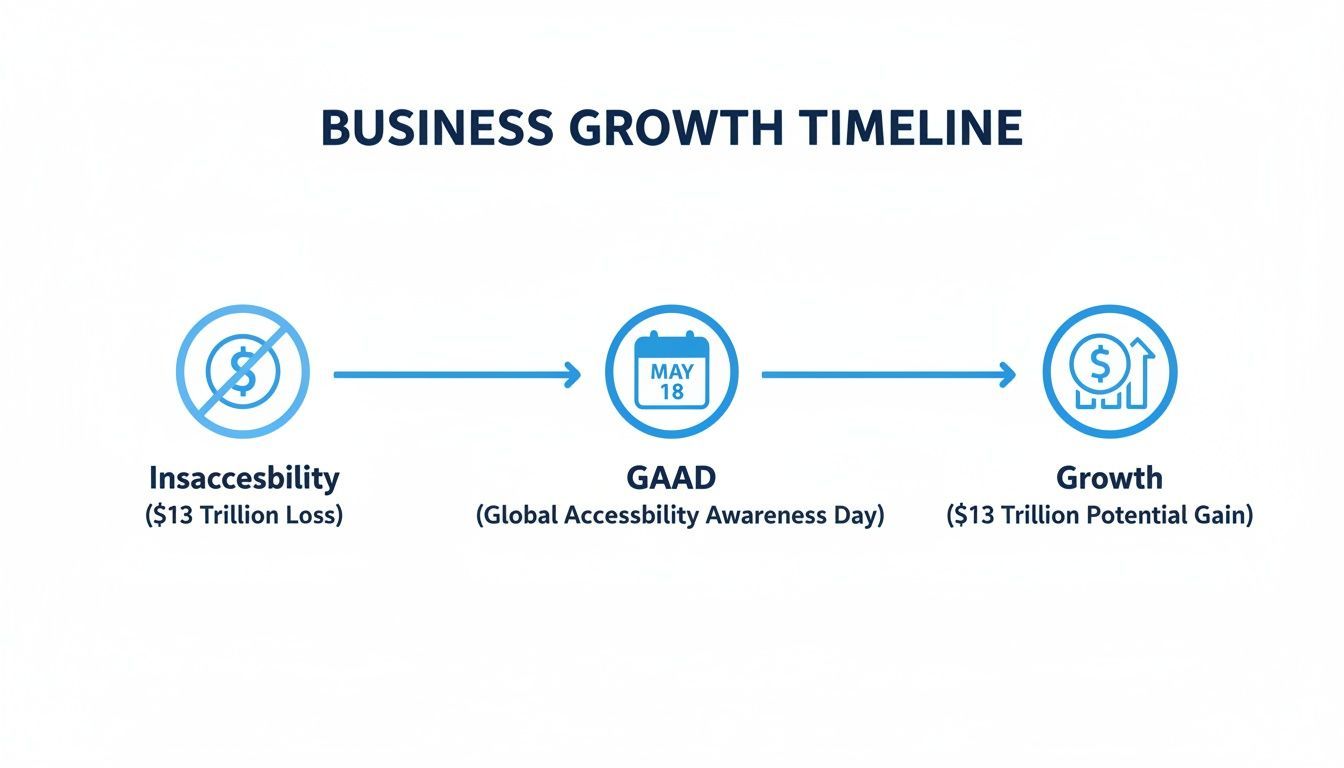
Think of it this way: making your digital world accessible opens the door to the $13 trillion global disability market. GAAD is the catalyst that transforms a potential loss into a measurable driver of growth.
Weeks 8–7: Build Your Foundation
The initial two weeks are dedicated to strategy and alignment. Before any events are planned or code is written, your teams must agree on what success looks like for your organization.
Your primary task is to set clear, measurable goals. Vague objectives like "improve accessibility" are impossible to track. Instead, define specific Key Performance Indicators (KPIs). For example, a strong goal is to reduce the number of critical accessibility errors on your top five most-visited pages by 25%. Another excellent KPI could be to increase organic traffic from users of assistive technologies by 10% in the month following GAAD.
With goals established, secure leadership buy-in. Frame this as a strategic business decision, not a technical chore. Use data to connect accessibility work directly to revenue potential, enhanced brand reputation, and reduced legal risk. Present a clear plan with a realistic budget and resource requirements. Executive sponsorship is crucial for securing the time and tools needed to succeed.
Weeks 6–5: Audit and Prioritize
With your goals set and leadership support secured, it's time to assess your current state. These two weeks are for data analysis, auditing your digital assets, and creating an intelligent remediation plan.
Start with a comprehensive website accessibility audit. Automated scanners are excellent for a first pass, quickly identifying widespread issues like missing alt text or contrast errors across your site. This provides a baseline score and an initial list of issues. The WebAbility.io platform consolidates this data into a single dashboard for an immediate overview.
An audit will likely produce a long list of items to fix. The key is to prioritize strategically. Collaborate with your developers to create a remediation backlog and sort issues by:
- Severity: Critical blockers always come first. These are issues that completely prevent a user from completing an important action, like an inaccessible "Add to Cart" button.
- Impact: Focus on high-traffic, high-value pages. Your homepage, key product pages, and login portal are excellent starting points.
- Effort: Identify low-effort, high-impact wins. These quick fixes build momentum and demonstrate progress early on.
This prioritized backlog is your roadmap. It transforms an overwhelming list of errors into a clear, step-by-step plan your team can confidently execute in the run-up to Global Accessibility Awareness Day.
Weeks 4–3: Plan Your Engagement
With the technical plan in place, shift your focus to people—both within and outside your company. These weeks are for empowering your internal teams and crafting your external communication strategy.
Internal training is one of the most effective ways to foster an accessibility-first culture that endures beyond GAAD. You can host a "lunch and learn" to cover basics like writing effective alt text or the importance of proper heading structure. Sharing authentic user stories is a powerful method for building empathy and highlighting the human impact of this work.
Simultaneously, your marketing team should map out external communications. What story will you tell for GAAD? You might publish a blog post detailing your accessibility journey, launch a new accessible feature, or run an inclusive social media campaign.
Key activities for this phase include:
- Drafting content: Begin writing blog posts, social media updates, and internal announcements.
- Designing assets: Create visuals for the campaign, ensuring they are designed accessibly (e.g., good color contrast, readable fonts).
- Scheduling sessions: Finalize dates and times for internal training and any external events, like a webinar.
Weeks 2–1: Finalize and Launch
We’re in the home stretch. The final two weeks are dedicated to execution and final touches. Proper planning should make this period feel controlled and focused, not chaotic. The aim is to have everything prepared well before the third Thursday of May.
Your development team should be deploying the last fixes from your prioritized backlog. Your marketing team should be securing final approvals on all copy and creative, then scheduling social media posts and emails. Use scheduling tools to ensure your campaign rolls out flawlessly on Global Accessibility Awareness Day.
Finally, conduct a final logistics check. If you're hosting a webinar, perform a full tech run-through. If you're launching a new feature, confirm the deployment schedule with engineering. This final review ensures your hard work culminates in a polished, professional, and impactful GAAD initiative that showcases your company's genuine commitment to digital inclusion.
Getting Your Whole Team on Board for GAAD
Countless Global Accessibility Awareness Day plans lose momentum because they are siloed within one department. When GAAD is treated as just a marketing project or a developer-only task, it misses the entire point. An impactful GAAD doesn't just raise awareness; it sparks real, collaborative action across the organization.
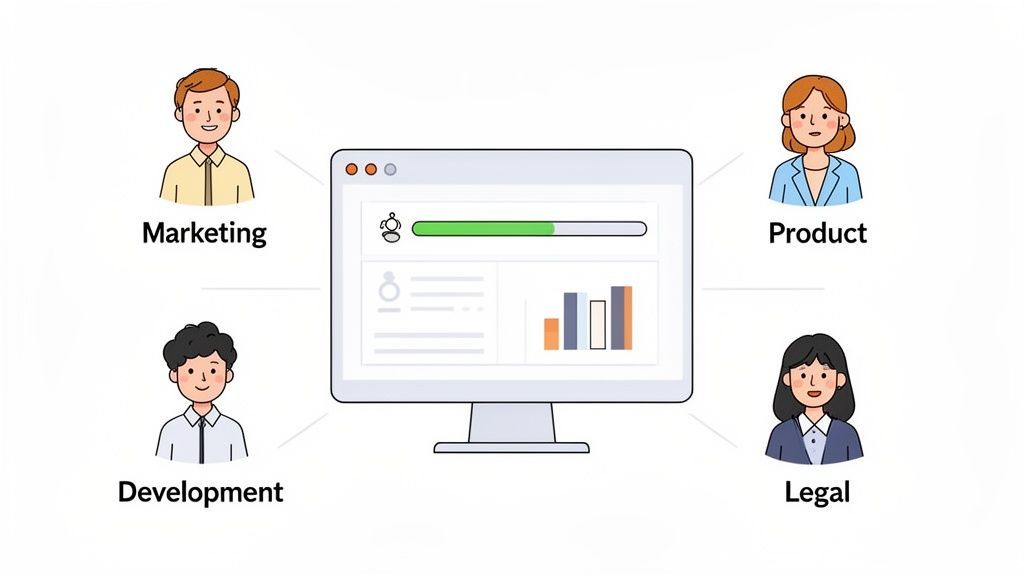
To achieve this, provide each team with a clear mission. Create specific playbooks for your key departments—Marketing, Product & Dev, and Legal & Compliance. This ensures everyone understands their role and how their work contributes to building a more inclusive company culture. Our experience and expertise show this is fundamental to success.
For the Marketing Team
Your marketers are the voice of your company. For Global Accessibility Awareness Day, their mission is to tell your accessibility story authentically and ensure every piece of content they produce is a model of inclusivity. This is their opportunity to build significant trust and connect with your audience beyond typical brand messaging.
Here’s what their GAAD to-do list should look like:
- Launch an inclusive social campaign. Go beyond a simple "Happy GAAD!" graphic. Plan a series of posts that educate your followers, share user stories, or spotlight a new accessible feature. The non-negotiable rule: every image needs descriptive alt text, and all videos must have accurate captions.
- Publish a blog post about your accessibility journey. Be transparent with your audience. A post detailing your company's commitment, challenges, and future goals is incredibly powerful. This is the perfect place to mention how you're using trusted tools like WebAbility.io to maintain accountability.
- Audit all GAAD assets for accessibility. Before any email, landing page, or ad goes live, it requires a thorough accessibility check. Is the color contrast sufficient? Are headings structured logically? Do links clearly describe their destination? This demonstrates that you practice what you preach.
Our team has seen it time and again: a company promotes GAAD with content that is, ironically, completely inaccessible. A beautiful video without captions or a detailed infographic shared as a flat image sends the wrong message and undermines your credibility.
Empower them with tools that simplify the process. Our free AI Alt Text Generator is perfect for social media managers who need to craft meaningful descriptions quickly, ensuring every post is accessible from the start.
For Product and Development Teams
Your engineers and product managers are building the user experience. For them, GAAD is the perfect opportunity to implement high-impact accessibility fixes that make an immediate, tangible difference. Their work transforms your company’s promises into a functional reality.
Here's a technical checklist to get them started:
- Zero in on critical user paths. Use the WebAbility.io dashboard to run targeted automated scans on your most important workflows, such as the checkout process, login page, or contact forms. This provides a clear, data-driven list of priorities.
- Host a "fix-a-thon." Dedicate a day or several sessions in the sprints leading up to GAAD to resolve accessibility bugs from the backlog. Focus on showstoppers first—issues like keyboard traps or missing screen reader announcements that completely block a user.
- Go manual. Automated tools are a great start but can't catch everything. Challenge developers to unplug their mice and navigate key features using only their keyboards. Have them use a screen reader like NVDA or VoiceOver to hear the site's experience. Nothing builds empathy and understanding faster.
These activities shouldn't be a one-off for GAAD. The goal is to integrate them into the regular development cycle. When accessibility testing becomes a standard part of every sprint, you prevent new barriers from being created.
For Legal and Compliance Teams
While GAAD is about people, not just regulations, your legal and compliance experts are crucial. They provide the guardrails, ensuring your accessibility efforts are grounded in established standards like the Web Content Accessibility Guidelines (WCAG) and are robust enough to mitigate legal risk.
Their GAAD focus is on governance and reporting:
- Review your policy against WCAG 2.2. Standards evolve, and your internal policies should too. Have the team review the latest WCAG 2.2 criteria to ensure your guidelines are up-to-date. Their analysis will help prioritize the most critical fixes from a legal standpoint.
- Generate and analyze compliance reports. Use a platform like WebAbility.io to pull detailed reports that offer a clear, objective snapshot of your accessibility posture. This documentation is vital for tracking progress and demonstrating due diligence.
- Draft an executive summary. The C-suite needs to stay informed. Task your legal team with creating a concise summary for leadership. It should cover recent progress, celebrate key wins, and flag any remaining areas of significant risk. This keeps accessibility on the executive radar all year long.
Bringing these teams together with a shared purpose creates a powerful engine for change. Marketing tells your story, developers build an inclusive product, and compliance ensures it's all built on a solid, defensible foundation. This is how you achieve a successful Global Accessibility Awareness Day.
Turning GAAD Into Year Round Action
The buzz around Global Accessibility Awareness Day is fantastic, but the real test is what you do the day after, and the day after that. The goal is to channel GAAD's energy into a sustainable shift in your company's operations.
Think of GAAD as the starting gun, not the finish line. It's your opportunity to launch a sustainable accessibility program that becomes as fundamental to your business as security or performance.
Keep the Momentum Going with a Public Pledge
One of the most effective ways we've seen companies maintain momentum is by making a public statement of intent. The #GAADPledge has evolved from a simple hashtag into a serious accountability tool. You’re not just posting on social media; you're setting a public benchmark.
Since its inception in 2012, GAAD has matured from an awareness day into a catalyst for year-round action. We saw this during GAAD 2023, where major companies announced ambitious, long-term accessibility projects. This is part of a larger trend: 58% of Valuable 500 companies now identify digital accessibility as a primary focus, integrating it directly into their business strategies. You can discover more about these industry-wide initiatives from the GAAD 2023 recap.
The most effective pledges are specific and measurable. You might commit to a fully WCAG-compliant checkout flow by Q4 or promise that all new videos will have human-verified captions.
Weave Accessibility into Your Daily Workflows
For accessibility to become part of your company culture, it must be integrated into daily work, not treated as a final step. An afterthought approach creates more work down the line.
Here’s how you can embed it across teams:
- For Designers: Introduce accessibility checks at the wireframing stage. Is there enough color contrast? Are clickable areas large enough?
- For Developers: Make automated accessibility scans a non-negotiable part of your CI/CD pipeline. This is your first line of defense.
- For Content Creators: Train your marketing and content teams to write meaningful alt text, use plain language, and structure pages with logical headings. A solid wcag compliance checklist is an invaluable resource for them.
Accessibility is a journey, not a destination. The goal isn't to be "done" with accessibility, but to create a system of continuous improvement where your digital products become more inclusive over time.
This proactive approach is infinitely more efficient than constantly fixing problems after they’ve already impacted users.
Use Reporting to Hold Yourselves Accountable
The business principle "what gets measured gets managed" is especially true for accessibility. To ensure efforts stick, you must track and visualize progress. This is where the right reporting tools are critical.
A centralized dashboard, like the one built into WebAbility.io, creates a single source of truth for everyone from developers to the C-suite. It allows you to:
- Track your Accessibility Score: Watch your score climb over time as a simple, powerful metric for your team to rally behind.
- Monitor Issue Resolution: See the number of critical and serious issues decrease, directly showing the results of your team's hard work.
- Create Executive Summaries: Quickly generate reports for leadership that connect accessibility work to tangible outcomes like reduced legal risk and a stronger brand.
When you treat accessibility metrics with the same seriousness as sales figures or site traffic, you signal its importance to the entire organization. This data-driven mindset fosters a culture of inclusion that pays dividends long after GAAD.
Your GAAD Questions, Answered
As Global Accessibility Awareness Day approaches, questions are bound to arise. Based on our extensive experience, here are answers to some of the most common queries from companies aiming to make a real impact.
What Is The Single Most Important Thing We Can Do For GAAD?
If you can only do one thing, make a specific, public promise to fix something real. Vague statements like "we're committed to accessibility" are nice but don't drive change. Action does.
Pick a tangible goal. For example, publicly pledge to fix the top 10 accessibility errors on your homepage by the end of the month. Or commit to making your entire checkout flow fully keyboard-navigable by the end of the quarter. This turns a day of awareness into a project with a deadline, demonstrating your seriousness and holding your team accountable.
How Can A Small Business Participate With Limited Resources?
Many smaller teams face this question, and the good news is you can make a huge impact without a huge budget. Focus on high-impact actions that deliver immediate value.
- A quick win: One of the fastest ways to improve your site is with an AI-powered accessibility solution, like the managed accessibility features from WebAbility.io. These can be implemented quickly and give your visitors immediate control over their experience with features like text-to-speech, contrast adjustments, and enhanced navigation. You can use GAAD to announce this valuable new feature.
- A no-cost, high-impact action: Train your team on the fundamentals. Teaching your content creators how to write descriptive alt text for every image is a game-changer for screen reader users and costs nothing but time.
The key for small businesses is to focus on what you can do, not what you can't. Smart, targeted efforts deliver real value and build a solid foundation you can expand on later.
How Do We Measure The ROI Of Our GAAD Efforts?
Thinking about return on investment is smart; it builds the business case for long-term support. You should look at both quantitative data and qualitative feedback.
The Hard Data (Quantitative)
- Conversion Rates: Analyze your web analytics. As you remove barriers from your site, you should see conversion rates for all users, including those using assistive tech, begin to climb.
- Accessibility Score: Use a dashboard to monitor your compliance score. An increasing score is a direct indicator of a better user experience and reduced legal risk.
- Fewer Support Tickets: Track customer complaints related to accessibility. A drop in this number is a clear sign you're on the right track.
The Human Feedback (Qualitative)
- Direct Customer Feedback: Don't be afraid to ask users with disabilities for their thoughts. A single positive testimonial can be more powerful than a page of statistics.
- Social Media Sentiment: Monitor what people are saying about your brand in accessibility circles. Positive chatter is a clear sign your reputation is improving.
This mix of data and personal stories proves that accessibility isn't just a cost—it's a direct driver of growth, loyalty, and brand strength.
How Do We Keep The Momentum Going After The Day Is Over?
The goal is to ensure your GAAD initiative is not a one-day wonder. To do this, you must weave accessibility into the fabric of your company.
This starts by building it into your daily work. Accessibility should not be an afterthought; it must be part of the process. For example, make it a required sign-off for new marketing campaigns or a mandatory part of the "definition of done" for every development sprint. Using tools for continuous, automated monitoring helps keep accessibility top-of-mind all year, not just in May.
Finally, establish a long-term structure. Schedule quarterly reviews of your accessibility progress and create a permanent, cross-functional team that owns digital inclusion. This creates accountability and ensures the work continues long after the GAAD spotlight has faded.
Ready to turn awareness into action? WebAbility.io gives you an end-to-end platform that simplifies accessibility. From our AI-enhanced managed solutions to our real-time compliance dashboard, we provide the tools to build a more inclusive digital experience, reduce risk, and connect with a wider audience. Explore what WebAbility.io can do for you.
Quick Questions
Tap to ask AI about this article