Accessibility in Finance: WCAG Compliance for Banks and Fintech
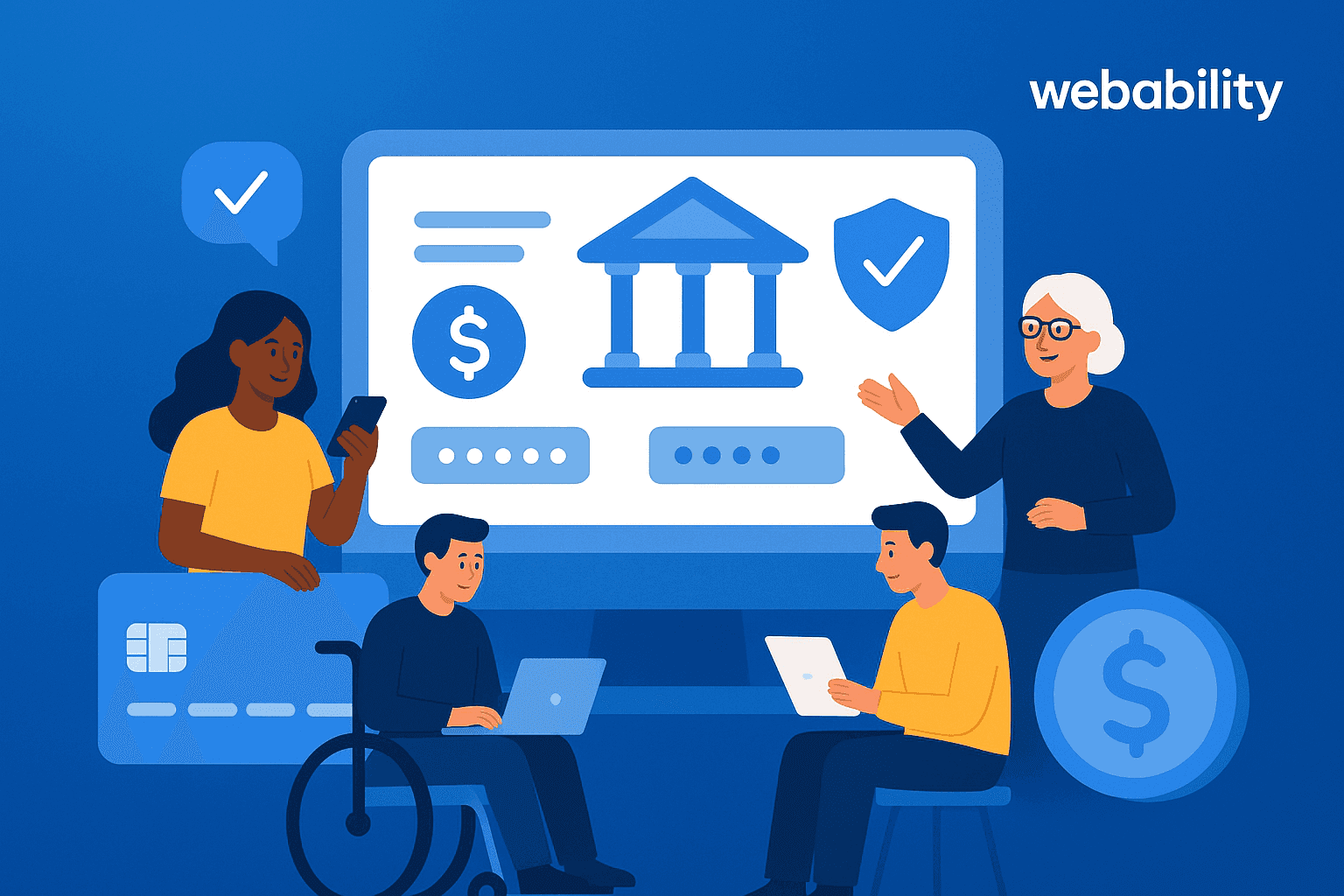
Accessibility in Finance: Building Trust and Inclusivity in Finance
Digital banking is now the norm, transforming how people and businesses manage money. With that convenience comes responsibility: making digital financial services usable by everyone, including people with disabilities. This guide explains what accessibility in finance means, why it's critical for banks, credit unions, and fintech, how to meet WCAG, the mistakes to avoid, and the tools that keep you compliant.
TL;DR: Accessible finance gives every customer independent, equal access to financial tools while reducing legal risk and expanding your market. Build to WCAG 2.2 around the POUR principles, follow the compliance checklist below, avoid the common mistakes, and set up continuous monitoring. Accessible finance is equitable finance.
See where your site stands.Run a free accessibility scan against WCAG, no signup. For hands-on remediation, see our accessibility compliance services
What Is Accessibility in Finance?
Accessibility in finance means designing websites, apps, and documents so that people with visual, cognitive, auditory, and motor disabilities can independently manage their finances - from checking balances to applying for a mortgage. The Web Content Accessibility Guidelines (WCAG) provide the global standard banks and fintech providers follow to make these services inclusive and usable for all.
Why Accessibility Matters in the Financial Industry
- Equal access to financial tools. Digital barriers can lock people out of essential services. Inclusive design lets users with disabilities check balances, transfer money, and apply for products independently.
- Legal risk and regulatory compliance. Financial institutions in North America and Europe are legally required to provide accessible digital services. The ADA (US), Accessible Canada Act (ACA), and European Accessibility Act (EAA) mandate WCAG conformance; failing to comply can mean lawsuits, penalties, and reputational damage.
- Business growth and brand loyalty. Accessible platforms reach millions more users - including aging populations and people with temporary impairments - and a visible commitment to inclusivity builds long-term trust and loyalty.
WCAG and the POUR Principles
WCAG, developed by the W3C, makes digital content more accessible. The current version, WCAG 2.2, adds support for users with cognitive and low-vision needs. It is built on four principles, abbreviated POUR:
- Perceivable - users must be able to perceive the information (screen reader support, alternative text).
- Operable - navigation and controls must work via keyboard and assistive devices.
- Understandable - content and interactions must be predictable and easy to comprehend.
- Robust - content must work with current and future assistive technologies.
How Financial Platforms Can Achieve WCAG Compliance
- Provide alt text for all images and icons - especially symbol buttons like "Submit," "Transfer," or "View Balance."
- Make all functions keyboard accessible - forms, menus, and modals must work without a mouse.
- Use descriptive form labels and error messages - login, credit applications, and transfers need clear labels that explain what went wrong.
- Ensure proper color contrast - at least a 4.5:1 ratio for readability for low-vision and color-blind users.
- Avoid auto-updating content without alerts - if balances update live, provide a screen-reader notification.
- Use semantic HTML and ARIA - proper structure lets screen readers interpret layout and meaning.
- Make PDFs and statements accessible - eStatements and invoices should be tagged and screen-reader friendly.
Common Mistakes to Avoid
- Empty headings or skipped heading levels.
- Relying on inaccessible CAPTCHA for login.
- Inaccessible tables without proper headers.
- Poor focus indicators for keyboard users.
- No skip navigation or page landmarks.
- Placeholder-only form fields with no
<label>tag.
WebAbility Tools for Financial Accessibility
WebAbility offers tools built for complex, form-heavy industries like finance, all WCAG 2.2-aware:
- Accessibility Scanner - identify WCAG violations on any public or password-protected banking page, including dashboards, forms, and transaction flows.
- Accessibility Widget - a lightweight widget adding visual customization, text scaling, dyslexia-friendly modes, and screen-reader toggles without altering site code.
- Compliance Reports - detailed audit reports with prioritized issues and step-by-step remediation, ideal for internal teams or regulatory documentation.
- Continuous Monitoring - alerts when new pages or updates introduce accessibility regressions.
Steps to Begin Your Accessibility Journey
- Start with a site-wide audit using automated scanners and manual testing to find gaps.
- Fix foundational issues first - color contrast, alt text, keyboard navigation, and heading structure.
- Conduct user testing with assistive technologies to surface UX issues tools miss.
- Train development and content teams so everyone understands the basics.
- Set up ongoing monitoring as part of your DevOps or QA workflow - not a one-time project.
Frequently Asked Questions
What version of WCAG should financial institutions follow?
WCAG 2.1 AA is the legal standard in most regions, but WCAG 2.2 is the latest and most inclusive version, especially for users with cognitive and mobility-related needs.
Is accessibility mandatory for private banks?
Yes, in many countries. In the US, the ADA applies to both public and private financial institutions.
How often should we test our website for accessibility?
Continuously - especially after redesigns, new feature launches, or major platform updates.
What is the difference between automated and manual accessibility testing?
Automated tools detect about 30-40% of WCAG issues; manual testing with assistive technology like screen readers is essential for full compliance.
Why does accessibility matter specifically in finance?
Digital barriers can block essential tasks like checking balances or applying for a loan. Accessible finance provides independent access, reduces legal risk under the ADA, ACA, and EAA, and expands reach to aging and temporarily impaired users.
Conclusion
Accessibility in digital finance isn't just a technical checkbox - it's about empowering every customer to manage their money independently and confidently. By adopting WCAG, following the checklist, avoiding common mistakes, and using the right tools, banks and fintech platforms build a more inclusive digital future while minimizing legal risk and expanding reach. Accessible finance is equitable finance - and that's good for everyone.
Quick Questions
Tap to ask AI about this article